It has been a long time coming, but I have finally started the YouTube channel I kept wanting to create for the last several years!
The channel is known by the same title as this blog: ART ISN'T EASY.
The true official title is AJ: Art Isn't Easy - Film Talk & Other Musings.
As is usually the case with this blog, the majority of what I will be posting about will be film related. However, I will want to dabble in TV and theatre content as well as I do want to try to cast a little bit wider of a net.
I am posting a link to my first video below, which is me talking about the films I recently purchased from the Criterion Collection as I begin rebuilding my own personal physical media collection.
This is currently, as of this writing on 5/6/26, the only video I have up but I am hoping that the month of May will be when my output starts to slowly increase. I am planning on recording a video this weekend that I would hopefully have up not long after.
In terms of film content, I will likely utilize and revamp quite a few of the topics I have discussed here. These could include "best of" lists, rankings of various Oscar categories (like acting and Best Picture), and of course, reviews of films both new and retrospectives.
We will see how a lot of this evolves.
I do have to admit that I am not sure how frequently I will be posting here. There is a possibility that this could even be my last post. I have been blogging like this for nearly a decade, and I am often surprised at the response I have gotten at some of my posts.
If I am proud of anything in particular, it would be my decade-by-decade project of doing my top 10 (or 15 or 20) films from each year. I've done the 60s, 70s, and 90s...and did start the 2010s but ended up not really having the drive to continue.
I would like to do the same for this channel, and maybe even re-evaluate some of the selections I made the first time around. The same goes for any of the content I have posted.
For those of you who love my award season content, I do suspect I will dive into various prediction videos and discussing my personal opinions of the nominees and who I felt got snubbed.
I think the biggest thing I would like to ask of you is if you feel there is a topic related to film or even TV or theatre that you would like me to attempt discussing, please let me know and I will try my best to make that happen.
Having said that, if someone wants me to talk about something like Marvel, I will sooner sit through Salo again. ;-)
Thank you all again for your support and I hope that my regular readers (and hopefully beyond as well) will make this leap with me. See you on the other side...of the internet I guess...
We have reached the end of another decade...and Hollywood wasn't sure what to do with itself.
When voters within the Academy submitted their ballots, the Best Picture lineup was perhaps one of the more polarizing I can possibly think of.
Not only did you have a bloated stuffy epic like Anne of a Thousand Days or a bloated misguided musical adaptation in Hello Dolly!, but then an X-Rated film called Midnight Cowboy about a young man from Texas who moves to NY to become a hustler, and Z, a very tense political thriller that became only the second foreign film to receive a Best Picture nomination.
In between those was Butch Cassidy & The Sundance Kid, which is honestly a film that falls squarely in the middle of the pack in that it isn't anything remarkable nor is it horrible...but it was very popular and likely the most iconic of the nominees in some ways.
What is rather hilarious is that Anne of Thousand Days wasn't even that well received at the time. The only thing that holds it together would be the performances. Genevieve Bujold is perhaps the only true saving grace that elevates the film to far better than it actually was...but even then, there is a reason that film has a 43% on Rotten Tomatoes.
Speaking of "43% on Rotten Tomatoes", fellow Best Picture nominee Hello Dolly! currently holds that same rating as of this writing. Do I like that piece as a musical property? Not necessarily. I do think it has its moments as a musical, but the film adaptation is way too grand and cheesy and opulent...not to mention Barbra Streisand was FAR TOO YOUNG for the role. I also think randomly putting in Louis Armstrong was tacky as it was only to market on the success that he had covering the title song...with no disrespect to him of course; he remains a true legend. The film ended up flopping at the box office due to negative word of mouth, and yet...much like FOX did with Doctor Doolittle two years earlier, they pulled it off again with Hello Dolly!
There you have it; sorry to all you Anne of a Thousand Days fans but that certainly won't be making this list. Neither will Hello Dolly!
1969 is, much like 1968 was, a rather eclectic year. It still isn't a super high-quality year compared to a lot of my previous favorites, but I do feel like some of the better films were the ones more overlooked at the time...or perhaps they were helped by the power of their acting. We begin the list with a film that contains one of my favorite Oscar winning performances of all time.
====================
#10 - THE PRIME OF MISS JEAN BRODIE
Directed by Ronald Neame
Written by Jacqueline "Jay" Presson Allen
This is a solid film for sure. I wouldn't say it is necessarily a stunning piece but is well made even if it does feel a tad stuffy amidst the changing cinematic landscape of the late 60s.
I am singling out this film primarily for the work of the late great Dame Maggie Smith. In a lot of ways, this was her true breakout role...especially considering her Oscar win was considered something of an upset.
She was certainly known for work in other films, primarily her Oscar nominated role of Desdemona in the infamous 1965 adaptation of Othello where Laurence Olivier gave us a heaping dose of blackface in the titular role.
A role like Jean Brodie is one that is perfect for an actress to sink her teeth into. The great Vanessa Redgrave had originated the role on the West End and was considered a sensation. Not to mention the beloved theatre actress Zoe Caldwell also got raves tackling the role for Broadway...but it was Smith who got tapped for the film adaptation.
Brodie is a teacher at an all-girls school, but she is someone who teaches with great passion and enthusiasm...and perhaps a bit of ego as well. She considers herself to be in the prime of her life...specifically her sexual prime...but she says that she wants to devote her energy to her "Brodie Set" girls. When she begins her first day of class for the school year, she tells her students her personal credo: "I am in the business of putting old heads on young shoulders, and all my pupils are the creme de la creme. Give me a girl at an impressionable age and she is mine for life!"
However, Brodie veers from the curriculum to romanticize the fascist dictatorships of such leaders as Benito Mussolini and Francisco Franco...and it unfortunately inspires one such student to travel to Spain with her brother during the Spanish Civil War to tragic results. All the while, Brodie's "prime" is also unraveling as she struggles to maintain relationships with the men in her life.
Like I said, the film is by no means amazing, but Smith most definitely is and she alone is a reason to sit through it. She performs with such a theatrical bravado that might seem false, but that is a lot of the point. For as passionate as Brodie may seem, she is also emotionally distant and fragile and too unwilling to recognize her own faults. A truly magnificent performance.
In fact, I want all of you to check out this clip. It's only a little over 2 minutes long, but it shows you one of Smith's finest moments as well. I also love seeing Celia Johnson as Miss MacKay, who gave one of my favorite performances of the 40s in David Lean's Brief Encounter.
________________________________________
#9 - THEY SHOOT HORSES, DON'T THEY?
Directed by Sydney Pollack
Written by Robert E. Thompson & James Poe
As will be a theme that continues for throughout the next couple of selections on this list, I am not exactly a passionate fan of They Shoot Horses, Don't They? I do believe it has merits as I was willing to single it out for this list, but I also don't think its without its faults.
Set during the Great Depression, we follow a group of people who are desperate to win a dance marathon and the bombastic emcee who is eagerly pushing them to continue.
The film veers quite a bit into the melodramatic which often left me with a mix of rolling my eyes and perhaps maybe only caring marginally. Having said that, this is another film much like The Prime of Miss Jean Brodie that gets buoyed up by its central performances. In a lot of ways, this was the dramatic breakthrough for Jane Fonda who truly gives one of her best performances here and likely would've been a stronger contender to win had it not been for Maggie Smith.
Her co-star Gig Young would win the Supporting Actor Oscar for his sloven emcee, and he is certainly at his acting peak, although his legacy would be tarnished when nearly a decade a later, he would murder his wife 3 weeks after their wedding and then turned the gun on himself.
I do think film manages to do well with, particularly thanks to Pollack's direction, immersing us into this desperate world at a time when human nature and moral was at one of its lowest points. I do feel those ideas and aesthetics give them film a bit of an edge that I appreciate more than some of the more traditionalist stylings of The Prime of Miss Jean Brodie.
________________________________________
#8 - MIDNIGHT COWBOY
Directed by John Schlesinger
Written by Waldo Salt
My history with Midnight Cowboy has been all over the place. I've never quite known what I truly feel about it. I guess you could say I admire it more than I used to, but I wouldn't say I am enamored by it.
As I mentioned in my intro, Midnight Cowboy was the first film with an X-Rating to win Best Picture. Keep in mind that the MPAA was only a year old, but that would also more or less be the equivalent of NC-17 today.
The film winning was certainly thrilling on paper as this is the same voting body that gave Oliver! Best Picture the year prior and would give it to the stuffy war biopic Patton the year following. The tides were certainly changing, and the industry seemed more willing to embrace darker and subversive stories.
Joe Buck (ugh...Jon Voight) is a young man from Texas. He quits his job at a restaurant and buys a one-way ticket to New York with one mission in mind: he wants to become a male prostitute. He does not find any success, mainly seducing an older woman but then gets conned into giving her money when she claims she is insulted that he would ever ask money from someone like her.
He eventually crosses paths with a con man named Rico "Ratso" Rizzo (Dustin Hoffman) who eventually takes him in when he gets kicked out of his hotel. The two live in squalor while Ratso (who insists that Joe call him Rico) insists they go into business together as hustlers.
As a duo, Voight and Hoffman are clearly compelling, particularly Hoffman who does such a 180-here from his mild-mannered and clean-cut Benjamin in The Graduate that it must have been thrilling to witness at the time. Hoffman's Oscar loss here would become a bit of a hot topic as this was the year he lost to John Wayne for True Grit, which was considered a huge lock and career win prior to the ceremony. Hoffman felt (rightly so I might add) that he was far more worthy to win for Midnight Cowboy, and this led him to take on an anti-Oscars stance until he would win for Kramer vs. Kramer a decade later.
More or less, Midnight Cowboy is a film I respect for what it was able to accomplish and for the doors it was able to open, but I can't say it's ever been a film I loved, even despite how it displays the gritty and grimy late 60s NYC in all its glory.
_______________________________________
#7 - WOMEN IN LOVE
Directed by Ken Russell
Written by Larry Kramer
Women in Love is such a bizarre film, and it is by no means perfect or even close to perfect. It just manages to find a way to still pull me in...and no, that isn't due to the wrestling scene.
Set in the Midlands of 1920 England, two sisters named Ursula (Jennie Linden) and Gudrun (Glenda Jackson in her first Oscar winning performance) have marriage on the mind as they prepare to go the wedding of Laura Crich, daughter of the town's very wealthy coal mine owner.
At the wedding, the two observe men who are part of the wedding party: Laura's brother Gerald (Oliver Reed) and Gerald's best friend Rupert (Alan Bates). Gudrun and Ursula choose to find a way to get themselves into a relationship with them and they end up spending time at an estate owned by wealthy Hermoine (Eleanor Bron), who was in a relationship with Rupert that is struggling.
As is usually the case with Ken Russell, Women in Love manages to have a provocative edge despite its relatively stuffy setting. The film is essentially a gothic sex fantasy and is perhaps best remembered, aside from Jackson's alluring work, for the naked wrestling scene between Reed and Bates in which you do get full frontal nudity. It is kind of remarkable the film passed British censors at the time, but it just goes to show you how quickly people were willing to embrace more challenging concepts.
__________________________________
#6 - THE PASSION OF ANNA
Written & Directed by Ingmar Bergman
As the final installment of a defacto trilogy, The Passion of Anna is easily the weakest of the 3 and feels like a step back for Bergman. However, it is still in my top 10 so that is clearly showing that I must not think of it too negatively. I think it benefits from Bergman usually still being pretty good fairly consistently and the fact this isn't exactly the strongest top 10 I've discussed.
We have Liv Ullman and Max von Sydow again. He is a divorcee named Andreas, who is still feeling very bleak with his marriage falling apart. She is Anna, a widower who lost her husband and son in a car accident.
She happens to be his neighbor and comes over one day asking to use his phone, and being a bit nosy, he listens in on her conversation which ends with Anna leaving his home in tears. She leaves her handbag behind, and Andreas looks through it finding a letter from her dead husband stating that he is unhappy in their marriage and feels fearful about the possibility of "psychological and physical violence".
One element that is rather fascinating, though I am not sure it's enough to truly make me that compelled, is that Bergman uses a motif where he is an unseen interviewer talking to the performers about their characters which also includes Bibi Andersson fresh off of her stellar work in Persona and also Erland Josephson who would go on to be iconically paired with Ullman in the legendary Scenes from a Marriage.
The film is also unique in that is an early case of Bergman filming in color, but that doesn't exactly benefit the film in any way. I would argue that his staging and Nykvist's cinematography are not as striking as they had been up to that point. What truly carries the film is the quartet of actors, and the material certainly allows all of them a chance to shine which is easy considering all 4 of them are among the greatest actors to have ever lived.
The Passion of Anna is a solid film, not one of Bergman's best, but there is enough here that I find it to be a rather intriguing piece.
___________________________________
#5 - MY NIGHT AT MAUD'S
Written & Directed by Eric Rohmer
I've briefly written about Eric Rohmer's work, and I do want to point out again that Rohmer had (along with Godard) the longest and most sustainable career out of any of the French New Wave auteurs.
I always found the fact that he was able to explore many different styles and ideas with ease to be rather refreshing, especially when he made believable films surrounding people younger than 30 when he was already in his 70s.
My Night at Maud's was Rohmer's breakthrough film that finally netted him both critical and commercial success. His late start had been due to him focusing on editing the famed Cahiers du cinema and mentoring people before taking a dive at the cause himself.
This was the 4th film released in what was series called Six Moral Tales. It's the Christmas season in the town of Clermont-Ferrand. We follow the lives of 4 single people and how they all manage to connect and interact with each other. One of the 4 at least already knows one of the other three, and they do come from varying backgrounds. For example, Jean-Louis (Jean-Louis Trintignant) is a devout catholic while his friend Vidal (Antoine Vitez) is a Marxist atheist. The titular Maud (Francoise Fabian) is also an atheist while the other lady Francoise (Marie-Christine Barrault) happens to be Catholic.
When they all end up at Maud's apartment, conversations break out from everything related to religion and mathematics and ethics...a wide variety. Once it begins to heavily snow, Maud offers her guest room...but there is tension as Vidal is an ex-lover of Maud's...and Jean-Louis is sort of feeling that maybe there is vibe with her.
My Night at Maud's has a very simple story that is arguably in some ways universal...but it gets a bit of a spark in that it tries to engage you in a philosophy and think over your own morals/ethics. Hence it being part of a Moral series.
______________________________________
#4 - FUNERAL PARADE OF ROSES
Written & Directed by Toshio Matsumoto
Quite possibly one of the more fascinating films from this era in terms of what it tries to explore, Funeral Parade of Roses is essentially a loose adaptation of Oedipus but set in the underground queer culture scenes of late 60s Tokyo.
I do have to stress before I go further that some elements of this could likely not be seen as appropriate today nor is the film completely successful in terms of tackling some of the themes it wants to put forth. I would argue that it can come off as messy and even too melodramatic and self-conscious for its own good.
And yet...I am giving it high marks. Well, not 5 stars or anything. This one gets a 4.5 but the extra boost is for what it was able to put forth at a time when the Stonewall Riots had only occurred 3 months prior.
Eddie (played by a famous gay entertainer in Japan simply known as Peter) works as a trans female hostess at a Tokyo gay bar known as The Genet. This bar is owned by Gonda (Yoshio Tuschiya), a drug dealer who lives with the madame of the bar Leda (Osamu Ogasawara). Eddie and Gonda have begun sleeping together and Leda becomes suspicious...only to be exacerbated when Gonda tells Eddie that she will be promised the position of new madame.
I am sure you can see the seeds being planted for a melodramatic story, and I haven't even begun to talk about the directions that the film takes us in. On top of that, the film follows a non-linear narrative structure and embraces the idea of an almost Brechtian style of commentary. A lot of the film has fourth wall breaks and a sense that these people know they are being filmed and want to be sure that we never forget it either.
And as I mentioned, Peter was not actually a trans woman but an androgynous gay actor who often did play drag...sort of reminiscent to how Chinese actor Leslie Cheung would be so affective at doing years later.
Funeral Parade of Roses is a lot. It isn't perfect, but somehow that manages to work extremely well in its favor even if sometimes it does feel like it tries a bit too hard. I just have to give them props for giving us something so bold in terms of being an early forerunner for Queer cinema...even if it may be of the tragedy porn variety.
________________________________
#3 - KES
Written & Directed by Ken Loach
Have I seriously not talked about Ken Loach yet on this blog? I guess a lot of his films barely miss my lists, but he is someone I do respect highly compared to how he approaches his work and what he tries to accomplish.
Loach is a socialist who often directed his work with a strong focus on social critique. He loved focusing on the working-class and giving them compassionate portrayals while also tackling the flaws with the British Educational System and how those of the lower classes were often not given the same career or learning opportunities to get the kind of jobs that might give them a bit of a boost.
We follow 15-year-old Billy (David Bradley), who lives with his poor & dysfunctional family in South Yorkshire. He is frequently abused, both physically and mentally, by his older half-brother who works in the coal mines, and also faces a lot of bullying from classmates and his strict teachers.
His mother is raising him alone as his father walked out on the family years prior, and unfortunately, she doesn't provide him much warmth. She mostly just considers him "a hopeless case". He does steal dairy for the family as a means to try to help, but then one day, steals a kestrel from a nearby farm with the goal of learning falconry and keeping it as a pet.
Kes could be seen as a bit of a cruel process of filmmaking as Loach did try to use as many non-actors as possible and in order to keep the spontaneity alive, he even had the teachers actually cane the students which led to their own shocked and pained reactions.
Even though that does leave me a bit cold, there is something so warm and passionate about the film otherwise...and that is clearly due to how Loach is able to unleash David Bradley. I sort of see this as a bleaker companion piece to The Long Day Closes because while young Bud feels very alone in that one, his family is still at least welcoming to him. Here, you practically want to shove the mom and the half-brother's heads through a window.
Although I do have to say...I often could pride myself on being able to understand a lot of thick British accents due to my Nan and her older sister Mary being very fond of British entertainment and being exposed to it from a young age. Kes is one of the biggest examples of where the Yorkshire accent is so intense that it truly did feel like I was watching something in a foreign language...not that I am criticizing the film for that obviously, but I do love how it only adds to the reality of the world. It is not the idea of swinging 60s London where people sound posh; people do live in the north of England after all.
__________________________________
#2 - ARMY OF SHADOWS
Written & Directed by Jean-Pierre Melville
Army of Shadows is a film I watched much later than basically all of the films on this list. When it was first released in France, the film was mostly met with disdain as critics perceived it as glorifying the legacy of Charles de Gaulle following the events of the Algerian War. Due to this, art-house cinemas here in the States that would frequently show foreign films took their cue from Cahiers du cinema and chose not to accept the film here either.
It wouldn't be released over here until 2006 and because it was deemed brand new, many critics would place it on their top 10 list for that year. Honestly, 2006 was actually a fairly good year for film in what was a relatively weaker decade, but I would say that Army of Shadows wiped most of the output off the map.
Based on a novel by Joseph Kessel where he uses his own experiences mixed with that of fictional characters, we follow resistance fighters who are weaving their way through a series of hidden channels such as safe houses to avoid capture and execution from Nazi forces.
What is it about French cinema, especially from this time period, that manages to look so beautiful even in settings that are relatively gritty by comparison. This is by no means The Umbrellas of Cherbourg, but even with stark greys and blues, the cold cinematography pops and feels so rich. It kind of reminds me of Melville's film the following year, Le Circle Rouge, which did make my 1970 list.
Considering the deeply personal connection to this era by not just Kessel but Melville too, Army of Shadows does have a strong emotional intensity that even some of the better war-themed films lack.
War is hell...and sometimes, you just have to decide to stop running.
____________________________________
#1 - Z
Written & Directed by Costa-Gavras
Co-written by Jorge Semprun
Ugh, the right-wing fascists are still rearing their ugly and punch-worthy heads.
A beacon of the political thriller genre, Z is truly a glorious achievement.
When the film first came out, legendary critic Roger Ebert dubbed it the Best Film of 1969 and considered it "a film of our time". He clearly wasn't wrong, but it is also a film that has aged very well for better and for worse and still feels very relevant.
The film is thinly fictionalized account of the events surrounding the assassination of a Greek democratic politician Grigoris Lambrakis. This occurred during the reign of the junta, a far-right military group who maintained a stronghold in Greece until the mid-70s.
For the film, the country nor the name of the assassinated deputy would be named, but we follow a group of the left-wing opposition who want to have a famous government deputy give a speech to plead for nuclear disarmament. As a surprise to no one, the junta members relentlessly try to block the group by making venues deny them space, sending thugs to attack them, and destroying their promotional material. The assassination attempt, staged as a car crash, is successful but when the autopsy reveals that The Deputy died from a blow to the head. A witness claims he can corroborate this, but before he can testify, he is struck down by a club from a passing car. Everything continues to descend from there...
Z is a film that I actually think can be rather rough in its presentation, but it manages to make the gritty realism into a rather appealing style. It also contains a stellar ensemble, led by Jean-Louis Trintignant, Yves Montand, Irene Papas, Pierre Dux, and several others.
It was, indeed, a "film of the times", This was coming out in the height of conflict: the Vietnam War was still raging; 1968 had been a year of turmoil with the Democratic Convention riots in Chicago and the murders of both MLK Jr and RFK, and even at the end of 1969, there was the killing of the Black Panthers' Chicago chairman Fred Hampton. Ironically enough, the Black Panthers were among the first to acquire the film for advance screenings earlier in the year in addition to the United Front Against Fascism.
In the end, even in moments of victory, Z shows that the world will never be rid of corruption. Even the "heroes" can be discreetly villainous. It is a film that will make you livid with the world around you, so perhaps it would not be the easiest watch for some these days...AND YET...maybe that it is why people should watch it.
Costa-Gavras, who is still alive at 93 as of this writing, is truly dynamic when tapping into political thrillers, just as he would be over a decade later with Missing, which also netted him more Oscar attention. He manages to enthrall to levels of tension and excitement that are almost unbearable, which only adds to the emotional weight of knowing how history has a way of repeating itself.
Z still remains a film of our time. I just wish we could consider the film as a work of absolute fiction.
====================
FINAL THOUGHTS:
I am very happy to have finally completed another decade of films for my blog, but I do have to stress once again that I am kind of surprised at how the late 60s ended up being frequently less compelling to me compared to the early half.
1969 in particular felt pretty dire in that I would only give Z and Army of Shadows 5 stars, Kes, Funeral Parade of Roses, and My Night at Maud's would get 4.5, but everything else would only get 4. Even then, I feel like those films each had something that I felt had one or two major selling points that made me feel better about justifying its position on this list.
I hadn't planned on doing this, but I just decided for the hell of it to rank each of the years of the 60s in order of what I think was the best to the worst:
#1 - 1964
#2 - 1960
#3 - 1962
#4 - 1966
#5 - 1967
#6 - 1961
#7 - 1963
#8 - 1968
#9 - 1965
#10 - 1969
Then again, knowing me, this list would likely shift a bit depending on the day.
With that, another decade is in the books. I would like to try tackling another decade which does make me have to address that I know I keep abandoning the 2010s after only doing 2010-2013, but I still admittedly feel compelled to pick a new one.
I am leaning towards the 1980s, because as a decade, it is often seen as a bit of a valley when it comes to quality compared to the 70s and the 90s...and honestly that is totally fair. However, I do think we get great gems sprinkled throughout the decade...plus, there is a year of film from the 80s that I lowkey think is one of my favorites ever and it is certainly one that I don't see get discussed so I would be excited to shine a light on it.
We will see if that is how this pans out.
ALSO - not to date this post - as of this writing, I am in the process of starting a YouTube channel that will mainly be a digital/video version of this blog. The channel is made and I also have an IG profile devoted to it. I will link them below, but I suspect that I won't have a video up until the weekend.
I hope to record the first video on Friday April 17th with the goal of posting it no later than Sunday the 19th...I hope all of you will come over to support that once the content comes out!
1968 was a monumental year, but I don't necessarily mean that in terms of the amount of quality. I was actually a bit surprised when drafting this list, as I found myself coming up with 8 films and then debated what to put for my #9-10 slots.
I opted to go for 2 films that I felt were a bit more transgressive for the time and the chances they took, even though I only give them each 4/5 stars.
What I am beginning to discover is that I have been talking up the growth that occurs in the late 60s, but it does seem to be in smaller doses. I find myself actually not feeling as much passion for the output, and by a bizarre twist of fate, I actually think the early 60s were much better. Then again, that is thanks to international cinema rather than the US.
Oh, and since I mentioned "monumental year", I do feel that despite the lower number of masterpieces and films I passionately love, I do think the top 3-4 films here in particular do show where cinema would be heading, perhaps not always to the potential it would eventually reach but the results were still exciting nevertheless.
However, my #1 selection is what is truly monumental. Film people reading this likely already know which film that is going to be. Oh, I mustn't forget! 1968 is the year that MPAA began giving films ratings based on content, but this system would not go into effect until November...so a certain film that likely would've benefitted from a warning come out a month BEFORE the system went into place. Oops!!!! More on that later...
Starting off at #10, we have a film that perhaps didn't always stick the landing, but I do greatly admire what it was trying to do and the timing of its release.
============================
#10 - UPTIGHT
Written & Directed by Jules Dassin
Co-written by Ruby Dee & Julian Mayfield
This was written to be a revamping of a Pulitzer Prize winning play called The Informer, which had a film adaptation netting 4 Oscars back at the 1936 ceremony.
The new setting is then-present-day Cleveland. The community is mourning the assassination of MLK Jr. and are understandably upset to the point of wanting to revolt. One of the men leading the charge, Johnny Wells (Max Julien) takes a group, and they start quest to obtain as many weapons they can steal from a local warehouse as they prepare for what they feel will be a true race war.
However, one older member of the group in Tank (Julian Mayfield). He had been in prison, but also was someone who supported the non-violent form of protest that MLK had favored while the rest are going for the more rebellious vibe of Malcolm X...but Tank ends up meeting a gay black man known as "Daisy" (Roscoe Lee Browne) who has made quite a living working as a police informant. Tank may see the appeal in this...and a Judas arc emerges.
Uptight is not a perfect film. A lot of it is a bit ham-fisted and despite being made by a group of black filmmakers/performers, the style does seem to fall in line with what would eventually be dubbed "blaxploitation". Nevertheless, the film also doesn't try to sugarcoat either. I will say perhaps the content of The Informant doesn't translate well to the context of this story, but in the end, the final results are quite captivating in their rawness.
Considering MLK had been assassinated in April 1968, the fact that they got this film released by that December is very impressive...and I can only imagine how effective it must have been at that time.
_________________________________________
#9 - SYMBIOPSYCHOTAXIPLASM: TAKE ONE
Written & Directed by William Greaves
If you were to look up the release date of Symbiopschotaxiplasm online, you would find that the general public wouldn't see the film until 1971 even though the film was made in 1968.
I decided that I would follow that rule, plus Letterboxd also lists it as 1968, and just place the film here as it is certainly a very unique film compared to the others.
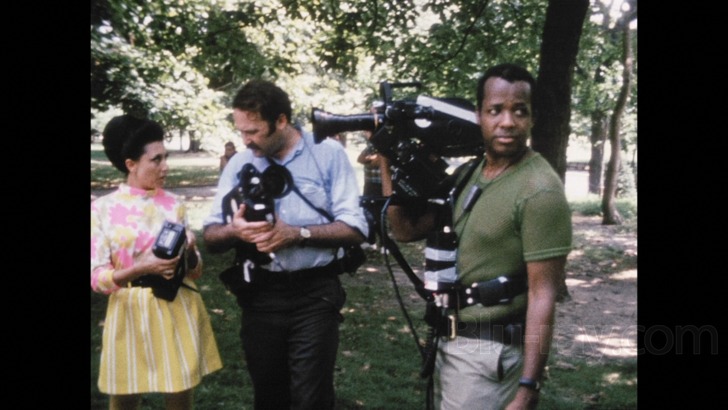
Symbiopschotaxiplasm was something of an avant-garde experiment for actor turned filmmaker William Greaves. He was rather frustrated with the lack of roles for black performers and took an interest in becoming a documentarian. His goal here was to try to capture life in what would hopefully be the realest way possible and hopefully remove the stigma of feeling the need to perform for a camera. Instead, it unravels into something truly meta as the documentary is essentially another documentary inside of a documentary.
The film is low budget, as most documentaries often are, but it is clear that the limitations Greaves had to work with leave a lot of the film feeling a bit rough and even hard to hear at times as if it the sound quality would rival that of the early talkies of the late 20s.
This was a documentary that felt very ahead of its time, and something of its own being. It does feel like something that perhaps Godard would try to tackle in the later years of his career.
Greaves passed away at the age of 87 back in 2014. I had only been living in NYC for roughly a year at that point, but I do remember seeing the reports through local news. I think he was a bit of an unsung hero for black filmmakers and in the world of teaching as for nearly 15 years, he taught acting the famed school of Lee Strasberg.
________________________________________
#8 - THE LION IN WINTER
Directed by Anthony Harvey
Written by James Goldman
The Lion in Winter is the only film on this top 10 that received a Best Picture nomination that year, and a lot of its power comes from its ensemble led by two great actors at the top of their game: Katharine Hepburn and Peter O'Toole. Oh, and on top of that, we have a young Anthony Hopkins as their eldest son Richard in what was a breakout role for him.
King Henry II (O'Toole) is trying to establish his line of succession during the holiday season of Christmas 1183. In the process, he causes series of political and familial turmoil which affects the relationship with his already estranged wife Eleanor of Aquitaine (Hepburn) and their sons...while also taking up with Alais, the half-sister of French King Philip II.
Much like The Favourite would do with Queen Anne 50 years later, The Lion in Winter was mainly fictional and only takes scant writing from history and embellishes the lore behind them.
As I stated before, if I would recommend this film for anything, it would be the acting. O'Toole never won a competitive Oscar, and this should have been the easiest way for him to not only win an overdue award, but it also would've been for one of his absolute best performances. The Academy infamously opted for Cliff Robertson who gave a truly erratic performance in the rather mawkish Charly, based on the iconic story Flowers for Algernon.
Hepburn's win for this was her third, and this was part of the tie with Barbra Streisand for Funny Girl. I have often brought up the famous Hepburn quote where she said the right actors win Oscars but for the wrong roles. I certainly don't agree with that as canon because a lot of amazing actors never won or weren't even nominated, but there is also truth to her statement.
Of her record 4 Oscar wins, The Lion in Winter is the only one I felt she actually deserved...and even though Hepburn was not British, her stature makes her fit into this role while not even adopting a semblance of a British accent.
While a historical drama at heart, I do like the slight edge of wit and even camp that The Lion in Winter has. It does give it a bit of a jolt from being way too stuffy.
________________________________________
#7 - HOUR OF THE WOLF
Written & Directed by Ingmar Bergman
In what would be the only true horror film he would make in his career, Ingmar Bergman certainly had an energy and aesthetic that would've made him quite susceptible to dark surreal horror had he wanted to sustain it. I think of something like The Lighthouse as where Bergman would've gone had he been young enough to keep making films in the present day.
Hour of the Wolf is also not one of his films that gets talked about as extensively as some others, but that's also just because the amount of excellent work he did was so vast. It may not be absolute peak, but this is truly a fascinating film from him.
Considering the era of Bergman that we are in, not surprisingly Liv Ullman and Max von Sydow are here and just as splendid per usual. He plays a painter named Johan Borg, who suddenly disappears and it causes his wife Alma (Ullman of course) to go a bit mad, suffering from insomnia and frequently having nightmarish visions and hallucinations.
The two of them lived on an island...because Bergman was positively obsessed with the island of Faro...and to add to the drama, Alma is pregnant at the time of his disappearance.
With the element of horror being very prominent, a lot of critics at the time viewed Hour of the Wolf as being a step back for Bergman...and like I said, maybe it isn't exactly him at his peak but it has a lot of aspects to admire about it...namely the amazing performances plus it has to be him and his main cinematographer Sven Nykvist creating some of their most alluring visuals.
Much like Through a Glass Darkly, The Silence, and Winter Light in the early 60s, Hour of the Wolf is considered part of another defacto trilogy. Spoiler alert: we will see the rest coming up...but that likely wouldn't shock you to hear.
__________________________________________
#6 - THEOREM
Written & Directed by Pier Paolo Pasolini
Pasolini's legacy is so closely linked to Salo and his eventual torture/murder that occurred shortly thereafter, but he was a trailblazer who had such a fascinating cinematic voice.
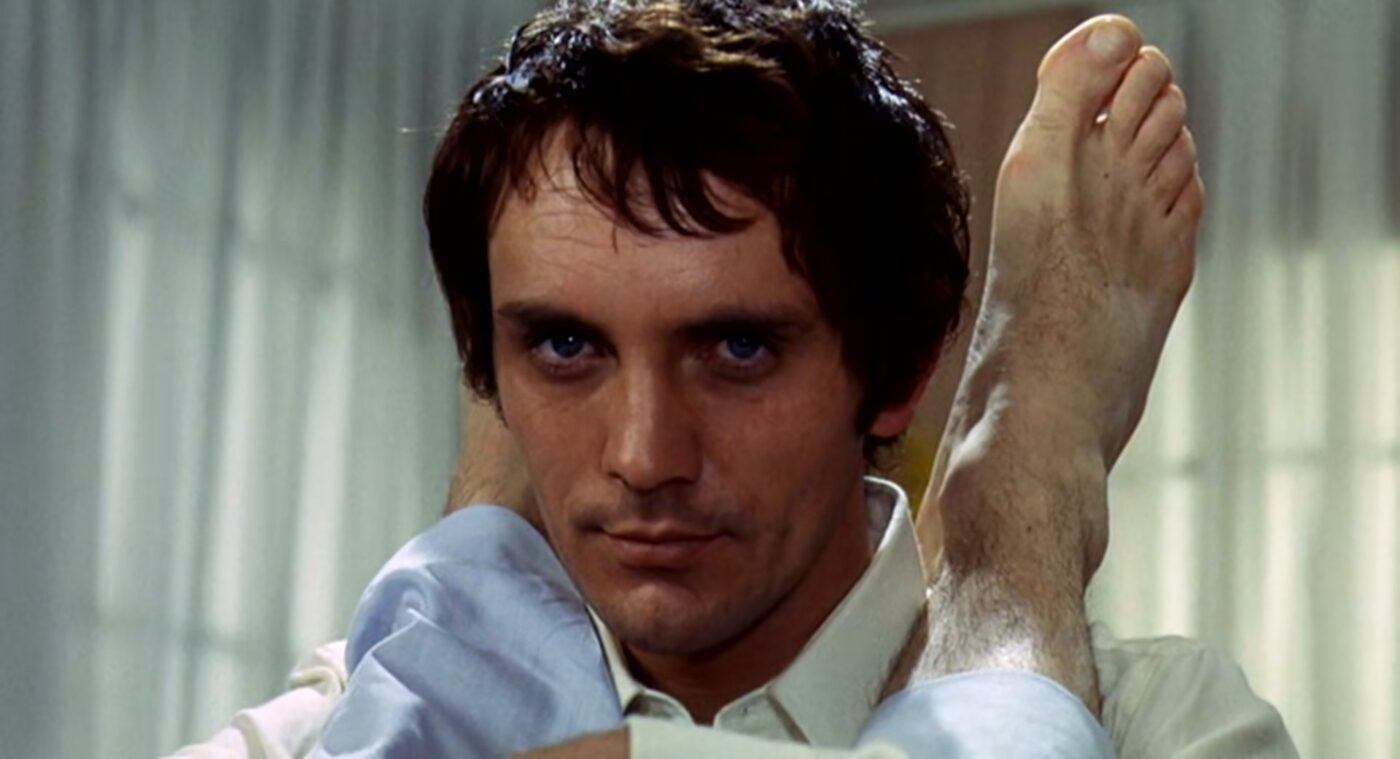
Theorem is, in a word, depraved. I don't mean that negatively considering the fact I am talking about it here, but this is the kind of challenge that Pasolini wanted to make people watch. We focus on a wealthy Italian family, whose names we never learn, who have a mysterious man enter their lives that we only know as The Visitor (Terence Stamp).
This man is able to more or less seduce himself into their lives...and I mean that pretty much literally. He stops the maid from committing suicide and takes on a loving approach with her; he earns the trust of the young sensitive son and ends up sleeping with him; he energizes the bored and dissatisfied matriarch by taking her to bed; he allows the young daughter to gain more trust in men that she didn't have before, and he even manages to tend to the needs of the ailing patriarch.
The Visitor doesn't ask for anything in return for his "services"...which sort of makes me think of this as a far more bizarre version of that episode of The Simpsons where Homer gets a promotion thanks to his sudden hair growth and his assistant Carl voiced by Harvey Fierstein ("My mother told me never to kiss a fool!") enigmatically appears and disappears seemingly tended to Homer's every whim in the process.
As mysteriously as he arrived, The Visitor leaves...and now the family and maid only have the trappings of the bourgeoisie life they knew of before...and needless to say, they go a bit mad.
Theorem is such a fever dream and quite possibly my favorite of Pasolini's works...at least off the top of my head. As a surprise to no one, the Catholics denounced the film for its explicit sexual conduct and when the film was going to be given an award at the Venice Film Festival, the Vatican protested and the award was dismissed.
Pasolini and his producer Donato Leoni would face obscenity charges thanks to the film's content but would be dismissed only an hour after deliberations began.
I guess in this case, sex won out.
__________________________________________
#5 - FACES
Written & Directed by John Cassavetes
I can remember the first time I watched Faces. I was feeling a bit off about it, because the quality of the tape I watched it from was relatively old which only made the low budget "cinema verité" cinematography look far worse. I admired a lot about it, but it wasn't until a couple of years later when I revisited the film on TCM that I discovered that it was actually a lot better than I gave it credit for.
A middle-aged couple named Richard (John Marley) and Maria's (Lynn Carlin) marriage is put through the ringer when Richard has a chance encounter with a prostitute named Jeannie (Gena Rowlands) and now decides to ask for a divorce when he enjoys the potential of having freedom with Jeannie...perhaps even more women should they come along.
Although Maria is not exactly going to take this lying down. Despite feeling very off kilter, her friends take her out for a night on the town, and she encounters a younger man named Chet (Seymour Cassel) whom she rebuffs but will eventually consent to.
Faces was, much like the majority of Cassavetes' small but mighty filmography, fully financed by himself and his wife and muse Gena Rowlands for roughly $275k. The actors were told that they would not be paid for their work during filming, but they would benefit from any profits that would come in. Cassavetes also liked casting actors who weren't as well know, and even in the case of Lynn Carlin, she had no prior acting experience and had previously been working as an assistant to director Robert Altman. Eventually, Cassavetes hired her as a script supervisor and then opted to cast her as Maria...which led to her receiving an Oscar nomination for Best Supporting Actress.
Despite some high praise, the film was met with detractors. Pauline Kael felt the film was "crudely conceived" and while I highly respect her writing and how well she can articulate her opinions, I disagree with her here. Faces is a film that might look a bit rough, but it does feel incredibly raw and real...as if Cassavetes decided to privately film people but maybe every so often they'd realize they were being filmed.
His two masterworks did come later on, A Woman Under the Influence, which I discussed in my 1974 post and Opening Night from 1977 ...but Faces was a major turning point for him. It also was a major win for indie cinema and proved that so much could be accomplished even with a meager budget.
_________________________________________
#4 - SHAME
Written & Directed by Ingmar Bergman
Being the second film released in Bergman's trilogy about violence and moral decline, Shame was also the best of the 3. We will be seeing the 3rd installment on my 1969 post because, as I shock to no one, I think rather highly of it, too.
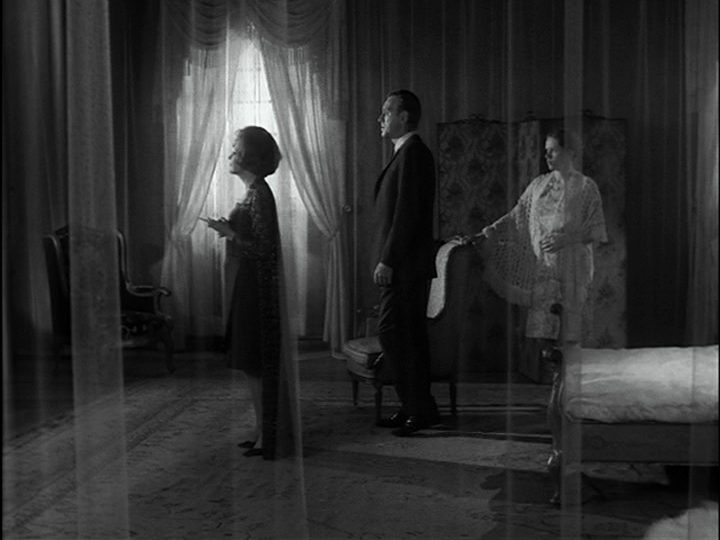
As evidenced by the photo above, Von Sydow and Ullman are once again back and ready to go through yet another bleak and tragic story that only Bergman can provide.
As a married couple named Eva and Jan, they are former concert violinists who live a rather apolitical life. Their home and safety are threatened when a small civil war breaks out, and they are considered by one side to be sympathetic toward the enemy. They end up having to flee and, in the process, their marriage begins to crumble.
Shame was seen as a comment on the Vietnam War, which was still raging despite much opposition, however Bergman had stated this wasn't his actual intention. He mainly just wanted to tell a story about how even a relatively small war can still lead to the "disintegration of humanity". I also love how we are sort of left to pick up the pieces as Bergman doesn't try to veer into propaganda but rather leave the causes ambiguous so we don't truly know which side is "the right one". In the end, war is hell regardless of the side you are on.
As the war rages on, Eva and Jan struggle with each other and as is to be expected, Ullman and Von Sydow turn in stellar work. It is great anti-war film while also being an amazing character study on how it can affect two people. In a way, it is the relationship that becomes the focus and not so much the war. It stays in the background in many ways, and for me, it is remarkable at how much more captivating it is to watch those two legends act opposite one another.
_________________________________________
#3 - NIGHT OF THE LIVING DEAD
Written & Directed by George Romero
Co-written by John Russo
Another low-budget game changer...to put it mildly.
As someone who grew up an hour outside of Pittsburgh, I do very much love the legend these Romero films that still persist in the area.
Night of the Living Dead was made on a shoestring budget and was a passion project for George Romero, who wanted to tackle a horror film after having gained directorial experience working on local commercials and for another local Pittsburgh institution: Mister Rogers' Neighborhood.
It was made on a budget of roughly $125k (around $1 million in 2026) and would wind up grossing $12 million domestically (a whopping $112 million and change in 2026) and an additional $18 million internationally (nearly $170 million today). That means the film essentially grossed the equivalent of about $300 million by today's money. Making back more than 250 times its budget, it still remains one of the most profitable films of all time.
Night of the Living Dead would help unearth one of the most popular horror subgenres in history: the zombie film. In my intro, I referenced a film that would not receive a rating since it came out a month before the MPAA came into existence. THIS was that film.
Imagine a group of kids and teenagers entering a theatre for a Saturday matinee, which often would show horror films, and the film they sit down for is Night of the Living Dead in which we watch every character that we had been following die by the end. The low budget atmosphere only adds to the eerie dreary vibe, especially when we watch the zombies in the midst of a feast...and then at the very end, when our leading man seems to be about to be rescued, he is shot to death when the group gathered assume he was one of them.
Romero had intended on casting the role with someone white, but when black actor Duane Jones came in, Romero decided to something unique for the time: using a black actor in a lead role where being black had nothing to do with the role. While Sidney Poitier was a black leading man, and had even won an Oscar by this point, a lot of his roles dealt with the fact he was black. It was very rare, BUT it does give the role a certain tragic weight even beyond the simple fate of the character. Many praised Romero for that, even though he acknowledged a lot of it was coincidental. Years later, Romero was asked if he was inspired by the assassination of MLK with creating the ending, but he said that was not the case as the film was already finished at that time.
Night of the Living Dead was meant to be a B-movie, but instead, Romero changed the face of the genre and gave us something distinctive and downright creepy. I have never been a big fan of zombie films, but this one is a classic for a reason.
_______________________________________
#2 - ROSEMARY'S BABY
Written & Directed by Roman Polanski
For those of you who don't know, I was raised in an evangelical religion known as Apostolic. It was certainly not a very...umm...liberal minded surrounding to be a part of. I was very much one of those kids who was not allowed to read Harry Potter because it contained "witchcraft" nor did my mother want me to see anything that dealt with Satan or any kind of demonic entity.
Strangely enough, she wasn't as offended by The Omen, but obviously she forbid me to watch The Exorcist, which I ended up not seeing until I was in college.
When it came to Rosemary's Baby however, she was on the fence. She recalled my Nan sending her to bed in the early 70s and then heard her watching the film when it aired on TV for the first time. My sister rather randomly watched the film when she was pregnant with her first child and I do remember her being VERY upset about it.
I watched it and then had a conversation with a friend about it on the phone and was quoting how at the end, they are all saying "Hail Satan!" which prompted my mom to come check what was happening in my room.
Organized religion...what a world that is...
Moving past that, Rosemary's Baby tells the story of a young newlywed couple of Rosemary (Mia Farrow) and Guy Woodhouse (John Cassavetes) who move into an apartment in a gothic building known as The Bramford (though the exterior shots are of the famous Dakota building located on Central Park West). A friend of theirs warns them that the building has a history of murder and witchcraft, which they basically ignore.
Shortly thereafter, they meet their elderly neighbors Minnie and Roman Castevet (Ruth Gordon & Sidney Blackmer), who also happen to be caring for a recovering drug addict named Terry (Angela Dorian). One night while returning from a night on the town, Rosemary and Guy come across a commotion outside their building; it appears Terry jumped from the window to her death...or so it seems. After this dies down, the newlyweds get closer to Minnie and Roman, but it is Guy who takes a strong liking to them while Rosemary finds them to be rather nosey and void of boundaries.
Rosemary & Guy are trying for a baby and not having much luck, but one night, after what having appears to be laced chocolate mousse, she has a "dream" where a demonic entity rapes her while Guy and the Castevets and other neighbors watch...all nude by the way.
So yeah...Rosemary is now pregnant with the antichrist. Fun times.
It is a shame that Mia Farrow got snubbed as she does truly fantastic work here, but it does thrill me that Ruth Gordon won for her work. It feels like an early forerunner to the recent Oscar win of Amy Madigan.
While the film may have some pacing issues at times, not to mention the Polanski of it all, I can't help but think this was a stellar achievement and another step up in content for Hollywood.
________________________________________
#1 -2001: A SPACE ODYSSEY
Written & Directed by Stanley Kubrick
Co-written by Arthur C. Clarke
I don't think I had another choice. This simply just has to be 2001.
Yes, maybe some of the space images might look a little bit outdated to say the least, but I still can't believe what Stanley Kubrick was able to accomplish in the mid-late 60s making this. The thought of seeing this on the big screen in 1968 not having seen anything like it before...and still being a year removed from us landing on the Moon...it must've been an otherworldly experience.
Kubrick, the madman genius that he was, worked with Sc-Fi writer Sir Arthur C. Clarke on adapting a couple of his short stories such as The Sentinel and Encounter in the Dawn into a longer script. The film begins with the Dawn of Man, and we watch a tribe of hominins discover an alien monolith. Shortly thereafter, they discover that they can make weapons to use against a rival tribe with the bones of dead animals.
But in the middle of the iconic scene (which Greta Gerwig used for the opening of Barbie, showing this film's staying power), we see one of the bones fly into the air and we get that famous cut transition to the satellite in space millions of years later.
The bulk of the film now takes place in space, where we follow a voyage of multiple astronauts, scientists, and a sentient computer called the HAL 9000 as they prepare to visit Jupiter to investigate an alien monolith.
I am not here to say that 2001 is necessarily an easy watch. It does require a little bit of patience, and it isn't a film you can say has a great script in terms of dialogue. Sure, it has its very memorable moments and manages to leave us guessing and analyzing...but this is the perfect example of a film that truly thrives on it being a visual spectacle as its main selling point.
The use of various classical music pieces also adds something special to this, and I cannot hear "The Blue Danube" without imaging a pen floating in mid-air. It looks so seamless too!
Kubrick only ever won a single Oscar in his career, and it just so happened to be for this film's Visual Effects. He was nominated for Best Director, but the film was not nominated for Best Picture. That year, the top two awards went to the film adaptation of the West End musical Oliver! which is fine and all, but it just goes to show how back and forth the voting body was at the time...especially considering what will win Best Picture for 1969!
When it comes to the genre, it is very evident that so many films owe a debt to what Kubrick was able to achieve here. I would even go as far to say that it is one of the most important films to have ever been made for the absolutely meticulous care that Kubrick and Clarke put into this to advance the visual medium.
=====================
FINAL THOUGHTS:
While not a vast list, I do really love how eclectic this lineup actually is. You really see shifts that are rather groundbreaking from not just the epic visual effects of 2001 but the content in the stories and the form of others. You have the abstract meta documentary that is Symbiopschotaxiplasm and the sexually explicit "eat the rich" story of Theorem.
We also have Bergman being Bergman while also having him tackle horror for the first time while seeing that low-budget films such as Night of the Living Dead and Faces could give us marvelous dividends.
I don't recall 1969 being that strong either, but I have been surprised with other lists recently; maybe it will make me change my mind upon writing it. We are bringing the 60s to a close, and I am excited that I was able to tackle such a fascinating decade for film such as this one.
When looking at a year like 1967, this is what a consider an even bigger turning point away from what was Old Hollywood and what would eventually be dubbed, conveniently enough, New Hollywood.
In Mark Harris' book Pictures at a Revolution, he talks extensively about the 5 films that received an Oscar nomination for Best Picture that year and when you really examine them, you can see how much the tides are turning...though, full disclosure, the flat-out erratic nature of 1969's list is even more bonkers so stay tuned for that.
Of the 5 films nominated for Best Picture, only two will make my list. Some of my readers who might follow this stuff more intently may already know which two of those films I will single out...but I also don't want to spoil more about it. I will bring up the other nominees at the very end.
Are we about to see an uptick for Hollywood films on this list? Truthfully no. I would say it's still about average based on how a lot of the years have been, but there will be a victory of sorts with this year. Could we finally have a film from the US actually make it to my #1 slot???? The last time I did that was for 1960, so maybe the time has come ;-)
==========
TWO HONORABLE MENTIONS:
The Jungle Book
Directed by Wolfgang Reitherman
Written by Larry Clemmons, Ralph Wright, Ken Anderson, & Vance Gerry
The significance of The Jungle Book in Disney's is that it was the last film Walt Disney supervised production on prior to his death in December of 1966.
There have been some criticisms of racist interpretations, namely with the character of King Louie the ape. Disney himself wanted Louis Armstrong to voice him, but it was quickly nixed because of the horrendous implications. Italian jazz singer Louis Prima would be given the role, and a lot of the character's mannerisms were distinctly his style.
At the time, actor Gregory Peck was President of the Academy of Motion Picture Arts & Sciences, AKA The Oscar people. He was very much a champion of embracing the idea of what would become "New Hollywood" and also calling attention to younger performers/artists/filmmakers and acknowledging that films not normally considered "worthy/prestige" were actually films they should consider. He lobbied hard for The Jungle Book to get a Best Picture nomination, which sadly did not happen. It would still take another 24 years until Beauty & The Beast would become the first animated film to achieve that feat.
Oh, and "The Bare Necessities" is an absolute banger and it's bonkers that it lost the Oscar to "Talk to the Animals" from freaking Doctor Doolittle.
--------
In Cold Blood
Written & Directed by Richard Brooks
While he doesn't get discussed much when it comes to other famous directors, I have always commended Richard Brooks for being one of the few filmmakers who came from the Hays Code era of Hollywood who jumped in headfirst towards the darker and far more intriguing material of New Hollywood.
As based on the nonfiction crime novel of the same name by Truman Capote, In Cold Blood shows us a glimpse into the world of Perry Smith and Dick Kickock (Robert Blake & Scott Wilson), two men who would murder a family of 4 in Kansas.
Due to Robert Blake eventually being found guilty in a civil court of murdering his wife Bonnie Lee Bakely in 2005, that does add an unfortunate and uncomfortable layer to this film...but aside from that, I do think this is quite the achievement in this kind of storytelling for this time period.
====================
#10 - COOL HAND LUKE
Directed by Stuart Rosenberg
Co-written by Frank Pierson & Donn Pearce
Well...Paul Newman is in it. Need I say more?
I have talked about the appeal of Paul Newman many times, but it isn't even necessarily from an attraction standpoint. He is simply one of the most captivating and charismatic performers to ever grace the screen, and I would say Cool Hand Luke is one of his peak efforts.
Set in an early 50s Florida prison, Luke Hanson (Newman) is beginning a 2 year sentence for damaging several parking meters. He is not willing to comply to anyone's rules, especially the prison's sinister warden whom we only know as The Captain (Strother Martin) and he also goes up against the power of the prison yard leader Dragline (George Kennedy).
However, Dragline and the other inmates begin respecting the will and grit of Luke...especially as he continues enduring a lot of abuse for not complying with The Captain ("What we've got here is...failure to communicate")
Nowadays, Cool Hand Luke plays really well, especially as more and more people have realized how heinous our prison system actually is. Even at the end, when it is clear that he has made a fool of these people, nothing changes. The Captain gets the last laugh...and it does hit you with a thud.
__________________________________
#9 - MARKETA LAZAROVA
Written & Directed by Frantisek Vlascil
Co-written by Frantisek Pavlicek
This is admittedly one of those films that I am putting on a list from memory after only having seen it one time over a decade ago. While I clearly do think highly of the film based on my memories, this is also one that could use a rewatch for me.
Marketa Lazarova is the daughter of a feudal lord named Lazar. She had been planning on joining a convent, but shortly before this, she is kidnapped by two robber knights as an act of vengeance against him after he refused to help them with a defense pact against the potential wrath of the German king.
What I remember beyond that is how dreary the film was, but not exactly in a negative way. It is the mark of a good filmmaker to be able to immerse you fully in the world that they are creating onscreen and I would say Vlascil does that here.
One other thing I do want to mention is the setting itself. This is during the 13th century where Christianity had not fully replaced paganism, and the film clearly tries to create conflict in that way between the characters.
It is an unflinching look at how diabolical humanity can be, and how nothing may be exactly as it may seem.
___________________________________
#8 - BOB DYLAN: DON'T LOOK BACK
Written & Directed by P.A. Pennebaker
Another instance of me including a documentary on one of my lists, but this is one of the truly iconic documentaries especially when coming from a musical standpoint. As conceived by documentarian legend D.A. Pennebaker, Don't Look Back follows Bob Dylan as he travels the UK for his 1965 tour.
Dylan has always had an allure and an air of mystery about him, and not surprisingly, Pennebaker still manages to keep that allure and mystery alive. This was right at that point where Dylan would be subjected to a lot of attention in the press for embracing more of a rock style seemingly at the expense of his folksier roots.
Dylan is also a man who marches to the beat of his own drummer, and we see him here in all of his unfiltered glory...even if he is often being a jackass to others. In the end, Pennebaker offers a very cinema-verité glimpse into the world of an artist experiencing peak success and how he offered something so new and fresh and remarkable in terms of his output.
______________________________
#7 - THE PRODUCERS
Written & Directed by Mel Brooks
Considering most people didn't see this film until 1968, and it would win the Oscar for Best Original Screenplay for that year, I had always considered The Producers a 1968 film...but it seems as though everything lists it as 1967 these days so I will just go with that.
Mel Brooks had mainly worked as a comedy writer, but he was inspired to write something about an old Broadway producer he used to work for who had a very inspired way to try to raise money for his productions: seducing old ladies and having them write out checks to the title of his latest play - "Cash".
Originally, he wanted to do it is a play but was told that there were too many different locations to make it work. He tried it as a book but was told "too much dialogue, not enough narrative". Therefore - he made it into a movie script, and managed to weasel his way into directing it as well. How so? It would save the producer money.
The original title of the film mirrored the musical in the play: Springtime for Hitler. Not surprisingly, this freaked people out and they even suggested he call it Springtime for Mussolini. Thankfully, the biting power won out and all that changed was the film's title, the more banal The Producers.
Max Bialystock (Zero Mostel) has produced Broadway flop after Broadway flop but still has a catalog of horny old ladies that he prowls upon for money. His accounting firm sends over a new accountant to help do his books named Leopold Bloom (Gene Wilder), who by happenstance comments that under the right circumstances, a producer could wind up making more money with a flop than he could with a hit. If a play was a surefire flop, the producer would not have the means to pay the backers so he'd essentially walk off with a couple million.
While I would argue a lot of the structure of The Producers would be improved once it became a Broadway musical, namely the final third of the show after Springtime for Hitler premieres, there is still something so bold and invigorating about this. Many years later, South Park did a joke where it had been 23 years since the AIDS epidemic had been at its peak, so now it was able to be joked about. That sentiment came from The Producers, which had its peak success 23 years after Hitler was found dead.
If you truly want to see how well it is to tackle something that dabbles in shock value: The Producers is a forerunner in that subgenre.
________________________________________
#6 - PLAYTIME
Written & Directed by Jacques Tati
Co-written by Jacques Lagrange &
He only made six feature films in his career, but Jacques Tati was able to make a name for himself and also a bit of a market that felt very different compared to the edgier and rough-around-the-edges work of his French New Wave contemporaries.
Tati had been a mime and really embraced the idea of the whimsical in a lot of ways. I will admit that I have never been as passionate a fan of Tati, but I do admire greatly the kind of energy and vibe he brought to his films, mainly because I do think of him in one particular way: the French Charlie Chaplin.
I still wouldn't say he matches that level in terms of the pathos, but Tati would star in his films as a character named Monsieur Hulot. He had a very distinctive look: overcoat, pipe, hat, but he was often clumsy and somewhat oblivious to the world around him. Tati would say that one major difference between him and Chaplin was that the latter was smaller and able to finagle himself more bombastic situations and could be very unassuming if he needed to be. Tati's stature and build made him far more susceptible to being noticed and maintains a certain level of subtlety. Even with how the two walked, Chaplin had that distinct sort of "waddle" while Hulot sort of glided.
Playtime is likely Tati's best work, but this is at a time when he was growing a bit resistant to playing Hulot as a fully central character in his work, so he toned down a lot of his immediate involvement. The sets for the film, which are massive, were built specifically for the film and they certainly do create a very fascinating and vast playing field.
The film links two characters indirectly having similar experiences and crossing each other's paths: Hulot of course but also a young American tourist named Barbara who are having difficulty adjusting to the bustling new life filled with growing technology in Paris.
The film utilizes very little dialogue, and even when it does, a lot of it is background noise and a mix of various languages. In many ways, if someone likes very subtle and conceptual humor, Tati's work is a great gateway to foreign cinema since a lot of it doesn't require extensive use of subtitles.
__________________________________
#5 - BELLE DE JOUR
Written & Directed by Luis Bunuel
Co-written by Jean-Claude Carriere
We make our first stop upon the "Catherine Deneuve Looks for Love in All the Wrong & Even Colorful Places" train.
Following the adoration and acclaim she received with her work in Jacques Demy's The Umbrellas of Cherbourg, Deneuve managed to solidify herself as an absolute icon with her work in Luis Bunuel's Belle de jour... which means "beauty of the day" as she is a married woman who does sex work during the day while her husband isn't home.
I do have to add really quickly that despite how well the film turned out; Deneuve and Bunuel did not have the best working relationship. He felt he was forced to use her via the producers and the influence of her then-lover at the time, Francois Truffaut. He also said that he felt Deneuve was a bit of a prude about the sexual content. I do think that's a bit interesting considering she had already appeared in Playboy at that point. Deneuve felt that she was being used and that she wasn't fully being respected by Bunuel.
Deneuve's character of Severine is married to Dr. Pierre Serizy (Jean Sorel). They both legitimately love and care deeply for one another, but Severine is unable to be intimate with him due to some past sexual trauma. Beyond that, Severine has sexual fantasies that are beginning to consume her such as exploring S&M and domination in general.
She does eventually find her way into entertaining gentlemen callers, which surprisingly leads her into embracing more of a sex life with her husband. However, one of her "johns" named Marcel (Pierre Clementi) is able to provide her the thrills and excitement she craves...but at what cost?
Belle de jour is certainly one of the films I think of from this time that began pushing the envelope when it came to telling complex stories about sex and also the fact it came from the viewpoint of a woman.
It also feels somewhat unique for a Bunuel film, but he is still able to give it his usual surreal edge at time, particularly with the use of fantasy sequences.
_____________________________________
#4 - THE YOUNG GIRLS OF ROCHEFORT
Written & Directed by Jacques Demy
I think what is remarkable about The Young Girls of Rochefort is that it could just be seen as some kind of attempt of Jacques Demy to capture the magic he had with The Umbrellas of Cherbourg. You take a noun and pair it with a place...and then cast Catherine Deneuve...yep, the YSL/Chanel diva is already back!
The Young Girls of Rochefort does not feel like a rehash in any way to what Demy/Deneuve had recently accomplished.
Considering that The Umbrellas of Cherbourg could be seen more as a bittersweet romantic tragedy despite the fact that one of them truly ended up finding happiness, Young Girls feels a bit brighter in its world of glorious colors of reds and yellows compared to the more pastel vibes of Umbrellas. There is a jovial nature to this one that might make it more of vibrant and, perhaps, more of a classic musical in the sense that we get choreographed numbers that are more reminiscent of the MGM musicals from the 30s and 40s.
It is pretty evident with a role like this plus her work in Belle de jour, Catherine Deneuve proved she had the range and was quickly becoming one of the more captivating screen presences of that era.
We meet twin sisters named Delphine and Solange, played by Deneuve and her real-life sister Francoise Dorleac. They live in the small seaside town of Rochefort off the Bay of Biscay. The two of them long to move to Paris with the goal of Delphine becoming a dancer and Solange becoming a composer.
There's a lot of chaos in their town currently as a carnival is passing through, and it is that type of atmosphere that gives this film such a glorious sense of place. While Umbrellas popped with color, the weather always seemed to be overcast and rainy or, famously, snowy in its last scene. Here, it is like we are living in a sun-soaked world that makes you want to jump right in.
It is hard to say which of the two I prefer. I honestly don't think that there is a firm consensus as I have seen a fair amount of people prefer one over the other...but if you were to ask me my personal opinion at this exact moment, I might say Umbrellas. This makes me want to watch Rochefort this coming weekend, because maybe that opinion will change. Both of them are very much their own distinct being and offer something special onto themselves.
In the span of just 3 years, Jacques Demy gave us two of the greatest musicals ever captured on film...and a lot of praise needs to be given to Michel Legrand for his compositions as his work here is simply infectious and jazzy to the nth degree.
____________________________________
#3 - LE SAMOURAI
Written & Directed by Jean-Pierre Melville
Co-written by Georges Pellegrin
The term "film noir" is associated with crime/dark drama films from the 40s/50s that usually incorporated shadowy B&W cinematography and usually contain a femme fatale in some cases. We eventually would get the revamped version of this in "neo-noir", which incorporates those sensibilities, but the films are made in color and depict more explicit forms of violence and sexuality.
Examples of those would be Chinatown, Taxi Driver, Body Heat, and Blue Velvet. Although I would agree with the claim that Le Samourai was the granddaddy of this entire genre style shift.
A hitman named Jef Costello (Alain Delon) lives rather meagerly and goes about his work, creating alibis to keep himself out of harm's way. These are often given to him by his lover Jane (Nathalie Delon, then married to Alain). Jef is hired for a new contract but seemingly has someone trying to kill him, all while a commissaire (Francois Périer) is on his tail.
Everything about Le Samourai is cold in the best way. The cinematic palate is an array of gloomy grays and blues, everything feels sparse and ugly, while also somehow being pristine and eye-catching.
It is also doesn't hurt that we have Alain Delon as our lead, someone who has popped up multiple times in these posts from Rocco & His Brothers to Le Cercle Rouge. Delon was easily one of the coolest actors to have ever lived, up there with Paul Newman. His charisma level was off the charts, and he just had such a stunning face that could've been passed off as just "handsome but stupid", but Delon was as talented as he was attractive.
Le Samourai might not necessarily be his best, but this might very well be him at peak "cool".
____________________________________
#2 - BONNIE & CLYDE
Directed by Arthur Penn
Written by David Newman & Robert Benton
I always talk about how Hollywood of the 60s inches closer and closer to the New Hollywood era of the 70s where we finally caught up with the rest of the world. In many ways, Bonnie & Clyde is the film that led that charge, and the mixed reviews that often got vitriolic at the time proved that so many people weren't ready for it.
The subject matter is certainly well-known: a true story based on two lovers by the names of Bonnie Parker and Clyde Barrow (Faye Dunaway and Warren Beatty) who go on a crime spree killing people and robbing banks left and right during the height of the Great Depression.
It is kind of humorous to me that there was such an outcry about the depiction of violence onscreen considering that eventually violence seemed far more accepting than anything remotely sexual. With the push of films like Bonnie & Clyde and with 1966 giving us a bit of a jolt with films like Blowup and Who's Afraid of Virginia Woolf?, the Hays Code was officially dead and by the next year, the MPAA would be formed...for better and eventually for worse in a lot of ways.
The interesting thing about Bonnie & Clyde for me is that it was one of the big examples of a highly acclaimed film that I watched and didn't truly connect with at first...but despite that, it kept staying on my mind and building in esteem in the decades since I first watched it.
Obviously, Dunaway and Beatty are magical together, but I found a lot of enjoyment in the supporting players more. This was Gene Hackman's breakout role and still one of the true pinnacles of his career, which is saying a lot. You also have the rather infamous performance of Estelle Parsons as Blanche, who despite winning the Oscar (one of only two that the film received, which left Warren Beatty incensed after the ceremony), seems to divide fans down the middle as being perfect at capturing this distinct character or being way too shrill and obnoxious. I fall more in the "she was great" camp, because that is what Blanche Barrow needed to be...plus by the end, when she is left a blind shell of her former self, you almost pity her as much as you enjoy seeing her put in her place.
This is a film that has been written about so frequently that it is hard for me to truly feel like I can add anything new, but I will reiterate at the very least that I admire and respect what this film achieved and how it opened the door to more daring films to emerge from the Hollywood floodgates.
___________________________________
#1 - THE GRADUATE
Directed by Mike Nichols
Written by Buck Henry & Calder Willingham
As I cheekily alluded to at the beginning, I am finally giving my #1 spot to a film that came from the US for the first time since 1960.
What I find really interesting about The Graduate is that it is an example of a film that seemed highly acclaimed, but a lot of people have taken a step back from it. Even when looking at the infamous AFI Top 100 Films of All Time lists (that only included American films), The Graduate was #7 on the 1997 list but dropped to #17 when they redid it in 2007.
I was talking with one of my film buff friends yesterday (shout out to Dan) and he mentioned how he also felt the film was fine, and he didn't really respond to it.
I do think a lot of what helped The Graduate stick for me was seeing it during my formative years of becoming a film fanatic. I believe I was 12-13 when I first watched it, and I really took to the story and the very eccentric nature of it.
Benjamin Braddock (Dustin Hoffman) just completed his undergrad studies and is planning to attend graduate school in the fall...but he is feeling a bit loss and uncertain about his future. During a welcome home party, a longtime family friend and neighbor Mrs. Robinson (Anne Bancroft) barges into Benjamin's room as he tries to escape from the cacophony downstairs and asks him to drive her home.
Benjamin eventually picks up on the cue: "Mrs. Robinson, you're trying to seduce me. Aren't you?"
So yes, Benjamin begins an affair with a woman twice his age, married to a guy who seems pretty respectful (the great character actor Murray Hamilton), and a daughter who is about to start college named Elaine (Katherine Ross).
However, things become a bit more interesting for Benjamin when he takes a liking to Elaine.
The Graduate is interesting in that it sort of has moments that make it feel like it is still trapped in an early 60s aesthetic, but Mike Nichols' direction, the witty script, and particularly the use of Simon & Garfunkel's iconic score give this film such a unique vibe and it is clear to see why it was viewed as such a departure from the norm in 1967.
During the opening credits when we see Benjamin on the moving pathway at LAX as "The Sound of Silence" plays, it instantly puts you into this world and the mind of our protagonist...and it leads to a great bookend.
While I would argue that Bonnie & Clyde, The Young Girls of Rochefort, and Le Samourai might be a bit more vibrant and a bit more widely bombastic in varying ways, I always find myself thinking about The Graduate and at how well it captures that sense of aimlessness that a lot of us felt when we entered adulthood.
================
FINAL THOUGHTS:
What I ended up finding fascinating about 1967 is that it was certainly a year that became a turning point for Hollywood...but at the same time, a lot of those films have been written up to the max that it almost made me feel less enthused to discuss them; as if I didn't think I could offer anything that new or insightful about them.
I do want to mention the other Best Picture nominees from that year like I said I would do at the beginning as they are a great example of what was happening within Hollywood at the time.
As I stated, Bonnie & Clyde and The Graduate represented the "New Hollywood" movement that would take off fully in the 70s, but it was the other three nominees that were rather fascinating.
You have Guess Who's Coming to Dinner? which certainly dealt with a very relevant and controversial topic for the time: interracial marriage. It came just half a year after the legendary Supreme Court case Loving v. Virginia which granted that all 50 states should recognize and allow interracial marriage. Aside from maybe one scant moment involving the maid played by Isabel Sanford, I would argue that there is a very glossy and classic Hollywood sheen over that film. It is certainly a relevant topic for the time, but it does feel a bit docile.
Then you have the eventual winner: In the Heat of the Night. In a lot of ways, I feel like this was the film that bridged between New and Old Hollywood in that it did have more bite than Guess, but it was still inherently a "racism bad/white southern racist becomes less racist" piece.
But there is one more nominee to discuss, and it is easily one of the worst films to get a Best Picture nomination at least in the last 70 years: Doctor Doolittle.
The insane thing about this nomination is that 1) FOX had a big party to try to woo voters into nominating it and 2) It was a critical and box office dud and 3) It was the kind of over-bloated film that was starting to become less relevant. Even though My Fair Lady and The Sound of Music just won Best Picture 3 and 2 years prior, the movie musical was quickly on a decline. It's just a shame that if something more kid-friendly were getting in, they couldn't have just made history by nominating The Jungle Book.
We are now about to take a look at 1968 and I have to admit, I can't say for certain how this one will turn out. Yes, there are a couple of films that instantly make me think "that's a definite" but I wouldn't be shocked if I end up finding a couple of hidden gems or perhaps find myself a bit less enthralled.