
However - I haven't updated it to include the two most recent winners and haphazardly threw Michelle Yeoh onto the ranking without really thinking. Upon further inspection, I think I do feel like certain actresses deserved to be shifted around both positively and negatively.
My goal is to try to update this list every year from here on out whenever we get a new winner, but for now, let us start at the very bottom with my least favorite Best Actress winner. This choice is still the same from my previous post, and I think a lot of you who follow this kind of thing will agree.
_________________________________
#98 - Mary Pickford, Coquette (1929)

When the film industry shifted from Silent to Sound in the late 20s, it sent seismic waves around the industry as some of the biggest stars were deemed to be unusable once their voices would be factored into the equation. This concept was shown to show hilarious affect with Jean Hagen's Lina Lamont in Singin' in the Rain.
The era of 1928-1929 cinema is often considered one of the worst, if not the absolute worst, era in Hollywood history primarily due to the industry adapting to the changeover to sound. The results lead to films with strange robotic staging, performances than range from weirdly melodramatic or wooden as a board, and sound quality that often makes dialogue insanely difficult to hear.
In order to keep up with the times, Pickford's first foray into the talkies was Coquette, in which she would play a well-to-do southern belle whose infatuation with one of the working class leads to tragedy.
Pickford was known for having a long, luscious curls but cut her hair to a pixie cut to match the intensely popular flapper aesthetic of the time while also trying to shed her "Pollyanna" image.
The results did lead to respectful reviews and people accepting that Pickford could work as a "talkie actress"...however, time has not been kind to the film or to Pickford.
Pickford was only the second actress to ever win this prize, but she was the first to do something that has become more commonplace nowadays: campaign and lobby for votes.
Pickford was married to actor/filmmaker Douglas Fairbanks, who just so happened to be the first President of the Academy. Among the founding members, Pickford was also a part of that group. As a means to try to further the state of her career, she invited the judges/voters over to her famous Pickfair estate to push the agenda as to why she would warrant such an award.
That isn't why I am voting her as my least favorite choice to win the award...the performance itself is frankly more than enough to base this selection on. As I eluded to earlier, Coquette is very much a product of its time when it comes to being a film that struggles to overcome the early days of Talkies.
It is staged poorly and is presented in such a lifeless way that it is amazing that it is still somehow melodramatic at the same time.
Pickford's talent is not overly apparent in this film as it is is clear she lacks the prowess of her contemporaries such as the aforementioned Clara Bow or Joan Crawford, Janet Gaynor, Greta Garbo, Marlene Dietrich, Gloria Swanson, or the woman who should've won this award posthumously, Jeanne Eagles for The Letter.
______________________________________
#97 - Elizabeth Taylor, Butterfield 8 (1960)

You sure as hell did!
The winner of the Best Picture award in 1960 was the truly near-perfect romantic dramedy The Apartment, starring Jack Lemmon and Shirley MacLaine, in which she in particular gives a performance that blends romance and comedy and drama with such ease that I consider this one of the worst Oscar losses in history.
The tracheotomy in question that she lost to was that of the one given to Elizabeth Taylor, who nearly died after a severe bout with pneumonia. On top of this, Taylor had become something of a pariah in the press after Eddie Fisher left Debbie Reynolds for her.
There seemed to be a strong sentiment of forgiveness towards Taylor. When someone almost dies, the industry apparently soon wants to put aside the fact you're a homewrecker. That isn't to say I want to demonize Taylor for those actions; relationship dynamics and breakups can be highly complex.
However - considering the circumstances in which she won in addition to the quality of the performance/film she was in, I cannot support this choice.
Butterfield 8 is simply a trashy film that barely offers any kind of true value...and it is so tacky in its approach that they cast Eddie Fisher to play opposite Taylor in the film. Upon its premiere, Taylor expressed that she found the film to be "a piece of shit"...but I suppose you could argue Taylor fits the aesthetic of the film rather well. It's just a shame that it is clearly beneath her talents as evidenced by her work in previously nominated performances like Cat on a Hot Tin Roof and Suddenly Last Summer and especially in the performance that would net her a 2nd Oscar: Who's Afraid of Virginia Woolf?
There are truly some cringy moments to see here...and perhaps you could call them camp in their own way. Taylor yelling "I was the slut of all time!" leading to get slapped by her mother, and we also get one of the most ridiculous death scenes ever put on film.
Such a true waste of an Oscar win, and a clear case of where narrative and sentimentality carried the day over quality.
_____________________________________
#96 - Sandra Bullock, The Blind Side (2010)

Great opening line to a speech by a truly charismatic actress who had just won an Oscar for a truly unremarkable performance in a very abysmal movie that stands as one of the worst examples of the "White Savior" trope in cinema history.
I have been actively following the movie award season since the late 90s, and while the opinions of people who lurk on online film forums can be questionable and suggestive, I can't recall a time when it seemed like so many people agreed that it was so baffling that a particular performance was not only getting intense Oscar buzz, but that it was the frontrunner to win despite such clearly better competition.
It was almost as vitriolic as the awards embrace given to Emilia Perez.
Even more surprising was when The Blind Side actually slipped into the Best Picture race that year seemingly on the coattails of Bullock's success.
I am not saying that Bullock gives a truly terrible performance, but she is just...there. It doesn't help that the script is positively atrocious in all of its "white savior" circle jerk banality.
I can still remember the moment where she sits around the table with her southern belle friends and one says, "You're changing that boy's life!"
And with a meek but trying to be profound tone, Bullock says "No....he's changing mine".
I mumbled quietly "Dear fucking lord..."
Aside from Bullock, The Blind Side is appalling because the film was clearly structured to make the Tuohy family look saintlier than they actually were in real life. It also doesn't help that Michael Oher came out in recent years to shine a light on the Tuohys' behavior and actually sued them over tricking him into a conservatorship.
Bullock has given some strong performances, like playing Harper Lee in the lesser-seen Truman Capote biopic Infamous and she is basically the best thing about beyond the visual effects in Gravity, which I don't think is as amazing of a film as many make it out to be...and this performance is more or less serviceable at best and it isn't helped by the fact she is dealing with insufferable material.
______________________________________
#95 - Loretta Young, The Farmer's Daughter (1947)

Wins like Marcia Gay Harden for Pollock or Adrien Brody's first win for The Pianist seem very harder to pull off nowadays. Back when there were fewer precursor awards, it did seem easier for different voting bodies to opt for different performances.
And yet...no one seemed to think Loretta Young had a shot.
This was a character actress who hadn't received much attention prior who managed to beat out such heavy hitters as Rosalind Russell, Joan Crawford, and Susan Hayward with what was a relatively meek performance in a comedy.
And the only reason Young even got the role was because Ingrid Bergman was let go when suspicions were brought to light that she may have been having an affair with her co-star Joseph Cotton...because how dare a woman do such thing?! Of course, Cotton wasn't penalized because...you know...the patriarchy.
Considering how much of a departure this was from the other nominees, I suppose that is what made Young stand out. However, I do think it is fascinating how much many of us bemoan how the Oscars and many other voting bodies never tend to recognize comedic performances and yet, they are the ones that people often have the most flack with.
I do think the issue with Young is that her performance often lacks a certain spark or energy. Her character is supposed to be a Swedish farm girl who lives her family for a life in the big city who gets into the world of politics. I just find that for a performance that is supposed to be built on a lot of quirky charisma, it isn't quite there...and it also doesn't help that her Swedish accent slips in and out throughout the film.
The performance does have a charm to it, but I also feel like for being our leading lady, she often disappears next to her co-stars.
______________________________________
#94 - Gwyneth Paltrow, Shakespeare in Love (1998)

A lot has been said about Shakespeare in Love, particularly with how it won Best Picture in an upset over the very popular and acclaimed Spielberg WWII epic Saving Private Ryan. A lot of the reasoning behind this was that of Harvey Weinstein, a man whose campaigning tactics were nothing short of diabolical. That Best Picture win is frequently considered to be his magnum opus, but going along for that ride was Gwyneth Paltrow.
Paltrow was seen as a promising young actress at the time, coming off roles in films like Emma and Sliding Doors plus there seemed to be an overwhelming obsession with her in terms of how she epitomized old-style Hollywood glamour. The lovely YouTube channel BeKindRewind made a video on this topic and she nailed this point on how news outlets were giving Paltrow titles such as "the new Audrey Hepburn" or "the new Grace Kelly".
Paltrow's win seemed like such a coronation, but the remarkable thing was how toxic the opinion towards her win changed. It also didn't help that her acceptance speech was quite possibly the most made fun of since Sally Field's 1985 win as she seemed to go on for an eternity and was blathering and crying to the point you could barely understand her. My favorite moment is when she can barely get out the thanks to her mother, Blythe Danner, and when it cuts to Danner in the audience, she almost seems put off by the display, but that is me just being a bit snippy. As for the performance itself, it's fine. Nothing less, nothing more. It is not that remarkable in the slightest.
If you want remarkable, there were two nominees right there who gave stellar performances: Cate Blanchett's breakout role in Elizabeth and particularly Fernanda Montenegro, the Queen of Brazillian Theatre, in Central Station.
______________________________________
#93 - Luise Rainer, The Good Earth (1937)

The Good Earth was based on a novel by Pearl S. Buck about Chinese farmers in pre-WWI China who struggling terribly to survive. Paul Muni and Luise Rainer were both cast as the lead couple and in case the point didn't get across, they were lily white.
Anna Mae Wong had lobbied hard for the role seeing it as her big chance to have a dramatic breakthrough role only for it to be denied as they cast Paul Muni in the husband role. In those days, the dreaded Hays Code forbid any kind of interracial couple pairings in films and thus, the role was given to Luise Rainer, who had just won an Oscar the year prior for The Great Ziegfeld.
Rainer was something of a pet project for MGM head Louis B. Meyer. For years, he had loathed the actress that had been his biggest star simply because she protested the fact that she made less than her male co-stars or that she felt it wasn't necessary to devote all her time to Hollywood hobnobbing.
That was Greta Garbo.
And Meyer hoped that getting another actress from Europe could somehow duplicate Garbo's success but have an actress that was willing to go along with the game plan.
Hilariously, it backfired. Despite winning two back-to-back Actress Oscars, Rainer's star would dim fast, and she would leave Hollywood by 1940. Rainer couldn't stand the Hollywood game even more than Garbo. When Rainer won this particular Oscar, she hadn't even planned on attending the ceremony until Meyer sent someone to her home only to find her in pajamas. They forced her to get ready for the ceremony and videos clearly show Rainer trying to appear happy while Meyer forces her repeatedly to show off her Oscar.
I think this is a performance where it isn't just hard to separate the Yellowface angle, but also the fact that she tends to rely too much on stereotypes with nearly constant wide-eyed facial expression and accent that seems to flutter somewhere between a variation of Chinese and her native German.
Meyer lobbied hard for Rainer to win and the power of the film studios (as I have stated before) were too strong in those days...and he lobbied at the expense of Greta Garbo who was up for her truly iconic work in Camille.
However, in addition to Garbo, you also had these stellar women:
Irene Dunne, The Awful Truth
Janet Gaynor, A Star is Born
Barbara Stanwyck, Stella Dallas
Gaynor was the very first recipient of a Best Actress Oscar, and we will discuss her eventually. She would've placed a solid fourth here but Dunne, Garbo, and Stanwyck were all worthy to win this for some of the best work of their respective careers.
The win for Rainer seemed like a wasted opportunity, especially those three women never won an Oscar.
___________________________________
#92 - Katharine Hepburn, Morning Glory (1934)
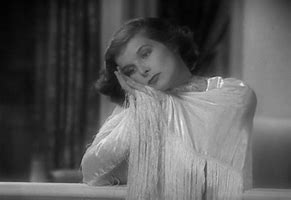
I have referenced the following quote various times throughout my blog because there is a lot of truth to it, particularly with that of Hepburn herself. She was quoted as saying "The right actors win Oscars, but often for the wrong roles".
Hepburn fits this to a tee. She has won more acting Oscars than any other performer: 4.
Of those four, I would say she only deserved one...I won't say which one to reserve some suspense, but chances are if you are a film person, you already know.
Her work as Eve Lovelace in Morning Glory is a prime example of how stiff and wooden some performances could be in these early films. A lot of the acting trademarks that would define Hepburn's truly illustrious career are oddly missing with this performance.
Of the nominees, character actress Mary Robson was my favorite from Lady for a Day but even she suffers a lot from the film around her.
__________________________________
#91 - Joan Fontaine, Suspicion (1941)

Conveniently enough, she wins the next year for a performance in a rather forgotten about Hitchcock effort, Suspicion, which revolves around a meek and relatively naive woman who marries a playboy type only to discover he is not the man he says he is...and on top of that, he might be a murderer.
Fontaine fits the ever-present blonde damsel in distress motif that pops up constantly in Hitchcock's films, but here, her portrayal as Lina feels far more lifeless than that of the previous years' "The 2nd Mrs. DeWinter".
Is it just subtlety or is it simply a lack of solid characterization? I am more inclined to agree with the latter.
Fontaine would've been a far more worthy winner in 1940 as opposed to 1941. If I were to opt for a candidate amongst the 1941 nominees, I would've opted for Bette Davis in The Little Foxes though I also wouldn't have minded Barbara Stanwyck for Ball of Fire.
__________________________________
#90 - Jessica Lange, Blue Sky (1994)
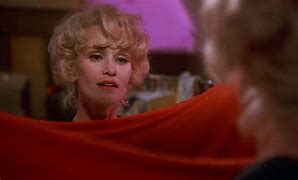
When it comes to the qualities I admire about Lange as an actress, I think that she gives herself over to a character in ways that are unrelenting and surprising. The downside to this is that it doesn't always come across as smoothly, so while I commend the effort and the boldness, I would just to follow it with "See you on the next film!"
Blue Sky is also a rather mediocre film which bombed at the Box Office when it was released after having been shelved for 3 years due to the bankruptcy of its original distributor, Orion.
Her role of Carly Marshall is a suffering housewife who has frequent outbursts brought on by mental illness. So yes, it is a challenging and demanding role that requires a lot of extensive care and preparation.
In the end, I don't think she fully succeeded nor does the film around her help in any way.
Her competition was incredibly weak as well, but I would probably give the win to Winona Ryder, who made for a truly wonderful Jo in Little Women.
This was also the year they randomly nominated Susan Sarandon for The Client, but that performance clearly had some passion considering she won the BAFTA for it! I will say out of the snubbed performances; I would've loved to see Jennifer Jason Leigh make it in for Mrs. Parker & The Vicious Circle or Jamie Lee Curtis for True Lies or Sigourney Weaver for Death & The Maiden.
Oh, if only What's Love Got to Do With It? actually came out in '94 instead of '93 so she could've wiped the floor with these people in a swift cakewalk...even though she should've done that pretty handily in '93.
_____________________________
#89 - Bette Davis, Dangerous (1935)

Bette Davis burst onto the scene in 1934 with her performances as the miserable and grating Mildred in Of Human Bondage, a character she sought to play because she knew it was a chance to show Hollywood what she was capable of in a role that most actresses would be afraid to tackle.
While the film did end up losing money, she herself caused quite the sensation and the public loved her commitment to the character. Controversy then arose when she was snubbed of an Oscar nomination which seemed to be due to the fact that RKO didn't want to spend a lot of money on a film that lost them money while Davis' own studio, Warner Bros., didn't want to put money up on an actress of theirs who made a film for a competing studio AND that they found difficult (i.e. she wouldn't put up with sexist and hypocritical BS...for the record, Bette Davis is awesome!)
Dangerous was a film Davis originally turned down, but she was persuaded to accept it when she was told it was inspired by Jeanne Eagles, the late actress who suffered from drug and alcohol abuse despite her immense acting promise. Eagels was an idol of Davis' and she wanted to try to tackle the role in her honor.
The results were essentially a disaster. Davis manages to find enough good moments, but the film itself is the real disaster and a lot of the scenes play as retreads of Davis' outbursts from Of Human Bondage...even down to having a monologue she foams out of her mouth to Franchot Tone (with whom she has no chemistry even though it was rumored they had an affair) that feels like a watered-down version of her "Wipe my mouth!" monologue she screams at Leslie Howard.
Davis knew that Dangerous was mostly a failure and talks about it extensively in her very candid autobiography.
This win cost Katharine Hepburn an Oscar for one of her best performances, which was for Alice Adams.
_____________________________
#88 - Reese Witherspoon, Walk the Line (2005)

Every year will bring us different dynamics by category, but it still does feel so strange that Reese Witherspoon won an Oscar for Walk the Line while Joaquin Phoenix did not. That isn't necessarily to say that Phoenix would've gotten my vote either; he happened to be in a crazy stacked category while Witherspoon's was rather weak by comparison.
I will say Witherspoon having an Oscar is something I do love knowing is a thing, especially because she has killed in films like Election and gave such an iconic turn as Elle Woods in Legally Blonde.
Walk the Line is one of those standard musical biopic films that really do nothing to advance the art of filmmaking but as it stands, Witherspoon does a nice job. However, it is really more of a Supporting performance that doesn't get much of a chance to shine.
As problematic as it is, Felicity Huffman did do a great job in Transamerica even if the idea of a cis woman playing a trans woman doesn't fly these days.
They did snub some truly wonderful performances like:
Joan Allen, The Upside of Anger
Natasha Richardson, The White Countess
Joan Plowright, Mrs. Palfrey at the Claremont
Laura Linney, The Squid and the Whale (although she could also be Supporting)
_____________________________
#87 - Grace Kelly, The Country Girl (1954)
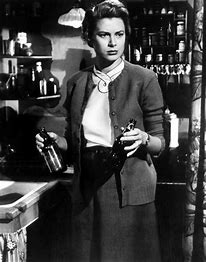
Despite a glorious comeback in which she gave the performance of her career, Judy Garland was cast aside due to her erratic behavior and controversial work ethic in favor of the glamorous Grace Kelly who did something that is also quite the popular favorite style in this category: "de-glamming" yourself.
Grace Kelly had talent, there is no question about that. However, her solid work in The Country Girl never left any kind of significant impression on me. It really truly read like an early example of Hollywood wanting to crown a new princess (pardon the pun) who had a pretty strong year with multiple hit films by singling out what was her biggest dramatic success in which she dared to present herself as looking rather plain.
All at the expense of Judy Garland, someone whose erratic and unhealthy tendencies were brought upon by Hollywood themselves.
Kelly would soon leave Hollywood to become a literal princess when she married Prince Rainier of Monaco.
I think it is a fine performance, but this is one of those cases where I can't help but sit here and think how laughable and petty it is that Garland lost this.
______________________________
#86 - Emma Stone, La La Land (2016)

I can remember seeing the film in theaters and mildly enjoying it...but the truth is that a film like La La Land should've been up my alley and yet I found myself a little underwhelmed; a feeling that has only grown a bit more over the years since seeing it.
While watching it, I remember taking to Stone and thinking she did a good job...certainly far more interesting than the performance given by her co-star Ryan Gosling. I wasn't closely following the award season at that time so when people began saying Emma Stone was the frontrunner to win and she won at SAG, I was floored. I couldn't believe that this performance was going to go along for the film's seemingly inevitable sweep.
I get that the film was trying to take on classic cinematic musicals with more modern and realistic performances, but for me, the results often felt lifeless. It didn't help that it was difficult to even care about Mia and Sebastian as characters or their supposed love story.
Stone's best moment is probably her performance of "Audition (The Fools Who Dream)", which helps by being a song that can be carried more by the acting than the singing voice, but even that didn't exactly wow me upon viewing.
Of the actual nominees, Isabelle Huppert would've made a strong winner for Elle as would've Natalie Portman for Jackie. Although in my dream world, Viola Davis would've been bumped up to Lead for Fences and won here rather than commit category fraud in Supporting.
__________________________________
#85 - Ingrid Bergman, Anastasia (1956)

The truth is that the fact that Hollywood felt that they needed to "forgive" Bergman is a joke. The controversy was that Bergman basically had an affair with Italian director Roberto Rossellini.
How dare she.
It is a truly sexist story. I would recommend watching YouTuber BeKindRewind's video on Bergman to get the full story. It is amazing how sensitive the morals were, especially towards women, back in the 1950s.
Maybe we ought to get used to it since, as of this writing, we seem to be heading back to that very decade…
Bergman's win here also benefited from relatively uninteresting competition, like Deborah Kerr in The King and I and Katharine Hepburn in The Rainnmaker, which are both good performances but not among their best.
Bergman has also been better than she was in Anastasia. It is a good performance but one that doesn't exactly draw much passion.
_________________________________
#84 - Norma Shearer, The Divorcee (1930)

Norma Shearer never really gets discussed anymore, but a lot of her legend comes from the fact that she was married to producer Irving Thalberg and that the clout managed to get her a lot of roles that she may not have been overly right for.
However, Shearer is a fascinating actress and over the 1930s, she would grow more polished as a performer. This is simply a case where I find her more melodramatic acting style to be a bit much and that it just doesn't measure up when comparing it to the other winners.
San Francisco Chronicle critic Mick LaSalle is a premier expert on the pre-Code era of Hollywood, so he has had a lot to say about the likes of Shearer.
"Shearer is the exemplar of 1930s sophisticated womanhood...the first American actress to make it chic and acceptable to be single and a virgin onscreen".
Shearer was definitely more of a pioneer for strong women than many give her credit for. She would go on to give better performances in movies like Marie Antoinette, but despite the low ranking for this performance, I do admire what she could accomplish at a time when women were even more discriminated against.
_______________________________
#83 - Jennifer Lawrence, The Silver Linings Playbook (2012)

Jennifer Lawrence being put into his universe certainly helped her, because it got her an Oscar and a couple of nominations for the succeeding films of his. However, his fascination with her still strikes me as odd.
She was only 22 when she starred in this film and yet she was cast to play someone older and play opposite Bradley Cooper. Her age is also a lot older in American Hustle as well.
Lawrence does a solid job with her characters, but something about them rings false. I do think we are approaching an era of her career where will we see potentially better things from her.
Even her performance in Don't Look Up, which features a sort of semi-dramatic/comedic outburst of despair, was done far better than anything she did in an O'Russell film.
Frankly, this Oscar should've gone to either Jessica Chastain for Zero Dark Thirty or Emmanuelle Riva in Amour. Circling back to O'Russell, I do remember when Emmanuelle Riva won the BAFTA for Amour, and the camera cut to him in the audience with a face of disgust because Lawrence lost the award; for the record, she was politely clapping.
I get being sad that your leading lady lost the award, but for the love of God, GET OVER IT! She lost to a performance she deserved to lose to!
_________________________________
#82 - Meryl Streep, The Iron Lady (2011)
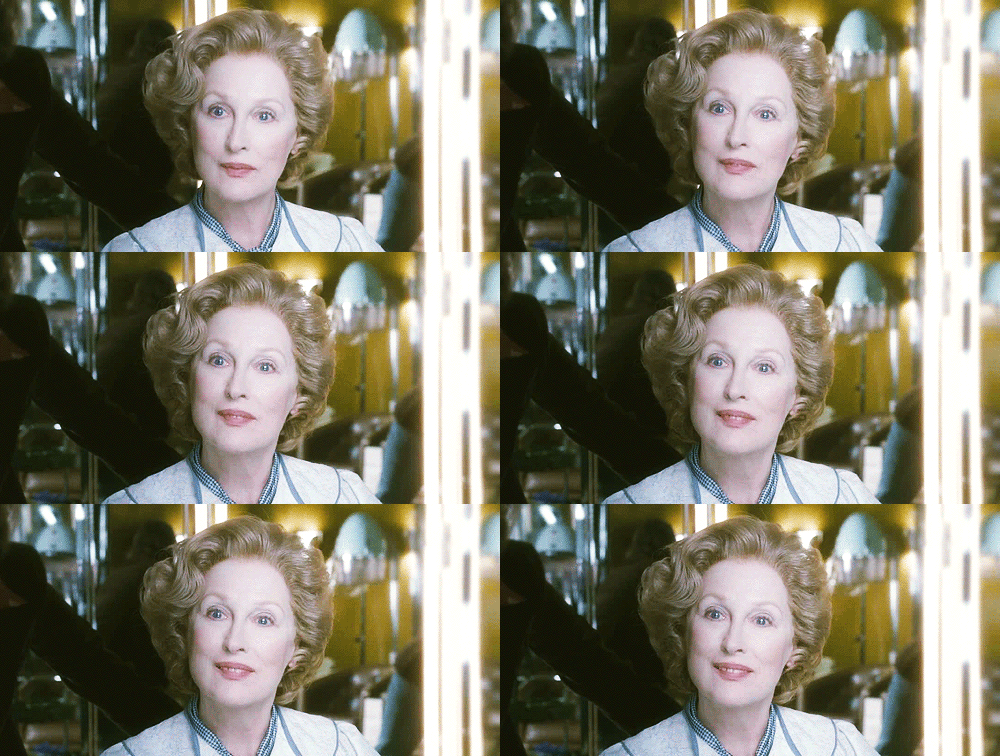
Not only was the film a slog, but it was about Margaret Thatcher...a woman who, on the day of her death, got RAKED OVER THE COALS by former actress turned Parliament member Glenda Jackson (who we will be seeing on this list) for her heinous politics and reign as PM.
One might think that speaking so ill of the dead on the day they died might be a bit cruel, but if there was ever someone who belonged on that list, Thatcher certainly deserves such a vile status.
I don't necessarily think Streep was horrible in the film. If there was ever an actress who has had a pretty solid track record in performance quality, Streep is a legend for a reason.
She can be a bit more mannered and calculated in performances, which this is clearly one of those. I feel like her scenes as the elderly Thatcher might be her best work in the film...even if the idea of us watching an elderly Thatcher wither away with her dying husband and making us feel sympathy for her is something makes me want to throw a sofa at the screen.
This was the year that Viola Davis came very close to becoming the second actress of color to win a Lead Oscar as her narrative heated up following her SAG win. This isn't to say that I necessarily would've voted for her, but she was certainly a better choice than Streep...even if The Help was a very problematic film in its own right.
2011 was a year in which we had so many stellar Lead Actress performances and yet the season seemed to veer towards the lesser side of that list. Aside from Rooney Mara, other contenders I wish had made a dent in this race would've been:
Tilda Swinton, We Need to Talk About Kevin
Elizabeth Olsen, Martha Marcy May Marlene
Kirsten Dunst, Melancholia
Olivia Colman, Tyrannosaur
Charlize Theron, Young Adult
_________________________________
#81 - Kate Winslet, The Reader (2008)

The Reader was a highly acclaimed novel, but the results onscreen were uneven and mostly forgettable as the film progressed.
As a concept (SPOILERS), the idea of an illiterate Nazi sympathizer and concentration camp guard seducing minors as a means to earn their trust so they will read to her is oddly intriguing but clearly problematic. As the film's presentation suggests, it dangerously flirts with them trying to make us sympathize with a Nazi and a pedophile while acting as something close to Holocaust Revisionism.
The nature of the role doesn't exactly due much to give Winslet to chew on, whereas her performance in that year's Revolutionary Road in which she got the act opposite her Titanic co-stars Leonardo DiCaprio and Kathy Bates gave her a role that might've seemed far simpler on paper, but it felt a lot more real and the vitality she gave the role was easily some of the best in her entire career.
As for her fellow nominees, I actually think Anne Hathaway did truly lovely work in the rather bleak Rachel Getting Married and this would've been a great opportunity to give her an Oscar out of the lineup given.
Some snubbed contenders I would've loved to see make it onto this list were Kristen Scott Thomas in I've Loved You So Long and Sally Hawkins in Happy-Go-Lucky.
_________________________________
#80 - Luise Rainer, The Great Ziegfeld (1936)

I may be ranking her pretty low, which is mainly due to the fact that the performance doesn't have much meat on the bone, and it is clear that her win was heavily orchestrated by Louis B. Meyer, but Rainer's performance in this has one standout moment that a lot of film historians call the first true example of an "Oscar scene".
Even if you may not be familiar with the term, you can probably assume that an Oscar scene means that within just a couple of minutes of screentime, you may give the kind of performance that truly cinches you an Oscar win.
For Rainer, there is one scene in The Great Ziegfeld which stands out as such.
This is a 3-hour film, and she is easily has supporting screentime in the narrative. Rainer plays Anna Held, the eventual ex-wife of the legendary Broadway impresario Florenz Ziegfeld...who eventually marries actress Billie Burke, who most remember nowadays as being Glinda in The Wizard of Oz.
Later in the film, Anna learns of Flo's marriage to Burke, and she calls to congratulate him. While speaking to him over the phone, she speaks of happiness to his marriage and also her upcoming projects while we see tears streaming down her face.
While the performance style is certainly of its time and does seem very theatrical by today's standards, there is something so captivating about watching her in this scene.
It isn't enough to rank her higher, but it is quite the lovely moment. Had she been in Supporting, she would likely have a bit of a loftier rating.
_________________________________
#79 - Hilary Swank, Million Dollar Baby (2004)

And her career still didn't really take off after the 2nd either.
It isn't that Swank is without talent (spoiler alert: her first win is going to be a lot higher on this ranking), but I didn't get the praise for Million Dollar Baby then and especially not now.
And once again, it isn't that Swank is bad in this. I just think the nature of the role (her being a female boxer) and her eventual fate did more to help her than the quality of her performance.
Meanwhile - you had Kate Winslet, who was still Oscarless at that point, in this category for her quirky and effervescent performance as Clementine in Eternal Sunshine of the Spotless Mind which would've been a perfect first win for her.
I have already written a lot about other actresses and their work thus far and yet I can find myself to drum up a lot of passion talking about Swank...which is about as a good a suggestion to show how indifferent I am about her performance and the film.
__________________________________
#78 - Ginger Rogers, Kitty Foyle (1940)

As delightful as watching Fred Astaire onscreen truly is to do, there is so much fire and charisma to Ginger Rogers whenever she appears. Not only was she one of the finest dancers in cinema history, but her comedic skills were on point.
It makes sense that seeing her take on a dramatic role in Kitty Foyle must've been quite the 180 that audiences weren't expecting, and she does solid work in the film...although I would argue that the melodramatic sensibilities of 1940s Hollywood does rear its head here.
I think this win certainly played into the narrative of seeing an actress spread her wings, and the unfortunate fact in this case is that many voters at the time expressed that they voted for Rogers more as a vote for her character as a person as opposed to Katharine Hepburn, who had made something of a comeback with her truly dynamic performance in The Philadelphia Story.
Not to mention, this category contained Joan Fontaine in Rebecca and Bette Davis in The Letter. Personally, I do think Fontaine or Hepburn should've taken this one in the end.
Rogers' win was solid, but I do think even based on its own merits, it was not worthy to win an Oscar.
_________________________________
#77 - Sally Field, Places in the Heart (1984)

On the same trajectory as Hilary Swank, Field came back 5 years later to win her 2nd Oscar...although it is clear that Field has had more of a career and legend about her by comparison.
Field seemingly benefitted from a race that didn't exactly have a strong frontrunner leading into the final days of the award season, so once Field took the Globe and having her film be a Best Picture nominee on top of it, it felt as though this win just felt into her lap.
The performance is solid as is the film, but it doesn't feel truly remarkable. Perhaps what is even more interesting is that 1984 was the year of the Farm movie in Best Actress with not only Field but also Jessica Lange in Country and Sissy Spacek in The River.
I would argue Field was in the stronger film, but that Lange maybe gave my favorite performance of the trio...and yet, I don't have a passionate favorite amongst the five nominees that year. I almost wish they just bumped the Supporting Actress winner Peggy Ashcroft up to Lead as she had been straddling both categories all season. That would've opened up the Supporting race, but my personal choice in that instance wasn't even nominated: Nastassja Kinski in Paris, Texas.
___________________________________
#76 - Katharine Hepburn, Guess Who's Coming to Dinner? (1967)

That sentimentality was due to Hepburn mourning the loss of her frequent co-star and off-screen lover Spencer Tracy, with whom she shared the screen in this particular film. Tracy died only 10 days after filming his final scene and it left the normally fiercely independent Hepburn rather distraught.
The subject matter of the film was particularly prescient for that time: a white woman seeking to marry a black man only months before the Loving v. Supreme Court case.
Hepburn's work as the mother who does realize that her daughter is doing nothing wrong is quite solid, but perhaps her most beautiful moment in the film occurs at the end in which she plays a quiet but pivotal role in Tracy's magnificent monologue in which he comes around to supporting his daughter's engagement.
It was already known at the time that his health was in a dire place, so with that in mind, it is no shock that the tear-streamed face of Hepburn listening to Tracy is her thinking about their life together. Even one particular line in which Tracy references living to the age of 110 makes Hepburn almost wince as she knows his death is nearing.
I do think my personal vote in this category would go to Dame Edith Evans for The Whisperers, but you also have Anne Bancroft's legendary work as Mrs. Robinson in The Graduate, although that performance also straddles the Lead/Supporting line.
___________________________________
#75 - Glenda Jackson, A Touch of Class (1973)

The 1973 Best Actress race was a bit of a free-for-all. It seemed as though most pundits felt any of the nominees could win...except for Glenda Jackson.
Marsha Mason and Ellen Burstyn seemed to have the most momentum, while Barbra Streisand seemed to be the populist fave. Joanne Woodward, along with Jackson, already had an Oscar.
Jackson's performance was seen as something of a departure from the other nominees. While the other performances came from various forms of drama (which is normally what the Oscars go for rather frequently), Jackson came from a rather cynical romantic comedy and it was not only a departure from the contenders, but a departure for her.
There have been similar instances throughout the years of performances winning in close races that seemed to benefit from being a lot different from their peers (i.e. Marisa Tomei winning for My Cousin Vinny over 4 dramatic actress from either the UK or Australia), so it doesn't really shock me here per se.
Although, I do feel a bit mixed on the win. I think Jackson does a fine job but it isn't her strongest work. I feel like Burstyn could've taken this one, freeing up her slot from where she won the following year.
_________________________________
#74 - Jennifer Jones, The Song of Bernadette (1943)

While Song of Bernadette might be her best work, it is also not anything particularly strong.
This is also another case of a film that is simply too overlong, and it also gets docked points for being essentially religious propaganda.
Jones might be the best thing about it, but she is also overshadowed at times by Vincent Price as the prosecutor.
In the end, I am not overly passionate about any of the nominees from that year so I will just let this one slide.
____________________________________
#73 - Jane Wyman, Johnny Belinda (1948)

What really helps the film is the performance by Jane Wyman, who gives a very heartfelt performance as a deaf-mute woman who was raped.
I think for its time; the film does come across a lot better than it could have and I think some of that is a testament to Wyman.
However, I think that the performances by Olivia de Havilland (The Snake Pit) and Irene Dunne (I Remember Mama) would've been more worthy of an Oscar.
Jane Wyman also got a second award of sorts around this same time because she got a divorce from Ronald Reagan. I would say great success, but still though, Wyman was a Republican and supposedly very homophobic, so in that case, she can go suck a lemon.
_________________________________
#72 - Jane Fonda, Coming Home (1978)

When she is good, she is GREAT.
It isn't that she is bad, per se. She just tends to not always be as emotive, and it gives a lifeless feel to some of her performances. I could sort of compare it to some of the same issues I have with Scarlett Johannsen, who often divides people with her acting.
In the case of Coming Home, Fonda was in the early stages of her comeback after spending a few years in relative obscurity and scorn after her visit to Hanoi.
*Side note: I adore Jane Fonda and her activism. No judgement or hatred here*
This was also one of the first major films (along with that year's Best Picture winner The Deer Hunter) to have a Vietnam-centric theme in which Fonda plays Sally Hyde, a conservative nurse who ends up developing a romantic interest in Luke (Jon Voight), an angry and frustrated vet who was left a paraplegic, while her husband Bob (Bruce Dern) is still deployed.
A lot of the issues with this film due stem from it being rather melodramatic and an example of Hal Ashby's sort of erratic abilities as a director.
I also did not find myself as invested in this love triangle, as I couldn't garner much sympathy for Dern's character, nor did I really find Voight to be that appealing either.
Fonda does sell it the best, but she just isn't quite there. I feel like the movie is nowhere near as radical as wants to be presented as.
Fonda also won over two truly magnificent performances:
Jill Clayburgh in An Unmarried Woman is one of the finest performances of the 70s. Vibrant, raw...actually I will let the film's tagline take it from here: "she laughs, she cries, she feels angry, she feels lonely, she feels guilty..." It goes on and on. It is one of the best performances to truly run the gamut of emotions.
Then you have Ingrid Bergman in Autumn Sonata, a truly sterling performance that was actually the finest of her career...but considering she already had 3 Oscars and the Academy was still very stringent about honoring performances and films in a foreign language, she didn't seem to have much of a chance.
__________________________________
#71 - Halle Berry, Monster's Ball (2001)

Now let's watch them have one of the worst sex scenes ever filmed...
Halle Berry stunned everyone with her lovely performance in Introducing Dorothy Dandridge just a couple years prior to her work in Monster's Ball.
She has talent...and yet, after this Oscar win, she has struggled for 20 years. She finally had a bit of a comeback with her directorial debut Bruised, but despite a solid acting/directing job, the movie was mostly subpar.
I think Berry does as good as she can in a film this low brow...but it does just come off as a bit cringeworthy at times.
I am not really happy with any of the Best Actress nominees that year honestly.
The fact they snubbed Naomi Watts for her dual role (in a sense) in Mulholland Drive is simply criminal. In terms of a breakthrough performance, what Naomi Watts achieved in Mulholland Drive is nothing short of astounding. There would be a lot to praise but I just think about that amazing audition scene. We see her rehearse it before with Laura Harring's character Rita and it feels very forced and typical...only for it to become something else entirely in the room, and it is glorious. Also, other snubs included Tilda Swinton in The Deep End and Nicole Kidman for her work in The Others...but she was nominated for Moulin Rouge instead.
Even though she wasn't technically eligible until the following year, Isabelle Huppert's work in The Piano Teacher is among the finest of her career.
__________________________________

Revisiting this list, I found myself realizing that some of these performances are truly interchangeable. When I did this ranking the first time, I found myself not necessarily hating some of these performances but rather just considering them be objectively not Oscar worthy. I do stand by that statement overall.
Selecting Pickford as my least favorite is clearly the easiest option and I know that is a pretty common consensus among those who follow these types of things...and yes, I am well aware that it is a niche group.
As of right now, I do have the full ranking drafted out, but I am sure as I begin writing about the actresses one by one, I may shift some of them around.
Next up, I will be ranking #70-41. This will be followed by:
and
My goal will be to keep adding each year to these posts, and perhaps even shift some of them around if I feel like it. I suppose you could say I want this to be as close to a living and breathing thing that a blog could be...same with when I re-tackle the Best Picture and Best Supporting Actress races. I do still want to do Actor and Supporting Actor, but there are quite a few performances from each category during the first roughly 25 years of the ceremony that I only saw once and never did again, so I don't feel as confident ranking those.
Stay tuned for the next volume!

.jpg)
.jpg)
.jpg)
.jpg)


