Welcome back to the Best Supporting Actress Ranking Extravaganza...I am sure you are all positively giddy to be here. Nothing like objectively ranking performances and facing comments like "You ranked Mira Sorvino THAT HIGH?!" but honestly, I welcome hearing about other people's opinions!
While maybe not as severe as the struggle I had with ranking and discussing a lot of the Best Actress winners at this point in the series, I did find myself having a similar response when putting my thoughts down for this batch.
With the upcoming performances, I still see a lot of the same issues (though not as negative) that I did with many of the winners in the first volume. I would say the biggest positive we get with many of these winners are that a lot of them have good or even very strong qualities in their work...it is just they also suffer from having portions of their performances containing bad choices/direction or weak characters/scripts and they either do all they can with what they are given or not enough.
I just think that last statement, "not enough", is more or less objective. I also know that a lot of times that many of the winners won an Oscar for reasons that didn't strictly just involve their performance. It is far too political to ignore such a thing.
With that in mind, let's dive in.
=================
#68 - Octavia Spencer, The Help (2011)
There was a narrative that made this win by Octavia Spencer so exhilarating at the time was that it was that it was a character actress who had been working and struggling for so long FINALLY getting her due.
What does sort of dampen it is that she plays a maid, and the movie just so happens to beThe Help...sigh...
Spencer's co-star Viola Davis got bumped to the Lead Actress race even though she herself was borderline supporting...and that path cleared up a victory for Spencer even though her great co-star Jessica Chastain was also in the mix (and had a huge splash in a few films that year).
Davis had the performance, but I am not so sure that I really even remember much about Spencer in the film aside from the infamous pie scene.
If there is anything I do love about this win, it is that it has allowed her career to blossom, and she has since received multiple Oscar nominations...though shockingly not for a performance that was better than all of her nominated performances: Luce.
__________________________________
#67 - Jennifer Connelly, A Beautiful Mind (2001)
After being one of the best highlights in Requiem for a Dream, Jennifer Connelly came back the following year and got lots of attention for a stereotypical Supporting Actress role: the long-suffering but supportive wife.
I am not the biggest fan of A Beautiful Mind and wish that the script had a rewrite and that it had a different director other than Ron Howard.
In a similar vein to that of Geena Davis in The Accidental Tourist, you come into this movie knowing that Connelly's Alicia will become an important and crucial fixture in John Nash's life. However, the character we meet feels so lifeless and droll. Connelly often seems to whisper her lines in such a way that it did remind me of the surprisingly lethargic energy that Davis had in her winning performance.
However, something does click once the trauma of John Nash's illness come into play. When this happens, Connelly comes to life and thankfully this portion of the performance does feel like something that would be worthy of Oscar recognition. Her anguish, her terror, her love all seem believable and you finally can see why someone might love this performance.
It is just a shame that the first half of it affects her so negatively.
____________________________________
#66 - Jennifer Hudson, Dreamgirls (2006)
When they called Jennifer Hudson's name on Oscar night, it was a foregone conclusion. The gal who got voted off American Idol a lot earlier than many expected managed to have the last laugh.
When a film adaptation of the beloved 1981 Broadway musical Dreamgirls was first announced, many who knew it felt that whoever would play the role of Effie White would probably win the Oscar.
And they truly needed someone who could do this role justice...like, imagine if they watered down the role of Effie like they did for Madonna when she played Eva Peron?
Jennifer Hudson can sing the Effie track...there is no denying that.
I am just not sure she nailed the acting. This was another case where I feel like we have a performer who just didn't really give the role the emotional depth it needed...and sure, Hudson was able to sell the songs, but I still don't think she excelled when just strictly acting.
At best, she was maybe a little above average at getting the point across. Not a disaster by any means but just sort of a lot of brass with not much weight.
__________________________________
#65 - Donna Reed, From Here to Eternity (1953)
Now we have Donna Reed, the epitome of what many consider the template of a classic 50s sitcom housewife...and she is a playing (even if the censors wouldn't allow it to be said) "a hooker with a heart of gold".
We see this character trope time and time again, and you certainly don't expect to see an actress like Donna Reed in such a role...and it isn't the last time we will see it here. In fact, we will see another "hooker with a heart of gold" trope in this very volume.
Reed is an interesting case here because she isn't exactly the biggest standout in From Here to Eternity, nor do I feel like her role is that compelling.
I do think she is able to take some of her more wholesome attributes as a person/performer and imbue the role with a rather surprising warm touch.
Hence the whole "heart of gold" comment.
I just think that in the grand scheme, Reed does come off as a little unnatural in this performance; that it feels a little calculated and over-rehearsed.
________________________________
#64 - Jo Van Fleet, East of Eden (1956)
Van Fleet falls into a similar trap as 1952 winner Gloria Grahame in that she made an impression in 3 films of 1955, but I would argue she won for a lesser performance in the grand scheme.
I feel like Kate is one of those characters that seems juicy on paper as woman who leaves her family behinds to open a brothel...you know, the typical Steinbeck fare...but she is a character that does feel shrouded in some mystery and because of that distance, I feel like it is hard to connect with the character in any way.
I think Van Fleet manages to give a performance that feels very lived in, and I do feel she has great chemistry with James Dean...but what she also suffers from are moments where she almost seems to try too hard to find moments of flourish; this could be even something as simple as how she chooses to move her head and look at another character.
Add Jo Van Fleet to the list of actresses who were worthy to win an Oscar but perhaps maybe won for the wrong role.
_______________________________
#63 - Angelina Jolie, Girl Interrupted (2000)
I actually ranked Angelina Jolie a lot lower in my previous ranking, but decided to give her a boost because she does do well with the kind of abrasive material she was given.
The career trajectory of Angelina Jolie has been an interesting one to follow, and I did think her take on Maria Callas in Pablo Larrain's Maria was beautifully done in 2024. Jolie is not a bad actress, and you can clearly tell that in her performance...and prior to this, Jolie had made a splash in two TV movies where she stole the show: George Wallace andGia.
I do think a lot of the performance suffers from being very surface level, but the commitment to it was what gave me the choice to put her above some of the people I have already ranked.
As for Jolie's competition, I have to say this is a case where I tend to like so many of the other contenders more like Toni Collette in The Sixth Sense, Chloe Sevigny in Boys Don't Cry, Catherine Keener in Being John Malkovich, or the snubbed Cameron Diaz in Being John Malkovich.
________________________________
#62 - Dorothy Malone, Written on the Wind (1957)
When one enters 40s or 50s Hollywood cinema, it might be wise to be prepared for some melodramatic films and/or performances that could be considered pulpy/soapy. Dorothy Malone falls under the "soapy melodrama" category...and a movie like Written on the Wind is a prime example of why I often struggle with Hollywood films of this era.
I do have a certain admiration for the films of Douglas Sirk, but I can't say that I always love his films in the way that I do the films of the big-name directors of that era like Alfred Hitchcock or international filmmakers like Bergman, Kurosawa, etc... Within the confines of the film, Dorothy Malone gives exactly the kind of performance that the film needs. When you are playing a nymphomaniac who is constantly stepping out on their husband, chances are it is going to be played with abandon if you're in a soapy Sirk film.
I just find myself taking a campy enjoyment in Malone, but I also find that a lot her choices don't exactly translate well to the screen. She is just too broad, but that was also a style for the time.
In some ways, she reminds me a lot of Susan Hayward, but even Hayward was able to find some intricate layers from time to time in her melodramatic roles.
I recall one online blogger referring to Malone in this film as an ultimate example of "so bad, it's good"...and even if that could be legit, I am still not sure I would give an Oscar to such a performance.
_____________________________
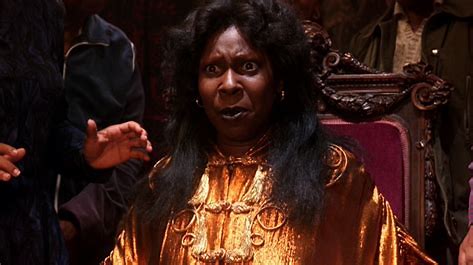
#61 - Whoopi Goldberg, Ghost (1990)
Here is a truly insane fact to put some things into perspective: when Whoopi Goldberg won the Oscar for Ghost, she became only the SECOND Black woman to win an acting Oscar. The male stat wasn't much better in that just the year prior, Denzel Washington became the second Black man to win in Best Supporting Actor for Glory following Louis Gossett Jr for An Officer & a Gentleman and the Lead win by Sidney Poitier for Lillies of the Field.
I don't think Goldberg winning for Ghost is a horrible win, but I do feel like she had competition that simply had better and meatier material.
The sad truth is that Goldberg probably should've won for her magnificent debut in The Color Purple five years prior...and if that had happened, she would've become the first woman of color to win a Lead Actress Oscar.
The thing about Ghost is that I do consider it to be an entertaining film, but I do get the sense that its surge towards the Oscars was more due to its high visibility and Box Office numbers....which managed to knock out far more viable potential nominees like The Grifters and Reversal of Fortune.
I still think the fact it even won Best Original Screenplay is truly one of the most hilarious wins in Oscar history.
Goldberg manages to be the person who steals the movie, and it did feel great for her to have this moment, but it just felt like the role simply wasn't a stretch for her. She was great comic relief but it just didn't feel like an Oscar winning performance.
Of the nominees, I wish we could've seen a win for either Annette Bening in The Grifters or Lorraine Bracco in Goodfellas.
________________________________
#60 - Mira Sorvino, Mighty Aphrodite (1995)
Woody Allen's films have managed to net 4 wins in the Best Supporting Actress category: two for Dianne Wiest, one for Penelope Cruz, and one for Mira Sorvino.
I have a lot of feelings about this win, because one hand, I do love the Academy choosing to reward a comedic performance that tread the line of being too much, but I still don't know if she was my favorite of the competition that year.
These days, a lot of the reason we've learned that Mira Sorvino never took off in such a manner after her Oscar win is due to the fact that her career was frequently sabotaged by Harvey Weinstein.
I find that Sorvino is actually a great actress, and I think she deserves a lot more attention and better roles. Sorvino is another contender who fell under the "hooker with a heart of gold" trope...and I have to say that she does entertain with it.
I also think she mostly suffers from her script, because even Woody Allen seemed to TRY to not demean this character, I feel like the subtext shines through that we basically laugh at this woman with her airhead demeanor, her squeaky voice that came from the same school of timbre as Vivian Blaine or Judy Holliday, and how she is so blatantly willing to talk about her porno career.
I think Sorvino actually does manage to overcome this by giving her a sense of dignity, even when Allen has her scripted to talk about extremely sexually explicit acts she would have to do for her porn work.
So in some ways, I do commend Sorvino for what she was able to bring to the role...but sadly it was the role as written I had issues with.
I do want to give a shout-out to one of her fellow nominees. Joan Allen made a wonderful impression as Pat Nixon in Nixon...and as fascinating a man as Richard Nixon was, I think the hold that his wife had over him was one of the more compelling aspects...especially since she had little patience for the game compared to someone like, say, Nancy Reagan would.
_____________________________
#59 - Wendy Hiller, Separate Tables (1958)
This is a performance that managed to win over a weak field of nominees, but I think what is truly remarkable about that fact is how it isn't normally the kind of performance that wins awards.
Subtle performances have obviously won Oscars, but this is one of those performances where I actually have to commend the voters for noticing that there was something...well...THERE.
Hiller is such a stoic presence and is able to enhance what could be considered a thankless role with a lot of efficiency and dignity.
I am not even sure I have as much to say about this performance...and admittedly, it has been a while since I have seen it. I do think that Hiller's performance style was very refreshing for its time as it was an era that was dominated by the likes of more melodramatic and flashy efforts.
_______________________________________
#58 - Zoe Saldana, Emilia Perez (2024)
Sigh, okay...
If you followed my posts about the 2024/25 Award Season or read my review of Emilia Perez, you will know that I was, and still remain, an iron-clad member of the "I HATE THIS MOVIE" club.
Among this group, I shared the common opinion despite my absolute hatred of the film, I felt that Zoe Saldana was far and away the best thing about it.
Did she deserve to win the Oscar? Not at all. Strictly basing it on the performance, I can't say she did anything bad, but the material is so bad that is bogs her down way too much. I also think she had the unfair advantage of being category frauded into Supporting when she was arguably the film's lead, even having a few minutes more of screentime compared to the titular role played by Karla Sofia Gascon, who got nominated in Best Actress.
A role like this truly shows Saldana has what it takes to deliver a performance that is awards caliber, but I just wish she were in a much better vehicle.
To be fair, her most buzzed about competition was Ariana Grande, who surprised everyone with her take on the iconic role of Glinda in Wicked. Even in that case, I would argue she was a category fraud as well. In what world is having Saldana and Grande competing next to Isabella Rossellini in a 7-minute-long performance somehow appropriate.
Even though I took issue with The Brutalist, ironically enough more so in the second half when she actually becomes a focal point, I was very taken with Felicity Jones. I was never really the biggest fan of her as an actress prior to this role but she really impressed me.
____________________________________
#57 - Goldie Hawn, Cactus Flower (1969)
I have often heard this being considered one of the worst wins in Oscar history, and I do have to disagree. I think that aside from the fact that she is essentially a co-lead in the film, the only real struggle with Hahn's Toni is that the role is very one-note until the end when she discovers the secret that her lover lied to her about being married in order to try to prevent her from wanting the same thing from him.
A lot of the ditsy qualities of this role played into the "dumb blonde" trope that Hahn was frequently lampooning on the TV show Laugh In...so it doesn't feel like a stretch for her.
Still though, she does a good job with the material. I just don't know if she was my first choice for the award, but I certainly don't begrudge the selection.
One of her fellow nominees was Catherine Burns in Last Summer, a film that is not widely known or able to be seen that frequently.
__________________________________
#56 - Penelope Cruz, Vicky Christina Barcelona (2008)
I alluded to Cruz's win earlier when discussing Mira Sorvino, and now, it is time to discuss how I feel about the performance directly.
I still remember the buzz that Vicky Christina Barcelona got when it came out. There was certainly a sense that Woody Allen struck gold...or maybe silver would be a better term here...actually maybe bronze.
I have always been of the belief that Woody Allen has not made a truly great film since 1989's Crimes Misdemeanors...and sure, he has made some okay-to-good films in the years since but even some of those good films have issues.
I would say Vicky Christina Barcelona falls under the "good" category from a basic entertainment standpoint, but it is also a film that is very lazy. The random narrator trope it has feels so unnecessary and intrusive, but as characters, they all feel very superficial and not particularly people we want to invest time in.
I do think Penelope Cruz, along with Rebecca Hall, are the two to make the most of their roles. Cruz started off her career in the US as being mocked for not being that great of an actress. It wasn't until many saw her in Pedro Almodovar's Volver that some were like "Okay, she is actually good".
Cruz IS good...and she did a good job here, but it really feels like a role that falls under "all flash, no real substance".
Of the actual nominees, Viola Davis made such a powerful impression with her brief screentime in Doubt while Marisa Tomei proved that she is still a better actress than many give her credit for in The Wrestler.
________________________________
#55 - Eileen Heckart, Butterflies are Free (1972)
When I think of Eileen Heckert, I think of her rather bombastic performance in the truly campy and wince-worthy film adaptation of the play The Bad Seed.
Heckert came from the theater world. In fact, she originated this role on the stage, but lost the Tony to her young co-star Blythe Danner (who was replaced in the film by Goldie Hawn).
Heckert winning seemed like a mild upset, but I suppose some weren't eager to give Shelley Winters a THIRD Supporting Actress Oscar for her memorable performance in, perhaps, the best of the cheesy 70s Disaster films, The Poseidon Adventure.
*Sidenote: How on earth did Airport and The Towering Inferno get lucky with Best Picture nominations while The Poseidon Adventure got snubbed despite being far better than either of those? Every year is just different I guess*
Anyway, Heckert gets to play the doting mother to Edward Albert's Donnie, a blind man.
Considering the fact he is blind, Heckert's Florence seems very unwilling to accept that maybe he is able to function as an adult without her doting guidance...but is still in a way where we don't necessarily see her as a villain; she is simply a mother figure who loves her son, but will need to just gradually learn that he is ready to truly have his independence.
Heckert does dominate the film and her dry wit is particularly used to great effect when she has scenes with Goldie Hawn, but I think the only real thing about Heckert that bothers me is that her film work still slightly suffers from not translating too well from the stage to the screen.
I feel like she could've been reigned in a little bit at times, but despite that, I think she was able to give a relatively middling film a lot of life and compassion and wit.
_______________________________
#54 - Anne Baxter, The Razor's Edge (1946)
Anne Baxter gets a lot of flak from some historians for fighting to be campaigned for Lead in All About Eve. Those same historians also think the vote-splitting led to Bette Davis losing what would've been her then record-breaking 3rd Oscar win for Lead.
Honestly, I don't think Baxter was strong enough inAll About Eve to be a threat...and frankly, I would've voted for Gloria Swanson inSunset Boulevard.
Baxter is another actress who falls into a similar category with Dorothy Malone and Susan Hayward; she is just very expressive and exaggerated...and often to her detriment.
I think The Razor's Edge gives her a chance to play to her strengths, but because the film itself is so weak, it doesn't help much.
I feel like as Sophie, she manages to shine and steal the entire movie, but it is just that erratic nature of the time period where I just can't get over some of the more melodramatic tendencies.
However, the scene in which she sees her old friends in a Parisian bar is perhaps enough to make me forgive her for some of the lesser moments in the film. That moment alone helped me boost her up a few slots.
_____________________________________
#53 - Rachel Weisz, The Constant Gardener (2005)
When this win originally happened, I was not a fan of it at all. This was even coming from someone who actually really liked The Constant Gardener and would've nominated it for Best Picture.
I felt this was a performance that was just...there. It just sat there and did what it needed to do and helped drive the plot and Ralph Fiennes' character.
Even if I still would've given the Oscar to Amy Adams in Junebug (a film I actually did not like but she was simply radiant in it), I can't help but acknowledge that there was a certain energy to Weisz in this film that has stayed with me in hindsight.
Although completely unrelated to her performance, I do want to address the idea that has been expressed online over the years that Weisz should've been nominated in Lead for this performance.
While she technically was the female lead of the film, I think she is totally Supporting. She only has about 25 minutes of screentime and most of that is within the first half of the film.
Then again, I suppose if Anthony Hopkins can be in Lead (and win) for The Silence of the Lambs or Lily Gladstone can be heavily campaigned in Lead for Killers of the Flower Moon, then the same could be said for Rachel Weisz.
I am still in the supporting camp, though...and I would say she deserved a nomination.
_________________________________
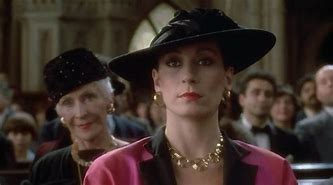
#52 - Anjelica Huston, Prizzi's Honor (1985)
This is an Oscar win I have actually sort of dimmed on a little bit.
I think everyone in my generation will always think of Anjelica Huston as Morticia Addams, but Huston is far more than that. I will take this opportunity now to recommend her work in Paul Mazursky's Enemies: A Love Story and especially in Stephen Frears' The Grifters.
As for her Oscar winning performance in Prizzi's Honor, she is easily the best thing about the movie and a great example of taking a character with relatively minimal screentime and making a meal out of it. She literally steals every scene she is in, and manages to practically erase Jack Nicholson (her former real life lover) off the screen. Perhaps the most memorable aspect of her performance is her delicious accent, which only adds to her appeal.
I don't consider ranking her here as necessarily a bad thing, but more a testament that she took a mostly nothing role and made it a lot more.
Having said that, I don't think a win for Oprah Winfrey in The Color Purple would've been unreasonable either.
_________________________________
#51 - Beatrice Straight, Network (1976)
I have talked a lot about performances that suffer do brevity in screen time, which often coincides with the role being underwritten. In the case of Beatrice Straight, I think we need to give credit where credit is due. And despite her performance's brevity, I will be giving it a little bit more of a discussion.
Ms. Straight holds the distinction of giving the shortest performance ever to win an Oscar: 5 minutes and 40 seconds. Within that brief screen time, she only has three scenes.
The second scene is inconsequential as we only see the back of her head and she speaks one line. The first scene is slightly more involved where we see her walking around the apartment searching for Howard Beale (Peter Finch) only to wake up her husband (William Holden) to tell him Howard left. While not much, this scene does manage to convey a certain warmth that makes her stand out...especially considering this has been a movie filled with a lot of sociopathic people up to this point.
It really all comes down to her third and final scene which is when Holden's Max confesses to Straight's Louise that he has been sleeping with Faye Dunaway's Diana and that he has fallen in love with her.
Keep in mind, this is a woman who has been married to this man for 25 years and she has been faithful and loyal to him...we've seen this kind of story many times both on film and in life. We also barely spend any time with her character in the film so why should we really care that much about her?
Well...Beatrice Straight makes us care. Or at least she made me care. And apparently, enough Academy voters as well.
While I am still not sure it is enough for me to think she necessarily deserved the Oscar, I still think this is a very prime example of how to truly make an impression with such a brief monologue. It also truly helps that the passion Straight shows make us far more sympathetic to her plight than the rest of the yahoos around her.
One final thing: when I talked about Faye Dunaway's Best Actress win for Network, I brought up the stage adaptation that was on Broadway written by Lee Hall and directed by Ivo Van Hove. When I saw this production, I remember wondering how (or if) they would do the big Louise monologue.
I can recall reading online how some TV broadcasts of the film actually cut the scene out for time which seems truly crazy if you were to watch the film knowing that Beatrice Straight won for it. In some ways, the scene isn't exactly essential, but it does shine a light on Max and how his actions within the chaotic world of the television are affecting those in reality.
I don't mean to be harsh, but in the stage version of Network, the actress playing Louise almost felt as if she was on the level of (to reference a lethargic performance from my last volume) Geena Davis in The Accidental Tourist. I am not saying every performer should copy what another does, but this was a prime example of how effective Beatrice Straight was able to make this brief appearance.
She gave it purpose, plain and simple.
And due to brevity of the great scene, I decided to include it here!
_______________________________
#50 - Jessica Lange, Tootsie (1982)
Lange went into Oscar night being considered pretty locked in to win Best Supporting Actress for Tootsie...and it seemed like a great way to acknowledge her as she was going to lose her Best Actress bid for Frances.
As a film, I actually have to admit that I love Tootsie...despite some of the aspects of it that have not aged well. I also think it contains one of the best performances of Dustin Hoffman's career and I do think he works extremely well with Lange in this.
For modern audiences who are used to seeing Lange portray characters who are often unhinged, it might be a bit of a surprise to see her in such a subdued role...and frankly, she does it very well.
After finishing work on Frances, her co-star Kim Stanley strongly encouraged her to tackle a comedy to counterbalance the intense dramatic work in their film.
Lange, however, isn't the funny part of Tootsie. Sure, she may get a line or two here and there that elicit a smile or slight chuckle, but Lange is essentially the straight man.
She does do well in not making her character seem like a fool for being fooled by Hoffman. Her final scene when he finally talks to her again as Michael and not Dorothy is mostly owned by Lange even though she barely speaks.
When she finally responds with "I miss Dorothy", you truly feel how sincere she is about that friendship...and that you might end up buying that she is willing to give Michael a chance since it WAS him.
It isn't a bad performance...I am just not sure it necessarily stood out even in her own film.
Lange was nominated against her co-star Teri Garr. While Garr's role was written for her, it still could've come off as relatively bland had it gone to someone else. Garr did wonders with Sandy and her brief snippets in the film are a prime example of a true Supporting performance that steals every second she is on screen.
This was also a stellar category if I was willing to rank Lange last of the five.
She was nominated against Glenn Close for her film debut in The World According to Garp, her Frances co-star Kim Stanley, Garr, and in another comic gem of a performance that I find truly delightful, Lesley Ann Warren in Victor/Victoria.
It is one of the best lineups this category ever had.
_______________________________
#49 - Fay Bainter, Jezebel (1938)
Jezebel was sort of seen as a film to give Bette Davis a chance to play a Southern Belle after having lost the chance to play Scarlett O'Hara in Gone with the Wind.
The gambit paid off as Davis managed to win her second Oscar in 3 years AND managed to squeak in a year before Gone with the Wind opened in theaters.
I can't say I like Jezebel more than Gone with the Wind, but I also find the latter to be immensely overrated...and to reiterate, I have always thought that even before the film managed to face more scrutiny.
I think Jezebel is a solid watch and I do think that Fay Bainter is a rather interesting aspect of the film...especially considering it is not that flashy of a role.
This is a movie that is truly all about Bette Davis, but in a true supporting role fashion, Bainter is there as her Aunt who never exactly steals the show from Davis, but still provides a rather compelling screen presence.
She isn't necessarily remarkable, but it is a good example of how sneakily effective a sterling supporting performance can be to a film.
_______________________________
#48 - Cate Blanchett, The Aviator (2004)
I think that my love of Blanchett might be slightly clouding my judgement here, because I might honestly consider ranking this performance a little lower.
In truth, The Aviator is a film I do like despite its bloated nature...but I have to admit that once Blanchett departs the film (aside from a small scene towards the end), it loses something.
Blanchett gets to play Katharine Hepburn, the current reigning champion of acting Oscar winners. Oscar voters always love a good impersonation/transformation...but I suppose what may hurt Blanchett here is that her take of Hepburn borders on caricature/cartoon rather than necessarily creating a real human being.
Having said that, she does have her great moments...particularly the scene where she leaves Howard. She does have wonderful chemistry with DiCaprio, who I still think gives one of his finest performances in this film and would've been a worthy winner.
Blanchett gives the film such a vibrant and entertaining edge for a lot of the first half, but I do wish more had been done to polish off more of the cartoonish edges.
Of the nominees, I think this should've gone to either Virginia Madsen in Sideways or Laura Linney in Kinsey.
_________________________________
#47 - Claire Trevor, Key Largo (1948)
With Claire Trevor, we get another example of an actress who took a role that is essentially thin and one-note and made as much out of it as they possibly could.
This is also another prime example of a supporting performance that somehow manages to be the best thing about the movie. Key Largo is a rather forgettable film and it is so weak that we somehow get the most lifeless and uninteresting performance out of Lauren Bacall.
Claire Trevor spends most of the movie just begging to have another drink and she essentially has no dignity...but considering how one-note the role is, Trevor does the absolute best she can with it. I actually originally had her ranked at #57 and then moved her up to #47.
There is just something about her in this role that I find to be impressive considering the limitations that are there. Maybe I will consider moving her a little higher in the future, but for her to get a 10-point jump is still nothing to scoff at.
_________________________________
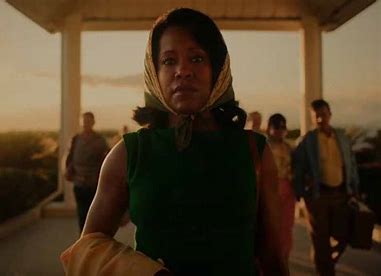
#46 - Regina King, If Beale Street Could Talk (2018)
The young girl who played Marla Gibbs' daughter on 227 does good!
In the last 25 years, Regina King has grown into being a truly wonderful actress, not to mention showing relatively good promise behind the camera when she directed One Night in Miami.
If Beale Street Could Talk, adapted from a James Baldwin novel, was Barry Jenkins' follow-up film to Moonlight and while it would've been hard for a lot of films to live up to a masterpiece like Moonlight, I do think he did a great job with this adaptation.
King plays Sharon Rivers, the mother to the film's protagonist Tish.
While King's screentime isn't much, and many have bemoaned that she doesn't do anything to warrant such recognition, I actually find her work here to be sterling and effective.
When Sharon goes to Puerto Rico to confront Victoria, the woman who is falsely accusing Tish's boyfriend Fonny of rape, King excels in this scene which is also incredibly infuriating due to blatant lie that Victoria is telling.
*Side note: Victoria is played by Emily Rios, who played the tragic Andrea on Breaking Bad. She does well playing such a despicable character here.
If Beale Street Could Talk is very bleak but oddly hopeful all at once...and I think that King's work in it might be minimal, but she is effective.
However, I still might've given my vote to Rachel Weisz for The Favourite in this case.
____________________________________
#45 - Anne Hathaway, Les Miserables (2012)
Even Anne Hathaway has admitted that this award season period was perhaps the most difficult time in her career as the internet seemed ready to pounce on her every opportunity that she appeared anywhere.
It does seem like that vitriol has since died down, but there certainly was a sense at the time that Hathaway was practically begging for an Oscar.
The moment the trailer came out for Les Miserables, people were like "Well there is your winner". In truth, the role of Fantine in the stage production isn't necessarily an awards magnet. Sure, it may have netted Patti LuPone a win at the Olivier Awards (which was also for her work in The Cradle Will Rock) but I grew up always thinking of the role of Eponine being the awards magnet.
I think what strongly benefitted Hathaway in this case was how the role was restructured. In the stage production, Fantine's big solo "I Dreamed a Dream" is placed right after she is ostracized from the factory...but in the movie, it occurs after she sells her hair and teeth and prostitutes herself, so the emotions are...well...understandably high at her bleakest moment.
I feel like this is one of those performances where I didn't exactly hate it or even hate the fact that she won...but I also find myself feeling that despite the intense emotion, something about it still feels so brash and very forced.
Nevertheless, she still comes off as a highlight to the movie, which I still consider to be rather horrid as a whole.
Hathaway should've been strongly considered for an Oscar for her lovely dramatic turn in Rachel Getting Married whereas in this race, I would've been inclined to vote for the still Oscar-less (as of this writing) Amy Adams for The Master.
_________________________________________
#44 - Mary Steenburgen, Melvin & Howard (1980)
The 1980 Award Season was all about domination within the acting categories.
Both Lead Actor and Actress had Robert DeNiro and Sissy Spacek sweeping through the whole season, while Mary Steenburgen had won every single Supporting Actress award except for the National Board of Review.
I feel like a lot of us these days tend to forget that Steenburgen is even an Oscar winner. It isn't that she is some obscure actress because she has popped up in so many movies and TV shows, but she has never really had another role that seemed to bring her anywhere close to Oscar glory again.
I do mostly support her win if only for the fact that her competition wasn't exactly the strongest. I do think in terms of the film she was in, Melvin & Howard is not as remembered or talked about today beyond if people happen to watch Oscar winning performances. While it didn't get a Best Picture nomination, it certainly seems like it was in the 6th slot with this win and its win in Best Original Screenplay. I know the film is based on a true story but there is such a disjointed and aloof quality to it that I found it often hard to connect to the film in any way.
I do think Steenburgen suffers a little from that and it does seem a little strange that she swept in such a capacity, but then again, her category was very weak.
________________________________
#43 - Allison Janney, I Tonya (2017)
I remember when The West Wing premiered and how it seemed like the entire country was in awe of Allison Janney and wondering where she had been.
And then she won 1,530 Emmys for it.
Janney has managed to sustain a solid career as a character actress, and it doesn't surprise me that Hollywood really took the opportunity to coronate her during that awards season.
As the irascible and bitter LaVona, the mother of Tonya Harding, Janney is certainly a force to be reckoned with. She dominates the first third of the movie and is truly indelible...especially when you factor in her pet parrot.
I think my only issue with the character/performance is that it relies so much on that irascible tone the whole time. She obviously does it extremely well and on its own terms, I do find it to be a very entertaining performance.
I think this is just one of those cases where I can't help but feel bummed out that there was another performance that year by an actress who is also mostly known for TV who played a bit of an irascible mother but got the chance to add layers to it: Laurie Metcalf in Ladybird.
This happens several times for me on these rankings, because I do really want to base these strictly on the performance within the confines of who actually won this category.
On that basis, I do think Janney did exactly what she needed to do...and it is a pretty solid win on its own. I just wasn't a GREAT win. It mostly just served a purpose of giving a truly beloved actress an Oscar to go with her house full of Emmys.
___________________________________
#42 - Alicia Vikander, The Danish Girl (2015)
Around the time of the ceremony in which Alicia Vikander won the Oscar, I was not actively following the Oscar scene. I had just moved to New York City about a year and a half before and with the chaos of that...plus just a sense that I was not overly as enamored with the movies of the time, I just felt disconnected from it all.
This is just one of those wins that I find fascinating if only for the fact that, as of 2025, it seems as if Vikander's win didn't actually translate into any kind of major career. Even that year's Best Actress winner Brie Larson was sort of affected by that...if you ignore the whole Marvel aspect, but whatever.
Vikander's work in The Danish Girl is certainly worthy of recognition and I think a lot of that has to do with what she was able to do with such weak and regressive material that seemed to not truly care much about the concept of someone coming out as transgender.
The film aged poorly rather quickly with the casting of Eddie Redmayne at the titular girl, but I do think Vikander was the only source of strong work in the film.
Having said that, this is a true category fraud selection. I think Vikander could've easily won this award for Ex Machina instead and I actually think it would've been a little more worthy.
She deserves better roles and a comeback.
__________________________________
#41 - Shirley Jones, Elmer Gantry (1960)
When discussing the Best Actress winners, I talked about how Sally Field defied the odds and managed to become a respected actress after having been known for her TV work on the frivolous sitcoms Gidget andThe Flying Nun.
Shirley Jones is, I think, a more precarious case.
Jones' career began almost as a fluke. She had no intentions of being a performer but a chance encounter with a pianist friend in NY got her an audition at an open casting call for Richard Rodgers. If you haven't heard the story, it is worth checking out.
This led to Jones getting to play two of the big female roles in the R&H canon for their film adaptations: Laurey in Oklahoma! and Julie in Carousel.
No one really viewed Jones as being a serious actress and she couldn't find work in more dramatic fare...so she turned to TV and managed to impress Burt Lancaster with her performance on a Playhouse 90 special called The Big Slide.
Lancaster was going to co-produce and star in the film adaptation of Sinclair Lewis' novel Elmer Gantry and felt Jones could pull off the small but pivotal role of Lulu Baines, a prostitute who has a steamy connection to the titular character that Lancaster would play.
Despite writer/director Richard Brooks originally having reservations about Jones for the part, Lancaster fought for her and Brooks later admitted that she was the right choice upon watching her first day's work, even calling her to tell her "I owe you an apology. Not only do I think you're going to be great in this part, but I also think you're going to win an Academy Award".
Many these days tend to forget that Jones is an Oscar winner because despite the clout of the win, she seems to be better remembered for being Shirley Partridge on The Partridge Family.
Film historians also seem to bemoan the fact she beat Janet Leigh for Psycho...but I have to admit that I think Jones does prove her worth as an actress here.
She may be a little too performative at times, but the scene in which she tries to con Gantry with photographers outside the window is actually very well done. This is a scene where we don't know what she is going to do because SHE doesn't know what she is going to do...and every moment, you see that doubt in her. She is trying to be sneaky and yet find herself still feeling complicated feelings of attraction towards this man.
Honestly, I would've liked to have seen more of this side of Shirley Jones as an actress.
________________________________
#40 - Katina Paxinou, For Whom the Bell Tolls (1943)
I can't really say I am a fan of For Whom the Bell Tolls...but yet again, Katina Paxinou gets the honor of joining the list of supporting actresses who are the best thing about their movie.
Paxinou gets to play Pilar, a very strong and masculine woman living in the mountains of Spain during a civil war.
As a character and actress, both Pilar and Paxinou seem so unique to the era in which they are currently in. This was the 1940s in Hollywood, when the idea of the perfect actress in terms of talent and looks would've been Ingrid Bergman who, coincidentally, happens to be in this very movie.
Paxinou's Pilar is a dynamic creation.
She is loud and domineering, but also very warm and loving and caring. This is a woman who says that she "would have made a good man" and is actually referred to by other men as someone who can "fight like a bull".
Perhaps one of her best moments in the film is her "ugly" monologue, where her vulnerability comes out with a dash of confidence still mixed in when she says:
"How it is to be ugly your whole life and to feel in here that you are beautiful".
It is a very intriguing and even refreshing performance that feels very different from most of the female performances of that era.
________________________________
THOUGHTS ON THE RANKING SO FAR:
As I stated before, this was another volume where I kind of struggled.
I think that despite some of the issues I had with these performances and even many of the films in which they were contained, I found myself finding better qualities in a lot of their work compared to some of the Best Actress winners.
The variety here just feels a lot more refreshing, but I still think the biggest problem is that a lot of the issues with these winners are mostly due to the nature of how their roles are written.
In the last volume, a lot of my complaints stemmed from the fact that so many of the actresses just didn't do enough with the material they were given.
Here, I found myself commended a lot of these actresses for doing more than what the roles may have given them on the page. It also doesn't hurt that so many of these actresses were actually the best aspect of their respective movies.
We still have two more volumes to go, but I will go ahead and say now that there will be a more positive shift in tone with a lot of these upcoming performances.
A lot of them would not have been my first choice for the win...or even would've been nominated. However, on their own terms, I find many of these to be commendable works. As we enter the top 40, it is going to become a little bit more of a bloodbath where I actually feel weird ranking some of the performances as low as I did.
Stay tuned for the next volume! As it goes with my blog, you may see the post tomorrow or a week from now or a month from now...
As was the case when I first did my Best Actress and Best Picture lists, I got a surge of readership when I posted my updated Best Actress lists recently.
Here is the link to access the first volume of my updated Best Actress ranking! You will be able to check out the additional volumes at the bottom of that post.
Supporting Actress is next on my journey, and I do find a lot of these winners...even some of the weaker ones...to be a bit more interesting than those that won in Lead.
Unlike Best Actress (and Best Actor), the two Supporting categories were not created until the 9th Academy Awards, but I think what makes Supporting more interesting is that this kind of acting category more frequently honors villainous roles or character actor types. They've also been easier for actors of color to win in and are more prone to allow performances from genre films to sneak in.
The true downside in the last two decades is that the Supporting categories have frequently become the place where the "co-leads" are demoted. If one co-star has slightly lesser screen time, you can almost tell which one will get the boot from Lead.
However, this does lead to some rather weird examples. Even though Cate Blanchett and Rooney Mara are both clearly lead in Carol, the latter got bumped to Supporting presumably because she was not as big a star as two-time winner Blanchett...and despite the fact she technically had more screen time than Blanchett.
So yes, I will be dealing with some category fraud when discussing some of these winners...but I am not really going to factor that into my selections in any negative way.
====================================
#89 - Gloria Grahame, The Bad & The Beautiful (1952)
Much like my Best Actress ranking, my choice for my least favorite Best Supporting Actress win remains the same. However, unlike Mary Pickford's performance, there is no denying that Gloria Grahame is perfectly fine in The Bad & The Beautiful...it's just...why?
Grahame only appears in about 9 minutes of the film, and yes, this is a Supporting category, and we will have far too many people who category frauded on this list. I certainly want to support actual supporting performances, but the difficulty with this is what is done with that time.
For example - Grahame is not the record holder for the shortest performance to win an Oscar. That person is also a fellow Supporting Actress winner, but if you happen to be reading this and aren't aware of who it is, I will keep it a surprise. It's sort of like recently with Isabella Rossellini in Conclave who was onscreen for roughly 7 minutes and while she made a good impression, I still don't know if it was truly enough for an Oscar nomination in the grand scheme.
Grahame's role in the film is the wife of a writer, who doesn't become a major focal point until an hour or so into the film. She comes in, plays his sort of doting and sort of unfulfilled wife, annoys him in a way that is admittedly endearing to the audience, but then she is gone.
I would say the only reason she won was due to the fact that 1952 was a banner year for Grahame in that she was featured in two other high-profile films: Sudden Fear which netted Joan Crawford a Best Actress nomination and that year's Best Picture The Greatest Show on Earth, and frankly...it almost would've made more sense to nominate her and give her the win for that film...not that it deserved more Oscar love however...
I think what makes this win truly sting more is that she beat out one of the most iconic comedic villains in cinema history. A performance that I find so indelible and delicious in its approach that it has to be on the Mount Rushmore of Oscar snubs: Jean Hagen, Singin' in the Rain.
The fact that Singin' in the Rain was mostly shoutout of many nominations that year was a true testament to how much the studio systems were willing to push other films for their own agenda as MGM head Louis B. Meyer lobbied for people to vote for their stuffy and overblown Ivanhoe adaptation for a nod instead.
When is the last time someone has actually watched that version of Ivanhoe? Is there a secret society of Ivanhoe fanatics I am not aware of?
But I digress...Grahame was clearly a wonderful actress, but I am not sure this was a role that truly stood out as being Oscar worthy.
_______________________________
#88 - Laura Dern, Marriage Story (2019)
I love that I live in a world where I can call Laura Dern an Oscar winner...but I also hate that it is for her performance in Marriage Story.
I am sure some of you have seen Christopher Guest's film For Your Consideration, which satirizes the concept of awards buzz in Hollywood and how it sets up expectations for certain films and performances that don't always pay off.
I feel like with Laura Dern, there was already a ton of goodwill building up for her after her dazzling turn as Renata Klein on HBO's Big Little Lies and that summer, industry insiders and online pundits were saying that Dern's role in Marriage Story could likely be an Oscar player, and she would get to deliver a strong monologue in one scene.
By the time award season rolled around, Dern swept all the major precursors and yet, when I watched the film, I couldn't help but be disappointed.
Dern plays a lawyer named Nora, who is hired by Scarlett Johannsen's character Nicole to represent her in her divorce from her husband Charlie (Adam Driver).
Nora is the kind of woman who knows what she has to offer and isn't afraid to use it to curry favor in the courtroom, but at the end of the day, this is a very shallow role where we never truly see much about her inner life. It is all VERY surface level and just feels like a bit of a retread of her Big Little Lies character.
Oh, and that "strong monologue"?
I actually didn't like it. I don't think Baumbach's writing of it was bad or anything, but I feel like the way Dern ended up delivering it felt too forced and disingenuous when it was supposed to be a key point where we see some semblance of this Nora's values.
As for her fellow nominees, I think Florence Pugh's work as Amy in Little Women was the clear choice for me personally...but this was also the year that Academy embraced Parasite and yet none of its ensemble got acting nods.
Cho Yeo-jeong, Park So-dam, Lee Jung-eun, and Jang Hye-jin were all arguably more worthy of a nomination. You also had the truly lovely Zhao Shuzhen in The Farwell, a film that got completely shut out of the Oscars that year despite the fact I thought it was easily one of my 5 favorite films from 2019.
_______________________________
#87 - Margaret Rutherford, The V.I.P.s (1963)
I almost debated putting Rutherford in last place, but what saved her was that her screen presence is just so commanding. What doesn't save her is that this is mostly just a 10-minute cameo spread out over a film in which she is supposed to provide a little comic relief and then some sentiment at the end. It also doesn't help that the film itself is mostly terrible and forgettable that she is actually overshadowed by a young Maggie Smith who would've made a far better winner.
1963 was actually a pretty dire year for Hollywood all around. If you look a lot of the nominees, so many of them don't stand the test of time. It makes me wish they had the wherewithal to nominate Fellini's 8 1/2 and then we would've had our first film to win that was international.
Even more bizarrely from that year was that they gave Hud a Best Director nomination and TWO acting wins, and it still got snubbed for Best Picture when it was clearly the strongest offering to come out of the Hollywood system that year.
Now I type this realizing I have barely even talked about Rutherford or her film, and that is actually a strong testament to how much of a thankless film and role it is. Most people remember Rutherford these days as been one of the few actresses to tackle the Agatha Christie character of Miss Marple...and it is clear she is an actress who can do quite a bit with anything (because the Brits are just better at acting...) and even if that means she makes the most of this role, it isn't enough to give her the top honor.
_______________________________
#86 - Ingrid Bergman, Murder on the Orient Express (1974)
When Ingrid Bergman stepped onto the stage to accept this prize, she mentioned "It's always nice to get an Oscar" which felt like a classy way of implying "Oh, this is happening to me for a THIRD time!".
However, it is the comments that Bergman would make about her fellow nominee Valentina Cortese that resonate with me more. Bergman knew what was up, and that was the fact that Cortese's performance in Day for Night (one of my favorite films of the 1970s, which is saying something) was easily the best performance in that category and should've won in a cakewalk.
As for Bergman herself, this is a case of yet another small performance in an ensemble film that benefits to having an actress behind it giving her role a little more oomph but...does that mean it warrants an Oscar?
The role of Greta is mostly confined to an interrogation scene where her own self-proclaimed "born backwards" personality is on full display. She is a woman who is still deeply affected by her past to the point where she is brought to tears when talking about her parents.
And yet...it just doesn't feel like it was much of a challenge or that she did enough that made me think this was the finest Supporting work of that year...even when simply judging it on its own standards.
_______________________________
#85 - Helen Hayes, Airport (1970)
We have now reached "The First Lady of the American Theatre".
So much of Hayes' legend is linked around the theatre that we simply cannot know about her performances beyond written accounts. Her film work is minimal in comparison, but it is clear that she was a performer who was adept at being a lead or a character actress, to say the very least.
Much like Margaret Rutherford, Helen Hayes is tasked at being the comic relief of Airport, the film that truly set off the Disaster film craze of the 1970s and that I frankly find to be a bit of a bloated piece of fluff.
There is a reason why I adore a film parody like Airplane! because it truly captures the lunacy of a film such as Airport. Melodrama can be richly entertaining, but I don't think that is something Airport ended up achieving.
Hayes plays Ada, an elderly woman who is a caught as a stowaway on a flight but despite being the film's comic relief, the scene that really stands out as the most memorable is when they use her to help stage a scene to try to get closer to a bomber who is on the flight.
The extremes of the scene, complete with the stewardess slapping Hayes for effect, work because Hayes sells it very well...but it is still not quite enough yet again. It just felt like a way to give a legend like Hayes a second Oscar nearly 40 years after her first.
I would've voted for Lee Grant in The Landlord, which I will bring up more when I discuss the role Lee Grant actually won for.
_________________________________
#84 - Renee Zellweger, Cold Mountain (2003)
It isn't very often that someone felt like they were the winner nearly a year before the ceremony actually occurred, but the moment that Renee Zellweger for Chicago lost to Nicole Kidman for The Hours seemed to start a floodgate that Zellweger just HAD to win for Cold Mountain.
No one really talks about Cold Mountain anymore, and for good reason. Prior to its release, it was seen as a bit of a hopeful Oscar contender as it was being helmed by the late Anthony Minghella who had won an Oscar for directing The English Patient.
Despite some nominations here and there from various precursors, Cold Mountain managed to get snubbed for a Best Picture nomination. I just think it is one of those stuffy and dull period pieces that people tend to think of when they think of the kinds of films that used to win Oscars.
Zellweger is, to continue a theme, supposed to be something of comic relief in this dreary film but it ends up coming across as way too brash and tonally out of place despite what the goal was supposed to be. She is supposed to be illiterate and uneducated but have a bit a common sense when it comes to dealing with the film's lead Ada, who just happened to be played by Nicole Kidman.
I actually do like Renee Zellweger and wish she would get more consistent opportunities from Hollywood, but it is a shame that her two Oscar wins are for performances that don't represent her finest work. I am not sure I would vote for her in any given year, but I DO really love her in the original Bridget Jones' Diary, and she was very fetching in Jerry Maguire.
As for who should've won, the answer is clear as day in my book: Shohreh Aghdashloo in House of Sand & Fog.
_______________________________
#83 - Melissa Leo, The Fighter (2011)
I wouldn't call Melissa Leo "comic relief" like I did Zellweger, but I will say what she shares with Zellweger is an overwhelming sense of brashness that is unrelenting.
You get what they are going for: a strong broad who is tough as nails and fits the Boston vibe to a tee...and it doesn't feel unique or original. Instead, it just feels one-note and over-the-top...which is to be expected considering this is an offering from one of my least favorite filmmakers of all time who seems to still make films that will get Oscar attention from time-to-time: David O'Russell.
Various film forums have commented on certain performances over the years where it seems as though you have to heavily emote in order to be close to Oscar glory. One such variation of this is destroying various items, such as plates, in a scene. I think this mostly began when Sissy Spacek broke a plate during her Best Actress nominated performance in In the Bedroom but here, Leo has a scene where she goes to town on some plates and all I can think during that kind of acting is "I am gunning for that Oscar!!"
The sad truth is that Melissa Leo is a wonderful actress, as evidenced by her Lead-nominated performance in 2008's Frozen River in which she gave such a heartfelt and beautifully subtle performance.
It is nice to see Leo with an Oscar, but this is a win that just makes me shudder a bit.
_______________________________
#82 - Mary Astor, The Great Lie (1941)
One thing you often hear about if you are trying to get into acting is "What is your type?". For every Bette Davis in the Golden Age of Hollywood who could pull off highly unsympathetic characters and still make audiences love them, you also had actresses who were more maternal and exuded great warmth. Some of the names that come to mind are actresses you will be seeing on this ranking like Anne Revere or even the 1942 Best Actress winner Greer Garson.
I would put Mary Astor in that same group. When I think of her, the first role that comes to mind due to it being the first thing I ever saw her in was 1949 adaptation of Little Women where she played Marmee opposite June Allyson's Jo.
However, when actors play against type, it can sometimes lead to glorious results. Despite Astor winning this, I don't consider this to be one of those times.
In The Great Lie, Astor plays Sandra, a highly respected concert pianist who also happens to be a temperamental diva. She was the former spouse of pilot Peter Van Allen (George Brent) who discovered that their marriage was invalid. Peter marries Maggie (Bette Davis) but soon after is suspected to have perished in a plane crash. Like clockwork, Sandra discovers she is pregnant with his child, and this leads Maggie to offer to raise it in exchange for financial assistance. Things take a turn when Sandra leaves for a world tour and then Peter turns up alive.
This is a film that is very melodramatic and pulpy, mainly elevated by the presence of Bette Davis and Mary Astor but that is only saying so much.
I talked about "types" earlier but the catch here is that Astor's role of the diva was not within her usual wheelhouse while Davis plays the more sympathetic and doting archetype.
Astor isn't exactly BAD in the role, but her diva antics do come across as a way too theatrical and melodramatic which in turn makes Davis, of all actresses, look almost dull by comparison as she is saddled in the kind of role that was honestly beneath her talents. The only reason she took the role was due to fan mail that encouraged her to try to take on "nice" female characters. She admitted later that the role didn't excite her and it felt too close to her in reality to devote much energy to it.
Astor does at least try, but I am not sure she convinced. Her quieter moments are a lot more compelling. The real solution here? They should've swapped out the films. Astor also happened to be in the legendary film noir The Maltese Falcon that same year...give her the win for that film instead!
______________________________
#81 - Geena Davis, The Accidental Tourist (1988)
When you look at the role of Muriel Pritchett on paper, it is clearly one that many actresses would gladly sink their teeth into. You have a character who is incredibly quirky/eccentric and who also gets to be the real reason our sad sack of a leading man gets pulled out of shell as he deals with a divorce and the death of his young son.
I could see Emma Stone excelling in a role like this if I were to use a more modern-day example.
Here's the problem though: The Accidental Tourist is one of the most bizarre film experiences in that it is so clearly supposed to be one thing and yet that doesn't translate onscreen.
Yes, this film does have the tragedy of William Hurt's character Macon dealing with his marriage ending when their 12-year-old son tragically dies, but it is also a romantic dramedy where an unlikely pairing ends up leading to a spark.
The Accidental Tourist is void of spark. It has a borderline lifeless energy at time as if director Lawrence Kasdan was like "Make this scene feel so real but as if you don't want to emote TOO much".
While we do get flashes here and there of energy, but is that a goal a film should aspire to have? It's not like Kasdan was making a film that was supposed to invoke the dreary philosophical nature of Ingmar Bergman...but those films had a different kind of energy.
Davis can act, but I almost feel like this win is for the idea of the character rather than how successful the character was portrayed. If I were to cast my vote for one of the other nominees that year, I likely would've given it to Michelle Pfieffer for Dangerous Liaisons.
_______________________________
#80 - Alice Brady, In Old Chicago (1937)
Alice Brady was the second person to win the Best Supporting Actress Oscar, but in reality, she should've been the first.
Just the year prior, Brady was nominated for My Man Godfrey but lost. Conveniently enough, the Academy had an opportunity to make up for it the next year.
In Old Chiago is not a good film and in it, Brady plays Mrs. O'Leary, the woman whose cow starts The Great Chicago Fire. Despite such a silly topic, the film manages to be rather droll and not overly compelling.
Brady does fine with what she is given, but it isn't overly remarkable. However, what really ends up making me rank her so low is her rather unfortunate final scene.
After the fire, O'Leary gives a big speech about how she and her family will persevere despite the fact they are responsible for the city burning down. As a monologue, it is written extremely poorly. As a staged scene, it was like Brady received no direction and she was trying so hard to remember the monologue from memory.
It has to be one of the worst scenes ever in an Oscar nominated film and especially for an Oscar winning performance.
______________________________
#79 - Shelley Winters, A Patch of Blue (1965)
This is one of those performances that tends to divide people, but I feel like I have heard more people be positive about her as of late compared to negative.
Much like Mo'Nique would do decades later in Precious, Winters gets to play a vicious and vindictive mother who puts her daughter through hell.
In this case, the daughter Selina (Elizabeth Hartman) is blind, and she ends up attracting a suitor who just so happens to be a black man (Sidney Poitier). Considering this is the 60s and before the Loving Supreme Court case, the pairing of a white woman and a black man would certainly be considered...well...abominable in the eyes probably half the country at that point.
Winters' character Rose Ann is obviously not too pleased with a black man trying to get with her daughter, but that isn't a surprise to us.
Winters had said that this was the hardest role in her career because she simply could not fathom how this woman was the way that she was...and perhaps that is where the disconnect is a little bit.
She is certainly brash and intimidating but this is where I think writer/director Guy Green struggled too because we have another case of a role being written as being nothing more than the villain. Winters does what she can, but at its worst, it becomes unintentionally funny and borderline camp.
_______________________________
#78 - Kim Basinger, L.A. Confidential (1997)
The first Oscar ceremony that I have a vivid memory of watching was the 70th Annual Academy Awards, which was the year Titanic swept.
However, that film managed to build up its haul thanks to the tech categories. The acting and screenplay categories belonged to the other BP nominees such as As Good as It Gets, Good Will Hunting, and L.A. Confidential.
Going into the ceremony, I feel like there was a lot of buzz around honoring Gloria Stuart for Titanic for sentimental reasons. However, all people had to do was look at the year prior when supposed "lock for the ages" Lauren Bacall lost the Oscar to Juliette Binoche.
In this case, they gave it to Kim Basinger...even though Julianne Moore and Joan Cusack were right there.
Basinger's win does seem a little strange in hindsight, but I suppose it was a way to honor the movie. I do think Basinger gives off an alluring screen presence, but at the same time, it just feels like something is missing.
I have never exactly considered Basinger to be a great actress, and I have to wonder what this role would've been with a different actress.
She is essentially supposed to be the femme fatale, but she feels a lot more aloof in the role as opposed to some of the more famous and legendary actresses who played roles like this in the past such as Barbara Stanwyck and Lauren Bacall.
While maybe a tad more successful in the energy department than Geena Davis, I do feel like she sort of suffers from a similar kind of issue...especially when you put her next to the stellar ensemble she works with. I just don't see where the desire was to rush to give her this win.
Then again, apparently my desires are not valid since it was enough to net her an Oscar meanwhile Julianne Moore is killing at as Amber Waves and Joan Cusack is outside a bar wearing a wedding dress screaming "Is everybody gay?!?!"
________________________________
#77 - Teresa Wright, Mrs. Miniver (1942)
As a film, Mrs. Miniver feels like such a product for its time. A lot of people still do love the film, but I have always considered it to be just on the brink of being another soapy 40s melodrama but a lot of it is held together by the wonderful leading performance of Greer Garson.
I think Teresa Wright, who became the first performer to receive a Lead and Supporting nomination in the same year and winning for this role, is a good actress but she is yet another performer who I feel can come across as very surface level.
A lot of her heightened emotions feel incredibly forced and it only becomes more apparent when acting opposite Greer Garson.
I don't know if I add much to add regarding her though. I find myself lacking a certain passion or interest in discussing them compared to others...which I suppose sort of makes sense. I guess it does come down to varying factors.
_______________________________
#76 - Jamie Lee Curtis, Everything Everywhere All at Once (2022)
I can consider this to be one of the most bizarre and out-of-nowhere Oscar wins in quite some time. It wasn't enough that a truly out-there film such as Everything Everywhere All at Once ended up going all the way with its groundbreaking sweep of 6 major categories, but that the high-profile campaigning and divided race that also included Kerry Condon from The Banshees of Inisherin and Angela Bassett for Black Panther: Wakanda Forever led to Jamie Lee Curtis getting swept up in the fever after winning SAG at the last minute.
The online discourse was mostly anti-Curtis taking it as her fellow co-star Stephanie Hsu clearly gave the more complex and interesting performance. This isn't to say I was necessarily anti-Curtis, but I will say over the last couple of years...and even the night of that ceremony...it almost felt like Curtis winning was an unreal event. THAT performance won an Oscar. It was a bit weird and comedic and campy, but it just seemed like a clear case of someone knowing how to work the room while campaigning plus having the added benefit of being in a film with immense passion behind it.
It was nice to see Curtis get this kind of recognition as she was always on the brink of Oscar consideration for mostly unexpecting comedic or genre projects like Trading Places, A Fish Called Wanda, True Lies, and even Freaky Friday.
Despite really enjoying what she brought to the table with this one, especially her scenes in the Hot Dog Universe, I just don't think it was a performance that warranted Oscar consideration. If they wanted to go the career route, I think Angela Bassett would've made a lot more sense as she at least had one truly powerful scene that impressed me greatly in her film.
_______________________________
#75 - Miyoshi Umeki, Sayonara (1957)
I feel bad ranking this performance so low because of its historical importance, but it is just yet another case where I don't think the role really had enough to it to make for a great showcase.
Having said that, what Umeki does have going for her is the emotional impact. Due to the tragic ending of her character, she certainly does linger with you. Plus, she does have two small moments that stand out, like when she is crying to her husband (played by Red Buttons) over wanting to get surgery on her eyes or while she watches a play with him and she gets taken in by the story.
It is just a very brief performance, but somehow, she manages to stand out and become the best aspect of the film. It just isn't necessarily enough for me to consider it an Oscar worthy performance.
I still love that the win happened because it was such a huge push towards rewarding performers of color...granted no other Asian actress would win until Youn Yuh-jung 63 years later...and spoiler alert...her win won't be discussed on here for a little while.
_____________________________________
#74 - Shelley Winters, The Diary of Anne Frank (1959)
Sorry to rank you so low again, Ms. Winters...but alas, here we are.
This is just an example of another performance where I am little surprised that it got singled out for this kind of recognition.
It isn't that Winters was bad, but I just feel there wasn't as much for her to do. She did have a couple of key moments, like when she lashes out at Anne calling her a "clumsy fool" for ruining her coat and also her response to when the Frank family discovers Hans has been stealing food and she has to defend him.
Petronella is a character who is also kind of unsympathetic at times and seems to be far more willing to take advantage of the Franks despite the truly dangerous and risky arrangement they are currently in. I think Winters DOES excel well at playing these types of characters, but unlike her work in A Patch of Blue, I think Petronella is a more of a fleshed-out character...and yes, she did actually exist but as written in film form, she does work and I think Winters does all she can with her.
It is just simply another case where I can't say the work is particularly Oscar worthy.
_____________________________________
#73 - Lee Grant, Shampoo (1975)
Yet another comedic winner and as much as I love Lee Grant, I just don't think this was a performance that warranted an Oscar.
After having been blacklisted and making a comeback in the 1970 film The Landlord, which would've been a better film for her to win for, Grant finally got the Oscar and the gratification that all of the blacklisting turmoil she went through was now a blight on the past.
Sidenote, The Landlord is about a guy who obtains a property in a Brooklyn neighborhood and is an early example of the concept of gentrification. Even more hilarious, the neighborhood is Park Slope. PARK. SLOPE.
Anyway, Grant plays Felicia Carr, a wife of a politician who is mostly unhappy and bored with her life, so she starts sleeping with her hairdresser, played by Warren Beatty.
She manages to make the most of her role, ringing out the juice of every line and stealing every moment she is in... but it still just doesn't feel like there is much to the role.
She gets some nice moments and is, perhaps, the best thing about the movie but it still just doesn't feel like there is much to really connect with.
I am kind of amazed how many of the performances so far just feel like surface-level pieces that don't offer much depth in any way.
At any rate, I am glad Lee Grant nabbed an Oscar...but let us take a moment to acknowledge Ronee Blakley in Nashville. Although, if I am being honest, they should've put Louise Fletcher here for One Flew Over the Cuckoo's Nest and given her the win.
__________________________________
#72 - Ethel Barrymore, None but the Lonely Heart (1944)
Nowadays, when you hear the surname "Barrymore", your mind immediately goes to Drew.
There was a time when the name "Barrymore" was attached to a family of actors who were highly renowned in the world of theater.
Ethel Barrymore is the one who seems to have the biggest legacy today, if not for her small filmography but she does at least have some name recognition in the theater community as the namesake of her own Broadway theater.
So much has been said about the legend of Ethel Barrymore. Many historians have referred to her as "The First Lady of the American Theatre" (which is also a title that has been given to Helen Hayes), and even if you watch the clip of her as the Mystery Guest on the old game show What's My Line?, you can clearly see the reverence held for her. Host John Daly even says she might have "the most recognizable voice in America".
When it comes to her film work, I always got the impression that she was always on auto pilot. Keep in mind, it was a very consistent and sturdy and well-oiled auto pilot, but it just always felt the same in how she would approach every role.
You could say it is an early example of a performer relying a lot on her name and larger than life charisma and personality...which does feel a little cheap, but I wish that Barrymore had the chance to really show us what she was capable of in films because it truly does seem as if us in the modern day are missing out on what "they" of the 40s knew about her caliber of work in the theatre.
_____________________________________
#71 - Gale Sondergaard, Anthony Adverse (1936)
Two little facts: Gale Sondergaard is perhaps best known these days as being the original actress they approached to play The Wicked Witch of the West in The Wizard of Oz. The first approach with that role was they wanted to model the character after the Queen inSnow White & the Seven Dwarves, but then after decision was made to make her ugly, Sondergaard did not want to do "ugly" onscreen and that led us to get the legendary Margaret Hamilton.
The second fact: Sondergaard was the first person to win this award...and much like the many actresses around her on this ranking, I think she falls into a lot of the same traps.
In many ways, this performance is truly a supporting one. This isn't some co-lead poser who got demoted to this category for an easy win; it was exactly the kind of performance that the category was meant to honor.
However, the problem with the role all falls back onto the whole "underwritten" aspect that I have gone into time and time again.
Anthony Adverse is a bloated epic of a film and within its 2 and a half hours of screen time, Sondergaard may appear for about 15-20 minutes. Her character of Faith is another one of those bitchy divas and she is gold-digger to the nth degree...and it is only made all the cattier when you realize she is the MAID.
When Sondergaard is onscreen, she is deliciously evil and can be very fun to watch but it just feels like that is all we get. Pure evil bitchiness with no layers yet again.
____________________________________
#70 - Anne Revere, National Velvet (1945)
I already made a reference to Anne Revere when I was talking about archetypes and how they can have varying results when you stay from them. In this case, we have someone who managed to win an Oscar staying within the wheelhouse they were truly known for.
Someone like Anne Revere was very adept at playing the warm and supportive wife and mother...and I feel like no better role captured that warmth better than in National Velvet.
The only reason I am ranking her so low is that it is yet another example of the role not really having enough meat on the bone...but she does do well with what she is given.
I think my biggest issue is that her character of Mrs. Brown is presented in such a saintly way that she seems like she is almost the poster-child of the perfect mother. She plays it very well, but it leaves the role feeling lack it is...once again...lacking a lot of depth.
In the end though, Revere was an underrated character actress of that era and it was nice to see her get this kind of attention.
_________________________________
#69 - Judi Dench, Shakespeare in Love (1998)
I have already brought up the case of Judi Dench, and it is a shame. It just goes to show how much a "makeup" mentality and getting swept up in the coattails of your film can lead you to win for a performance that is not remarkable.
I don't think I have to prove to anyone that Judi Dench is a stellar actress...and I think that she should've won the Oscar the year before for Mrs. Brown, in which she played Queen Victoria.
A lot was said at the time about the brevity of Dench's performance, including Dench herself when she won, and this may be a slight paraphrase: "I feel for 8 minutes I'm on the screen; I think I should get a little bit of him".
The 8-minute role was that of Queen Elizabeth I, and she gets three scenes and provides moments of dry wit and wisdom. I particularly do love the moment when she leaves one of Shakespeare's plays and encounters a puddle. The men around her are too busy bowing to notice she wants them to cover the puddle...but she plows through it: "Too late, too late..."
It is a role that does require great presence...which goes without saying...and Dench certainly provides that. Still though, there just isn't that much there. Just because Dench was able to make the most of a decently written role shouldn't be warranting the placement of an Oscar on your mantle.
_____________________________________
THOUGHTS ON THE RANKING SO FAR:
When I last ranked these performances, I had pretty much the same opinion that I have now. We have a lot of good to even great actresses here, but I think the true battle that some of these face stems from the roles they are playing.
The biggest negative with a lot of these stems from actresses who gave their role what it needed to succeed (Anne Revere, Judi Dench, Lee Grant), but I just don't think it was truly enough to be considered Oscar worthy. Then you have those who went hard in an over-the-top manner (Renee Zellweger, Mary Astor, Melissa Leo) and those who didn't seem to try enough (Geena Davis, Kim Basinger, Laura Dern).
I am looking forward with proceeding through this rather eclectic roster, especially considering this category has only ever had a repeat winner on TWO occasions and we've already covered both of Shelley Winters' wins, so that means we are still on the lookout for the double Dianne Wiest wins in these future volumes.