The 1975 Belgian film Jeanne Dielman, 23 quai du commerce, 1080 Bruxelles has been selected as the greatest film of all time in the prestigious BFI's (British Film Institute) Sight & Sound Poll.
The Sight & Sound Poll has been released every decade from 1952 to the present and it is a list compelled by the likes of film directors, writers, critics, and historians. While others may disagree, I do think there is a pretty solid argument that it is one of the more highly regarded and respected film polls out there.
For reference, I am going to show you the full top 10 lists for both 2012 and 2022:
Looking at these two lists, you might notice that some of the older films from the 2012 list were bumped in favor of somewhat newer offerings like 2000's In the Mood for Love or 2001's Mulholland Drive.
I am still just as surprised as anyone else about the selection of Jeanne Dielman as the "greatest film of all time".
Before I go any further, I did want to mention that I am going into this essay without discussing any kind of spoilers of the film. I do think it is better to go into it cold, but I also sort of regret even saying that much.
Maybe I will do a separate "spoilers" post about the film as I do think it deserves additional discussion. I am also going to do a separate post which will discuss the rest of the Sight & Sound film selections both from the critics' list and the directors' list which the latter did include Jeanne Dielman but not in the #1 slot.
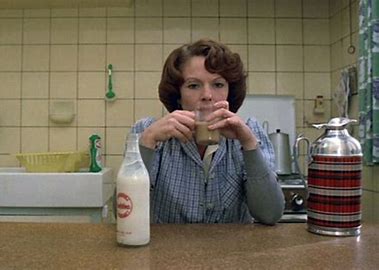
I discovered Jeanne Dielman when I was a freshman in high school, so this would've been 2003. At the time, Sofia Coppola's Lost in Translation came out which I adored. A lot of online film forums were discussing the possibility of her getting nominated for a Directing Oscar which would not only make her just the THIRD woman to get nominated, but the first American woman to do so.
It felt insane that the number was so low. She did manage to get the nomination, but lost to Peter Jackson, which was not considered a shock. Coppola did manage to win Original Screenplay, which was deserved and was similar to the SECOND woman who got a Directing nod: Jane Campion, who lost her Directing bid for The Piano to Spielberg for Schindler's List...but she did net the Screenplay win.
But I digress...
With all of the talk of women filmmakers not getting their fair shake, I found lists from older film fanatics who were recommending great films made by women that they felt deserved to be seen.
Of these lists, two films stood out to me:
Agnes Varda's Cleo from 5 to 7
Chantal Akerman's Jeanne Dielman, 23 quai du commerce, 1080 Bruxelles
Varda's work was seen as an inspiration to Akerman (and, admittedly, I might like Cleo a little more than Jeanne Dielman but that isn't relevant or important here) ...and it shows.
I was very lucky growing up that my local library had a rather impressive slate of films available for rent, and this included foreign films as well. There was an older gay man who oversaw that aspect of the library, and he often led me to choosing certain films to see and I credit him for developing a lot of my film tastes.
I remember him being thrilled when I rented Jeanne Dielman and he was eager to hear my thoughts.
I am not even sure I know how to describe my first thoughts on the film. At nearly 3 1/2 hours long, Jeanne Dielman is undeniably a process to sit through...but unlike longer films that managed to put me to sleep (coughTheEnglishPatientcough), something about Jeanne Dielman kept me in a rather surreal trance.
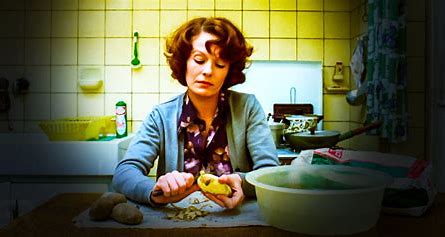
The movie is about a woman named Jeanne Dielman (and we never hear her name spoken aside from a letter she reads aloud to her son). She is a widow who spends her days doing routines that never vary, such as cleaning and preparing meals for her and her teenaged son. She manages to make a living by prostituting herself with one client a day.
And we watch her do these routines for 3 days' worth of time...but with each passing day, little moments cause the routine to crack, and we slowly realize that Jeanne may not be as stable as we think.
Despite being made and released in 1975, Jeanne Dielman was not seen in the US until 1983. Once critics did see it from our side of the pond, most praised it as being revelatory.
Jonathan Rosenbaum, a critic of The Chicago Reader, was among the film's earliest champions here in the States. When some bemoaned its long running time, he said:
"[IT] needs its running time, for its subject is an epic one, and the overall sweep ... trains one to recognize and respond to fluctuations and nuances. If a radical cinema is something that goes to the roots of experience, this is at the very least a film that shows where and how some of these roots are buried"
Many commented on how the film was showing a bold example of normalizing sex work as an actual career (which it is...I strongly feel it needs to be decriminalized).
Writer Ivonne Marguilles stated that the film was "fully in tune" with the European Womens' Movement of the 1970's and that it provided a "rigorous alignment of sexual/gender politics with a formal economy".
Queer film critic/historian B. Ruby Rich made even bolder proclamation by stating that Ackerman invented "a new language capable of translating truth previously unspoken". She also added that "never before had the materiality of a woman's time at home been portrayed so viscerally".
In 2009, The Criterion Collection released Jeanne Dielman on DVD for the first time, and it slowly developed a bigger cult following. However, with the passing of Chantal Akerman in 2015 at the rather young age of 65, a lot of her work got re-evaluated by many film critics and historians.
Criterion once again released another remaster of the film in 2017 and during this time, it felt very prescient. With the tides changing to look for more inclusion and diversity, many were discovering the film and Akerman's body of work for the first time. Even prior to 2017, the only other film of Akerman's I had seen was her 1978 film The Meetings of Anna, but Criterion introduced me to several others like Tout une nuit and I, You, She, He.
Between the 2012 and 2022 Sight & Sound polls, the tides have changed and while some like to criticize the concept of identity politics when putting in the world of artistic criticism, I think many films made by women and people of color have not gotten the credit they deserve.
On the critics' list alone, for the first time ever, there are two films made by women. In addition to Jeanne Dielman, the list above shows Claire Denis' Beau Travail, which was a film I saw once back around 2005 and really did like but feel like it warrants another viewing.
In terms of other inclusions, I will save that for the other post.
It seems remarkable that in just the span of 10 years, Jeanne Dielman went from getting listed at #34 in 2012 to #1.
Last year, I made a series of posts on my blog going on a decade's journey listing what my top 10 films were from each decade starting with the 1930s to the 2010s.
When discussing the 70s, I put Jeanne Dielman at #7 and stated that I felt this was a film that was starting to get more attention and that I would love for me people to give it the recognition it deserves.
I really truly did not think that I would see it be crowned the #1 movie by the critics and historians with the Sight & Sound magazine.
This is only the 8th list of its kind that has been made by the magazine/institute. Jeanne Dielman is only the fourth film to have been named the "greatest of all time" following Bicycle Thieves, which held the title only once for the list's inaugural outing.
Then, the perennial and cliched choice of Citizen Kane held the title for every list between 1962 and 2002 until Vertigo unseated it in 2012.
Jeanne Dielman still seems like such an obscure choice, but while I have read a lot of snide comments from people who probably haven't seen any movies outside of those made within the Marvel Universe, the film snob in me revels in seeing the film get this kind of recognition.
As I stated before, it is nearly 3 1/2 hours long...and it is presented in such a matter-of-fact manner that I can't help but marvel in how ballsy it actually is.
Akerman was a feminist filmmaker who actually did balk at the idea of being pegged as such because she sadly felt that there "was no such thing as Women's Cinema".
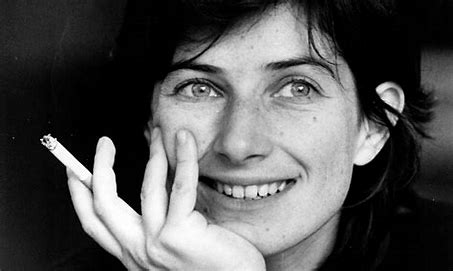
Chantal Akerman
Sadly, she kind of had a point.
She passed away right before a lot of the real surge of recognizing women filmmakers came to light, with both Chloe Zhao and Jane Campion winning Best Director Oscars within a year of each other.
Akerman was one of the true pioneers and was a true inspiration not just as a woman, but to any filmmaker. Her style of filmmaking inspired the likes of Gus van Sant, whose work on movies like Elephant were clearly imbued with the Akerman slow-paced haze.
Akerman was an unsung hero for so long and I think she truly is a beacon for feminist cinema...although she deserves to be held on a higher pedestal than that.
I am not sure how quickly I will have it up, but I do intend to do a more in-depth analysis and review (with spoilers) of Jeanne Dielman.
If you do have an interest of seeking out the film, it is available for streaming on Criterion but an easier platform to find it on is HBO Max.
Perhaps a slow-paced movie of such a length won't be for everyone, but I honestly...give it a look.
After giving us a season that managed to tackle topics such as faking your death, the meaning of having a soul, and babies shooting evil elderly men, Bill Oakley & Josh Weinstein were now going into their second season as showrunners with a stellar track record.
However, if you've been following these posts of mine, you already know that things are (for me) all downhill from here.
I have to stress that season 8 of The Simpsons is certainly not bad. In fact, I stand by my opinion that it has far more successes than it does misses.
I think the biggest thing about season 8 is that after tackling more relationship/character driven storyline in season 7, Oakley & Weinstein opted to go more into plot-driven material here that would put the characters into rather bizarre scenarios...and sure, they were mostly entertaining, but there is a definitely a feeling of the tide changing at times.
I have a few more thoughts about the season, but I will save them for after the top 10.
_______________________________
THE TOP 10:
#10 - Lisa's Date with Density
Written by Mike Scully
Out of all of the side characters to have been created in the 30+ year history of The Simpsons, I have something of a soft spot for Nelson Mandela Muntz.
As a bully character, he quickly became something more. It was almost as if he bullied based on principle rather than simply vindictive attack...and he also seemed to have no shame bullying adults. He was an equal opportunity bully.
In season 7, we got two moments that sort of put Nelson in a unique position.
During "22 Short Films About Springfield", a random adult character that we've never seen before puts Nelson in his place when he mocks him for driving such a small car...and during the moment, he is portrayed and drawn with such vulnerability that you almost feel bad for him despite the hilarity of the moment.
In "Bart on the Road", we learn that Nelson is a fan of crooner Andy Williams, insisting they stop to attend one of his concerts in Branson.
Seeing these interesting quirky details, the team came up with "Lisa's Date with Density", in which Lisa realizes she might actually have a crush on Springfield's oafish bully.
Lisa does manage to bring out a good side to Nelson, and even if it doesn't last, you leave the episode sort of understanding him a little better...and frankly, I came to love the character a lot more after the episode first aired.
_______________________________
#9 - Treehouse of Horror VII
Written by Ken Keeler, Dan Greaney, and David X. Cohen
While I do think "The Genesis Tub" and particularly "The Thing and I" are good segments, a lot of my love of this anthology episode comes from "Citizen Kang", in which longtime alien characters Kang & Kodos kidnap then-current Presidential candidates Bill Clinton and Bob Dole with the goal of taking over their lives and then overtaking planet Earth for themselves.
Homer is the one directly involved in witnessing this act and in order to make people not believe the story, they choose to soak him in rum so everyone assumes he is a drunk...which...to be fair...is not that far from the truth.
And even when everything could have a happy ending, Homer still manages to ruin civilization as we know it.
Perhaps my favorite aspect of this story is how both Kang & Kodos as Clinton and Dole seem to have no real sense of how these candidates should talk and yet the nonsense they dish out doesn't seem the least bit bizarre to the general public.
The most iconic of these lines would be Kodos as Clinton stating the line in the video clip below:
________________________________
#8 - In Marge We Trust
Written by Donick Cary
Marge themed episodes don't always seem to come as often...nor do they often seem to be as popular as those based around other characters.
However, I will always love Marge.
The writers may not always utilize her to their detriment, but they often can find ways to make her hilarious amongst all the chaos.
"In Marge We Trust" puts her in a role of noble power as she takes over Rev. Lovejoy's help line at the church and she becomes a Christian version of Dear Abby.
To contrast this, the B-plot is hilariously surreal and proves to be one of the show's more humorous bits of fanciful coincidence.
Homer, Bart, and Lisa make a long overdue trip to the dump to dispose of their Christmas Tree and come across a box of the Japanese cleaner Mr. Sparkle, whose mascot resembles Homer.
Homer is almost scared at why this mascot looks so much like him.
The actual reveal: that two mascots from two conglomerates came together (a fish and a lightbulb) to make the Mr. Sparkle mascot is merely a coincidence...but it works so well as a B-Plot that I admittedly have forgotten in the past that it came from THIS episode as it felt strongly enough to work as an A-Plot.
_______________________________
#7 - Hurricane Neddy
Written by Steve Young
If there was ever a character on The Simpsons that deserved to snap, it was arguably Ned Flanders. By this point, we've watched him 8 seasons taking a lot of heat from his neighbor Homer...and in many ways, a lot of the citizens of Springfield.
Flanders was always cheerful and eager to spread his jovial religious views onto anyone who would listen...and that inner strength and sense of self was always a source of disdain to Homer.
It is no hidden secret that Homer has a dark desire to be more like Flanders...and it is even less a secret that Marge also wishes that she had someone like Flanders. Even all 3 of the Simpson kids have shown a desire to have Flanders as their father figure.
Hurricane Neddy is the moment where we finally get to see Flanders reach the end of his rope. When a hurricane hits Springfield, Flanders' house seems to be the only one somehow destroyed.
Despite a brief moment of despair, it seems like his prayers may have been answered when the citizens of Springfield gather together to rebuild the Flanders' home.
Not surprisingly, it was a half-assed job and this sends Flanders off the cliff, insulting the entire Simpsons family and calling Homer "the worst person I have ever met".
Though, Flanders seems to know that he snapped and checks himself into a mental institution immediately after...and we discover with the aid of his former childhood psychologist that Ned Flanders was a child filled with rage who didn't take to his chill beatnik parents.
Obviously, I would never take or agree with the strict and devout ways that Flanders leads his life, but within the world of Springfield, he always provides such a great contrast to Homer and the loons around him. The episode simply works because it feels so good to see that Ned Flanders, the Saint, does indeed earn this fit of anger.
________________________________
#6 - The Mysterious Voyage of Homer
Written by Ken Keeler
Despite not being to the level of season 7 as I have stated before, I do have to admire that Oakley & Weinstein were willing to experiment.
"The Mysterious Voyage of Homer" was originally an idea pitched by George Meyer in season 3 but a lot of the staff felt it was too odd for the show and it was scrapped. While Oakley & Weinstein truly adored that era of the show, they were looking to find ways to imbue some new dynamics and dusted off the template for this episode.
The family attends a chili cook-off, much to Marge's dismay, and while eating several hot chili peppers (thanks to the rather dangerous method of coating his mouth with scalding candle wax), Homer hallucinates and thus we get one of the first truly surreal sequences in the show's history.
Not to mention the guest appearance of Johnny Cash as Homer's cayote spirt guide in one of the best guest star coups the show managed to net.
I also credit this episode for developing my love of Janis Ian's song At Seventeen. You hear it sung in a cheesy ironic way by a bunch of beauty queens way back in Season 4's A Streetcar Named Marge, but here, we get an actual snippet of the real song.
And then to also tie back to a season 4 moment, the episode ends with the song "Who Wears Short Shorts?" but in a moment where Homer and Marge have yet another sweet reconcillation.
________________________________
#5 - Bart After Dark
Written by Richard Appel
The idea of having Bart work in a burlesque house is slight tip in the direction of showing viewers that the show might be going for more bombastic ideas...but nevertheless, the episode works rather well.
A lot of it has to do with the setup: a classic example of what appears to be a kid losing a toy on someone else's property that seems truly scary, but instead of going for something sweeter and more sentimental, they trick you into having the secluded house actually being a burlesque venue that is quite popular with the men of Springfield.
The madame of Maison Derrière, Belle, has Bart start working there as a way to make up for destroying one of her stone gargoyles. Marge is rather upset by the fact that this venue even exists and in true Marge fasion, seeks for it to close down.
The episode ends with Belle and the citizens of Springfield being won over by a big song-and-dance number, We Put the Spring in Springfield...which ended up winning an Emmy for Best Original Song.
______________________________
#4 - Homer's Phobia
Written by Ron Hauge
The YouTube channel TheRealJims is devoted to the history of The Simpsons and if you are a truly fanatic admirer of the show like I am, I would recommend checking it out.
I bring him up because he recently did a video about the concept of "Jerk-Ass Homer", which was a term that was created in the late-90s in various online fan forums due to the distaste of how writers just seemed to make Homer a jerk simply for the case of being a jerk.
I will talk more about that when we get into seasons 9 and 10, but there is a valid point to be made which that particular video brought up: Wasn't Homer ALWAYS kind of a jerk?
Yes, he was.
However, the moments of volatility seemed a lot more sparce OR...and this is the key factor...his worst moments were met with punishments or embarrassments or actual realizations of his faults.
A lot of this came out of character driven storylines, and "Homer's Phobia" is a prime example of how an ignorant viewpoint ends up becoming a moment of character growth for him.
As the first real episode to delve into extensive LGBTQ+ themes, "Homer's Phobia" holds up remarkably well and it helps that they got someone like John Waters to guest star as the gay character John...whom the whole family instantly takes a liking to. If stuffy Marge can accept John, so should Homer...even Bart shows no sign of discomfort with John.
While the reindeer ending is a bit...odd, I do think the rest of the episode works well as a social commentary for its time.
This is another one of those episodes that seemed more based on a silly plot device rather than more character driven stories that would bear some resemblance to reality. Co-writer Mike Reiss actually objected to this episode at first for that very reason and fought hard to keep any real magical moments at a minimum. The final product ended up being one of his favorite episodes he contributed to.
Considering how much I adore Mary Poppins, I can't help but love this episode, too.
I actually considered this my favorite (or at least top 3) episode back around the time it first aired. While I certainly wouldn't rank it anywhere near that level anymore, I still greatly enjoy the episode and each of the beats taken from the plot of Mary Poppins.
Voice actor Maggie Roswell (who worked on the show doing such characters like Maude Flanders) was tasked with voicing Sherry Bobbins, the Mary Poppins counterpart. She excels in the role by imbuing it with a true Julie Andrews style. It was said that Julie Andrews was lined up to actually perform the role, but scheduling with her run in Victor/Victoria and her infamous surgery that cost her the upper range of her singing voice made her step aside.
Despite it being an unrealistic idea borne out of a fantasy film, this is one of the times (thanks to it being on the earlier side of the shift) that the show nailed it and gave us an episode that is just simply nostalgic and fun.
_________________________________
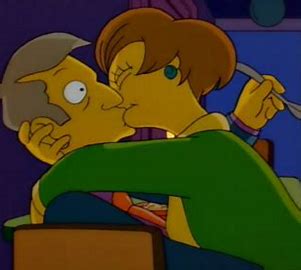
#2 - Grade School Confidential
Written by Rachel Pulido
As Sideshow Bob once said, "You only get one shot with Edna Krabappel".
Throughout the last 8 seasons, Edna Krabappel has been a common fixture within the show, but mainly confined to the world of Springfield Elementary where she is Bart's 4th grade teacher.
She is a snarky and surly and often crabby woman...but she also has a wicked and sly sense of humor and tends to be unlucky in love...or she just hasn't found the right man and she won't settle.
Pairing Edna with the ultimate Mama's boy this side of Norman Bates almost seems as right as it does wrong.
Principal Seymour Skinner's squarish tendencies and Edna's penchant for mocking him always made for great laughs, and it was clear that the writers saw immense potential in pairing them.
In fact, there were talks in the writers' room of doing so as early as season 3. Even in an episode from that season, "Bart the Lover", they reference Edna possibly dating Seymour to which she refuses because "his mommy won't let him out to play".
Bart discovering their affair is not surprising, nor is his becoming their gofer so they can exchange messages secretly throughout the school day.
Even after he ends up exposing them eventually which leads to their temporary firing, he pushes for them to get their jobs back. In the end, despite the antagonistic nature this triangle shares, it is truly amazing the hidden warmth they have for one another.
_____________________________
#1 - Homer's Enemy
Written by John Swartzwelder
Yeah, I know...this is a pretty typical choice. Also, it used to be (not sure if it still is) the highest rated episode of The Simpsons on IMDB.
When it comes to the concept of meta-commentary, there is a lot to unpack with an episode like "Homer's Enemy".
It acts as such a strong attack on the show's lead character and with rather morbid results at the end that when it aired, it divided people intensely.
At the time it aired, I was about to turn 9 but was an avid viewer of the show. I can recall the old Simpsons online forums blowing up because many people considered this the end of the show. Others considered it a bold masterpiece.
I obviously wasn't as astute as a lot of the people on the forum at my age, but I always loved this episode. It doesn't surprise me in the least that it has since gone on to be a classic and also the final masterful episode of the Golden Age as season 8 would come to a close just two episodes after this one.
"Homer's Enemy" is that of Frank Grimes, a character developed just for this episode (which is normally a motif I hate on other shows but leave it to this writing staff to make it work) who grew up having a hard life. Despite many obstacles, he persists. He takes a job at the Springfield Nuclear Plant and is placed in Sector 7G with Homer, Carl, and Lenny.
Almost instantly, Frank takes an instant dislike to Homer and is baffled by his laziness and incompetent behavior...especially considering he is the head of Safety for the plant.
The concept of having an outsider come into this world and instantly call out all of the great things that Homer has around him that he honestly didn't truly earn was a very bold move. The show had never been so blatant in calling attention to itself.
In many ways, it was a critique on themselves just as much as you could view it as being a metaphor for the American Dream and how no matter how hard you may work at it, some others may just grab more for doing a lot less out of pure luck.
The death of Frank Grimes at the end is easily one of the darkest places The Simpsons goes towards, but I still think it was a brilliant place to go.
______________________________________
Final Thoughts:
Season 8 is one that I have waffled on. For many years, I stated that the Golden Age ended on a high note with Season 7 and then we were left with a whimper in season 8.
Time has been far more kind to season 8 than I ever anticipated. Sure, there were a few episodes I absolutely loved from this season even back when it first aired (a few of them are on this list), but I didn't respond as strongly to the rather abstract and surreal choices after really loving the whimsical and character driven nature of season 7 and the dark and slick season 6.
I would say that while there is a noticeable drop in quality compared to seasons 6-7, I would still consider season 8 to be a part of the Golden Age...and it would be the season that officially ends it.
Season 8 does try to change the formula a little bit in the same vein that David Mirkin tried to do in season 5, but I think the big difference between these two seasons are that Oakley & Weinstein just had a more innate understanding of how to blend in a certain warmth and whimsy along with the snark and cynicism...or at the very least, they were able to maintain a stronger consistency level.
Maybe it is unfair to necessarily say it played a factor, but while Mirkin came in as an outside hire for season 5, Oakley & Weinstein were hired as writers prior to Season 4 by then-headwriting duo Al Jean & Mike Reiss, who had been with the show since day one. Not to mention, the original team of Brooks, Groening, and Simon were still strongly present in the writers room at that time.
Even if Mirkin did eventually find his groove and create some truly iconic moments, I just think Oakley and Weinstein were the better fit and they managed to turn out a slightly more successful spin at revitalizing the show than the final results of Mirkin's Season 5.
Sadly though, Oakley & Weinstein step down here and the reins are turned over to Mike Scully.
Scully has written a couple of great episodes (with a couple already being mentioned on my lists so far), but Simpsons fans have some strong feelings about him. In many ways, he is the man who set the show down the path that still has many bemoaning to this day that it should've been cancelled 20 years ago.
But I will go more into that when discussing season 9...
Years ago, legendary film critic Roger Ebert went on a tirade about David Lynch's infamous and iconic 1986 film Blue Velvet as he felt that the graphic sex scenes and nudity truly exploited star Isabella Rossellini in an uncomfortable and sleazy manner.
His colleague, Gene Siskel, basically sided with the filmmaker saying that Rossellini "consented" to what she did on the screen.
Maybe that is true...and it seems to be the case all over again with Ana de Armas, who is getting her next big splash onscreen after making a very promising debut in 2019's gem of a murder mystery Knives Out.
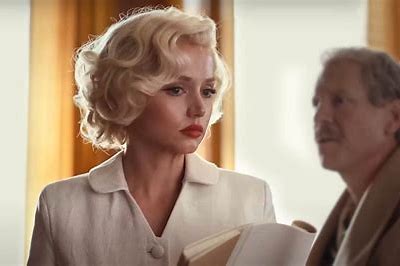
In a bit of casting that seems a little odd considering the effort it takes to hide her fairly thick Cuban accent, de Armas was given the task to play one of the most iconic figures in history: Marilyn Monroe...or rather her real-name, Norma Jeane Baker, in Blonde. This "SEMI"-autobiographical film is based on a Joyce Carol Oates novel which essentially told the life of Baker/Monroe with a lot of fictional and exploitative tendencies.
Before I dive more into the film and the performance of de Armas, I want to state quickly about the expectations I sort of held for this film over the past nearly two years.
Andrew Dominik's career has been rather limited, and he only really achieved any kind of significant success with 2007's The Assassination of Jesse James by the Coward Robert Ford starring Casey Affleck and Brad Pitt. I have no affinity to his work whatsoever and judging by how much he has been touting up his work on Blonde over the past year, he has an ego that seemingly rivals that of Quentin Tarnatino's.
How so?
He was quoted in an interview that he felt Blonde would be seen as one of the ten best films ever made.
So, does that mean that in a decade or so, we will start seeing Blonde appear on the BFI's Sight & Sound poll?
Oooh! Can I answer?!
Please let me answer!!
No.
No, it won't.
Prior to its release, I would hear these comments by Dominik how the film would be dark and different than the standard biopic, and yes, there were many others who seemed to sense that perhaps this was going to be a film that would flirt with the idea of being pure trash.
I sort of had this sense that maybe it would be viewed as a more abstract example of Pablo Larrain's Spencer, last year's biopic that took on a rather unhinged look on a brief moment of Princess Diana's life over one Christmas holiday at Sandringham. That film polarized people immensely and while I certainly responded to it rather mutely at first, I grew to respect it more over time for its rather surreal approach. It certainly fell in the same vein as that director's previous film Jackie, about Jacqueline Bouvier Kennedy Onassis...and that was also a film I actually quite liked more.
I viewed Blonde as being one of those potentially polarizing films that would make me say I wished cinema could be as bold as this all the time.
And yet, despite the film being rather bold and going against the grain in many ways, I find the final results to be frustratingly pretentious, heinously exploitative, and rather offensive to the legacy of Marilyn Monroe.
I am also someone who has never had any real interest in Monroe being just a basic fleeting curiosity being someone who was fascinated by Hollywood and the entertainment industry growing up. She also even delved into my love of political history considering her rather infamous involvement with the Kennedy brothers.
Still though, Monroe was a woman who suffered from great trauma and was thrown into a Hollywood system that ruined her much like it did the likes of someone like Judy Garland.
And you get the sense that Dominik wants to show that Monroe was more than her basic image: blonde, voluptuous, sensual, breathy...along with being a drug/drink addicted kook with daddy issues...and yet, that is all we see.
It is a film that is simply brutal in its approach...and a film that somehow manages to both appall and appeal at the EXACT SAME TIME.
The film is overbearingly long and pretentious and yet, the style and look of it does have moments of interesting flourish. Biopics have become the bane of many film lovers' existence with the frequency in which they become the key part of awards bait season...and yet, here we are. We are given a film that is truly so bold and relentless in its approach that you sort of marvel at it and then quickly find yourself wanting it to calm down.
Through it all, Ana de Armas manages to come out of the film relatively unscathed. Sure, there are some issues with her accent work, and the script can be so brazen that you find yourself sensing that she has about run out of the energy to convey differing levels of tortured emotion, but in the end, she shows real promise here.
After giving such an assured and witty performance amongst the loony chaos of Knives Out, she does prove she has the ability to provide emotional intensity and also the ability to anchor a film.
Is she Oscar worthy for this film? I don't know.
It's still too early to tell and it is all too fresh in my mind, but I will say that I am far more pleased by her performance than I am upset. I do feel like a nomination might be worthy, but with as polarizing as the response has been, I would be surprised to see it happen currently.
Although...if Glenn Close can get nominated for Hillbilly Elegy, then anything is possible.
I did want to quickly single out Julianne Nicholson, who gets a brief but potent supporting role as the unstable mother Gladys.
She manages to imbue her role with a certain energy that is oddly captivating despite being essentially a one-note villain most of the time. I hope she keeps getting cast in more projects, because ever since we watched her scream at Kate Winslet in the car in Mare of Easttown, she proved she is one of the more real and underrated actresses working today.
So yes, Blonde is a film that manages to shock, infuriate, and intrigue you.
At its core, it is an exploitative and cruel film that basically drags the ghost of Monroe through the mud and doesn't want to let up.
That alone is nearly unforgivable.
On top of that, you have a run time of nearly 3 hours, and it FEELS that running time. You have a filmmaker who considers his own work to be among the best films ever made...and when you watch the film knowing that, you get the sense that Dominik is practically masturbating at the thought of his own visual and artistic genius.
There are ingredients in this film that prove it could've worked splendidly, but instead it was just a sour and bitter pill that might make you think "Hmmm...if only we had a spoonful of sugar".
I admire and hate so much about this film all at once.
So, I will give it a middling rating with some apathy.
I recently discussed Nathan Fielder's previous series Nathan for You, which aired on Comedy Central from 2013-2017. For access to that post, please utilize the link below:
Does having a knowledge of Nathan for You benefit your enjoyment of The Rehearsal? I would say it isn't essential, however the journey of Nathan of You does add something to the viewing experience here.
Going into discussing this show, I am going to take a quick detour in the world of theatre.
As someone who went to school for theatre, I am very familiar with the work of German playwright Bertolt Brecht.
I truthfully never responded to Brecht back then...and I wasn't as overly enthused when I got to act in one of his plays: The Good Person of Szechuan. Although there are some pieces of his I do really like such as The Caucasian Chalk Circle or The Threepenny Opera.
Brecht has had a significant level of staying power due to his style of writing/Theatre, which is referred to as "Brechtian".
One of the keys to understanding the Brechtian style is that it revolves around the Alienation Effect. Putting it at a very basic level, Brecht didn't want people to get swept up in his shows to the point where it was like you were watching real life. Everything was presented in over-the-top manners with very little done to try to hide that you were watching a live performance.
Even Tony Kushner would experiment with this kind of style in Angels in America...particular with the treatment of the Angel itself.
You could even make a case that The Rehearsal taps into an almost pseudo-Brechtian territory and there are moments that certainly feed into that kind of analysis.
But...after watching the season finale last night, I think the whole experience of the show wouldn't necessarily fall into that category. If anything, The Rehearsal is something unique in of itself.
I think Nathan Fielder created something truly masterful here.
Taking the tools of the kinds of scenarios he would create on Nathan for You; he takes it to a deeper level on The Rehearsal where he is trying to help others, but it ends up becoming a way for him to learn a lot more about himself.
While Nathan for You was presented as a satirical take on reality shows that would help struggling business owners, The Rehearsal wants to help people cope with their own daily lives.
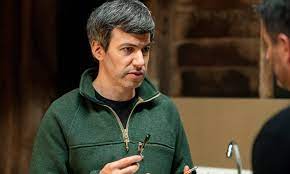
At the head of it all is Nathan Fielder.
Fielder is one of the more fascinating figures to ever appear on TV because on one hand, he is essentially always playing a version of himself, but he very much fits a mold of commitment to the scenario at hand that places him in a similar orbit to Sacha Baron Cohen, even though he relies mostly on his iconic characters like Borat.
Fielder is very unassuming and meek in his demeanor and appearance. He plays up to this though, often leading to interactions with people that seem to lack any kind of social awareness. It was what made the cringe factor of Nathan for You both unbearable and hilarious.
I wouldn't say he always delves into cringe with The Rehearsal. Although, he does manage to stumble upon moments that certainly spark an uncomfortable feeling or, at best, make you just want to lean in and see what happens next.
The Rehearsal is presented as an experiment. In the pilot episode, Fielder places an ad on Craigslist that is asking for people to come to him if they are seeking guidance which leads to him encountering Kor Skeete, a man from Brooklyn who is obsessed with trivia nights at bars. Skeete is ashamed because he lied to many people about his education and that he did not have a master's degree. One person he is especially afraid to tell is his friend Tricia.
Fielder proposes that he will help Kor rehearse this conversation and be able to provide him with the environment to do so...which actually includes going to the bar where they will eventually have the discussion and then Fielder commissioning a replica of the bar be built both interior and exterior inside a warehouse at the Brooklyn Navy Yard.
At this replica, Fielder has hired extras to act out as if they were real patrons in a bar and then hires an actress to play Tricia for Kor to rehearse with...and it becomes so specific that the actress who will portray Tricia is able to meet with the real Tricia over a business related matter (staged by Fielder) without Tricia knowing her mannerisms are being studied.
While the rehearsals go off without a hitch, including testing out multiple scenarios based on how the real Tricia could respond, the actual event drags on as the weight of the moment overcomes Kor, but he does eventually open up to his secret and Tricia accepts the news without much fanfare.
The pilot episode, entitled "Orange Juice, No Pulp" (as all the episodes are titled based on dialogue or themes within the episode), proves to be a truly remarkable debut that puts you deeply into the world of the show...but this wouldn't be a Nathan Fielder creation if it didn't throw you off guard.
In the second episode, Fielder creates an even more complex rehearsal for Angela, a devout woman in her 40s who is considering adopting a child. As part of the routine, Fielder rents out a house in rural Oregon and then arranges for Angela to go on dates with men in hopes to find a guy who may be willing to rehearse with her as a paternal partner that also has an interest in her intimately.
This guy will be Robbin, who is ten years Angela's junior, and he has an obsession with numerology. They do seem to hit it off due to her very devout faith and watching these two interact becomes a perfect mix of comedy and cringe.
However, Robbin being the man that he is, really wants to have sex with Angela and she...being a devout Christian woman...wants to save herself for marriage. That, combined with the weird setup for caring for the child, which includes...
-Swapping out the children every 4 hours due to child labor laws.
-Aging up the children abruptly after a set amount of time.
-Caring for a robot child at night.
...leads to Robbin bailing on the rehearsal.
With this abrupt setback, it now allows Fielder to do what he does best: find a way to keep this snowball rolling. Fielder offers to become a non-romantic parental figure.
And just like that, The Rehearsal manages to become a serialized reality show with small episodic bits to keep you engaged throughout the episodes.
I am not sure I can properly convey the true joy and awe I felt watching The Rehearsal unfold. In many ways, this ties back into what I said at the very beginning that having a prior knowledge of Nathan for You could benefit in your viewing pleasure of The Rehearsal.
The Rehearsal does build upon many styles and themes that were set on Nathan for You. One of the biggest issues some had with the predecessor was that it came off as too mean spirited in that it often played up people's true concerns about their job and personal lives with humor at their expense.
The Rehearsal takes on a more nurturing approach and yet, there are times where Fielder finds himself second guessing how he is proceeding with dealing with other people's feelings/emotions.
One of my favorite "subplots" of the six episodes involves the fourth episode, which was entitled "The Fielder Method". In it, Fielder decides that a certain amount of detail and truth is required to be believable actors within these staged rehearsals so he rents out a storefront in LA and begins teaching acting classes based in The Fielder Method.
However, as a teacher, Fielder isn't sure if he truly sold his ideas or himself as a person. How does he solve this?
He stages the class again with other actors as extras and him posing as a random student named Thomas (whom he copies by wearing a blonde wig and the same outfit) while another actor plays Nathan, trying to mimic his demeanor as much as possible.
One of the assignments the real Nathan Fielder gave his students was to observe someone random in society and try to start a conversation with them...and he discovers that the one student he was trying to portray as his own exercise is having issues with properly connecting to other people.
This leads Fielder to actually moving into Thomas' apartment as he is trying to truly see how it might feel to be Thomas while also trying to get into the mindset of how it must be to be placed into the world of The Rehearsal.
After devoting so much time to this exercise, Fielder returns to Oregon because he is STILL posing as a father to a child named Adam...who is now a 15 year old.
When Fielder arrives, the kid greets him amicably and warmly while Fielder feels awkward about the whole thing...so much so that he breaks "character" to talk with the teenager as an actor.
Fielder and Joshua (the young guy playing Adam) agree that if this were more of a reality, Adam would be far less receptive to seeing his father return after such a long time...and they proceed to act out over a period of days where Joshua rebels and becomes a drug addict.
It proceeds down to such a dark level that Fielder realizes he wishes he could've done more even in this simulation, so with Angela's blessing, the reset the timeline and have Adam become a six-year old again.
"The Fielder Method" was one of the best episodes of TV I have seen in quite some time in how it tackled such a bizarre mix of life imitating art imitating life to the point where sometimes you buy into the lunacy of the situation...and how much the young actor who played teenaged Adam commits to the rebellion is surprisingly affective. So much so that we watch him have one-on-one sessions with Fielder where he helps guide him through preparations of the role, such as "What might a troubled teen turn to in order to cope?". Joshua tells Nathan he has a friend whose father left home and by the time he was 15, he was deep into drugs and already sexually active.
And with that, we watch all of that work play out.
Fielder's desire to become involved in parenting also deeply affects that of Angela, who often becomes distant and not invested in the rehearsal when Nathan isn't around because she can't seem to commit to the fake reality.
At first, Fielder views this from a lens of concern and even a little resentment.
However, he soon realizes that he himself contributed to some of the downfall and in mutual agreement, Angela parts ways with The Rehearsal and Fielder decides he wants to continue on parenting "Adam" as a single father".
This all leads to a season finale in which the true potential horror of the show comes to light.
A young child actor named Remy becomes so invested in his fake world playing son to Nathan that he doesn't want to leave when the show is done with him. At first you think he is just a kid having a tantrum, but as a child without a father, young Remy took to Nathan and even Fielder himself admits that he bonded with the kid in a way he hadn't to the others.
With the help of a professional child actor who is playing Adam at age 9, Fielder goes through the entire process again and hopes to find a way to see if he did something wrong in his approach...all the while, young Remy is at home crying because he misses "Nathan" or as he wants to keep calling him: Daddy.
It feels almost like a full-circle moment: we are back in area where Nathan Fielder is playing with fire and despite his innocent intentions, someone is hurt by his actions and worse, it is a 6 year old boy.
There is also the fact that his mother is involved and she does express how she was concerned over the dynamics of the situation, but even though it isn't explicitly said, you can tell that this is a mother who realizes maybe she made a mistake but thought it would be a truly wonderful opportunity for her son.
Nathan Fielder is a master at digging himself into a hole but instead of that being a detriment, he revels in it...and it is always a delight to watch him climb his way out.
Near the end of the season finale, Fielder makes a passing comment to Liam, who is currently playing Adam as Remy...and 9 year old Liam also does his homework to properly play Remy...that maybe he made a mistake at involving children in the process of this show.
Fielder always has that tendency of second guessing himself and how he deals with his emotions or lack thereof. Nathan for You famously ended with the 2-hour long episode entitled "Finding Frances", in which he helps his friend and elderly actor Bill Heath try to find a long-lost love he let slip away. The episode played in a far more serious manner than anything else he had dished out prior...but it showed that there was this darker philosophical layer underneath the absurdity of having people climbing the top of a mountain just to get a gas rebate.
It left you wanting more and wondering what he could possibly come up with next.
The Rehearsal latched on to that feeling and ran with it...and sure, it may need to work out who to properly involve in the world of the show, but that is, in a way, perfect for a show that is about a rehearsal.
Season 1 of The Rehearsal was truly a rehearsal for the show as a whole....but I would say that in the end, he is more than ready for opening night.
Before I go into this, I will make it clear that I am by no means a fan of Funny Girl as a musical property.
It has a few truly great songs, but it is held up by a very meager Book and has one of the weakest Act Two quality drop-offs of any popular musical.
This is a show that truly rests on the merits of its lead performer.
Speaking of leading performers, I am obviously way too young to have seen Barbra Streisand play this role onstage. I have only listened to her cast recording and audio clips of her time onstage, watched the movie, and heard her sing the songs live in concert.
Streisand is one of those big icons that I haven't had a passionate a feeling towards as I have to someone like Judy Garland or a lot of the great jazz singers such as Ella Fitzgerald or Lena Horne.
That isn't to say I dislike Streisand as I very much adore her early albums and I think she has one of the true distinct and vibrant voices of any female singer in the last 60 years. I tend to dip on my opinions of her career post-The Way We Were.
What I am trying to say is that I have no real passionate affinity to either Funny Girl or to Barbra Streisand. Although, I will gladly admit that when Jule Styne wrote the score, he knew exactly what he needed to do to make Streisand shine.
Streisand's connection to the role of Fanny Brice is one of the most iconic in the history of musical theatre. The legend and her shadow have made it far more intimidating to revive the show in the decades since it premiered in 1964, but I do think there are those out there who also were willing to admit that the show itself is simply not that great.
Cut to 2011: Bartlett Sher wants to revive Funny Girl but a lot of controversy is had because he wants to cast Lauren Ambrose, who at the time was mostly known for her work as Claire on the HBO series Six Feet Under. Many were baffled at the casting choice, but it didn't matter as everything fell through and the production got scrapped.
Randy Graff, who had signed on to play Mrs. Brice, told Seth Rudetsky "It's cursed". It just seemed like it wasn't destined to be revived...but there was one particular girl waiting in the wings who wanted a chance.
2011 was a time in which Lea Michele was achieving the biggest fame of her career starring as Rachel Berry on the hit FOX series Glee. Prior to Glee, she was mostly only known to theatre audiences for her work in musicals like Ragtime, Fiddler on the Roof, and particularly Spring Awakening, which paired her with her best friend Jonathan Groff.
On Glee, her character is known for being the girl with the amazing voice and as the show came to a close, her character went from being a complete unknown to getting cast in a revival of Funny Girl as Fanny to great acclaim.
Then, Glee creator Ryan Murphy bought the rights to Funny Girl with the seemingly growing interest of giving Michele a chance to play her dream role in reality.
I could be here for quite a while if I go into my own personal opinion about Lea Michele as a person and a performer...OR all of the stories about her treatment towards people that she deems to be not worth her time.
All I will say is this: I have never found Lea Michele to be a compelling actress. She DOES have a good voice, however I don't find anything about her voice to be particularly distinctive or that remarkable as opposed to belters like Stephanie J. Block.
So that brings us to the 2022 revival of Funny Girl.
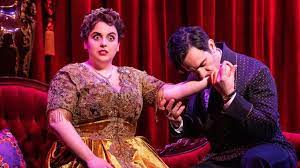
It was announced last year that comic actress Beanie Feldstein would be playing Fanny Brice and that it would be a life-long dream come true. This was the truth as photo-evidence showed that she had a Funny Girl-themed birthday party at the age of 3.
Feldstein had been mostly known for her supporting character work, although she did get a chance to shine as the co-lead of the delightful 2019 film Booksmart.
She also managed to be a great foil to Kate Baldwin's Irene when she played Minnie in the 2017 Bette Midler-led production of Hello Dolly. That would've been my introduction to her and I found her very charming in the role...and later that year, she was featured as best friend to Saoirse Ronan in Lady Bird.
Hearing her announced as playing Fanny was, to me, a refreshing choice. I knew she could sing but what sort of concerned me at first was that I hadn't really heard her sing anything that would hint she could tackle the belt-heavy score.
I had shortly found a video of her singing "Meadowlark" from The Baker's Wife on YouTube and found myself kind of underwhelmed by it. It wasn't that she was bad, but it just showed that it wasn't quite the right song for her voice.
The video was almost 10 years old so I thought to myself that it was possible she grew.
Feldstein is also great at comedy, and that became the other big promotional selling point: Putting the FUNNY back in Funny Girl.
So, let's do this...
I have seen many Broadway shows over the years. The quality of the shows varied but one thing I can definitely admire about Broadway performers is that they tend to rise to the occasion. Even if I may hate the material, the performers are usually very adept and able to show that there is talent underneath the mess of the writing or directing, etc...
I will reiterate that Feldstein is good at comedy...and she was able to find solid moments in a lot of the funnier scenes.
But I will say it....
I could easily make a case of Beanie Feldstein giving the worst performance I have seen on a Broadway stage.
This has absolutely nothing to do with the fact that she doesn't fit the mold of the role due to her size, because I have seen some people claiming it is a weight thing, but that is not it at all.
This simply comes down to the fact that she simply cannot sing the role and even when certain songs are closer to her range, the timbre of her voice comes off as too forward, too nasal, and too breathy.
A lot of people have posted audio clips of Feldstein in the role but the producers of the show are very quick in taking them down.
So, while it is a bit lengthy and jumbled, the following video below features audio of 4 different performances of the show's most iconic number "Don't Rain on My Parade":
#1 - Streisand's last performance on Broadway in 1965
#2 - Beanie Feldstein on Broadway
#3 - Julie Benko (Feldstein's standby)
#4 - Lea Michele doing the song in concert in 2018
In the case of Streisand, keep in mind that with her recording being nearly 60 years old, the microphone audio is more prone to come across as rather metallic sounding at times.
Also worth noting is that Benko sings the song a step up than the standard arrangement.
Some of Feldstein's staunchest advocates (and she does have them) just say that the critiques against here are quite vicious just because she isn't Streisand...or that she does the role differently.
Well...yeah...she isn't Streisand. But other people have sung the song over the years and did remarkably well with it, like Lillias White or Stephanie J. Block.
This isn't a matter of being different; it is a matter of someone being out of their wheelhouse.
I have performed in many musicals over the years and I know I have my limitations as to what roles I can sing.
I am obviously way too old now...and then again, so was he at the time he made the movie....but let's say that when I was in my early 20s, I was cast as Evan in Dear Evan Hansen.
Maybe I would've been able to act the role, but there was no way in hell I could've been able to sing that role.
That might be more of an extreme example, because there are moments in the score of Funny Girl where Feldstein would sound perfectly fine.
However, if you listen to how she sounds in this recording, it gives you a very firm idea as to what the problem is with her in the role and a lot of that stems down to her vocal technique.
Her breath support is often lacking which is only further exacerbated by the fact that her energy in the performance is very lackluster. This is where I will slightly diverge to admit that I think a lot of this has to do with the arrangement and tempo of the song.
The orchestra feels so sparse and then when you put her quieter, nasal timbre next to the meager orchestra that matches the level of meek energy, it makes for the least exciting version of "Don't Rain on My Parade" I have yet to hear or witness.
Many rumors have been swirling about how she got the part, whether that be her family helping to finance in some capacity to guarantee her a shot at her dream role (and FYI, she is Jonah Hill's brother...he opted to change his name for Hollywood) or that she presented herself as a viable choice to director Michael Mayer.
Speaking of Mayer, he is one of the more erratic directors working in musical theatre today. Funny Girl represents some of the worst, if not THE worst, work of his career. I think a lot of the blame can be placed on his shoulders along with that of the show's main producers...one of whom is Sonia Friedman, a very prominent producer from the West End.
This is a case of someone who made it through rehearsals, through the sitzprobe, and possibly didn't even truly have a real audition...and yet, they just let every aspect slide that she simply wasn't right for the role.
You can't even write anything more juicy in how the real downfall began.
After a truly awkward preview period in which online message boards proceeded to drag Feldstein down a muddy Henry Street, the show opened and she got the expected mediocre reviews...although Rex Reed showed her an immense amount of mercy.
THEN...Feldstein had a wedding to go to for a close friend out in the Hamptons and the scheduled weekend set of performances were set to go on with Feldstein's standby Julie Benko.
For the record, I had no idea who Benko was. She had been quietly making the rounds and as expected, she went on that weekend and got praised to the high heavens.
While I haven't gotten to see Benko live yet, it is obvious from the audio that she has a lot more confidence and verve in the role and she is able to make the rather ho-hum arrangement a lot more exciting.
Now that Feldstein is departing at the end of the month...although some wonder if she will bail even sooner...Benko will get the chance to play the role for a little over a month before Lea Michele will take it over.
Maybe if more news comes out, I will write a follow-up. I might also try to go see Benko in the role next month. As it stands, I think it truly is a shameful situation...but if the rumors are true that Feldstein is being rather bitter towards Benko, that sort of pisses me off.
I can understand that to an extent, but I also think it is fully aware that this is a case where the standby is just simply better and if you are going to be on Broadway, you need to be able to deliver.
It is shameful that some articles are now showing that the producers are painting Benko as having been deceitful for simply promoting herself and her performances.
She is getting praise because she, simply put, deserves some praise.
I still stand by the fact that Feldstein was woefully miscast and gave one of the worst performances, if not THE worst, performance I have seen in a professional show.
And it simply has to do with the quality of her voice being ill suited and being directed in a matter that didn't try to factor in any of her comic strengths.
It also has NOTHING to do with her weight either. Some will still claim it is a fat shaming issue, but that is very much not the case. Sure, she may look NOTHING like the real Fanny Brice but Streisand didn't exactly look like her either...and neither does Lea Michele.
If you really want to get technical, Benko does bare a slight resemblance.
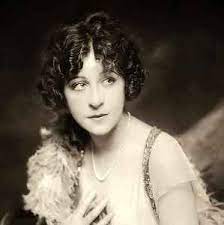
Having said that, Fanny Brice isn't even really known as a figure in that capacity anymore. Her legacy is mostly connected to this rather messy musical...which is both a blessing and a curse.
...and speaking of curses, hopefully in the years to come, someone will come along who can play Fanny Brice to its best potential.
Right now, Benko deserves the shot...but also, why the hell has no one given Jessie Mueller a call?!?!