It isn't very often that I sit down with a film and try to figure out what exactly I thought about it...and can be even rarer if I find myself thinking that I both hated and admired it all at the same time. You may find yourself understanding all the sides, whether they be people claiming the film is an auteur masterpiece while others claim its an obtuse bore.
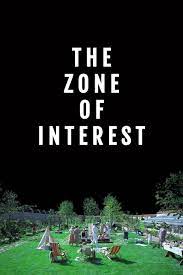
I knew that a film like The Zone of Interest would be difficult to sit through, and I can't say that my reaction to it was that much of a surprise.
I don't think I could ever say that I loved The Zone of Interest. It seems like too nice of a word to use for such an outing...but I will say that I highly respect it for what it made me feel.
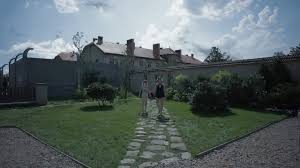
If we were to just describe this film at the most basic surface level, we are watching a family live their lives right behind the walls of Auschwitz. So yes, it is a family of Nazis who seemingly have no real shame or concern about living next door to a place where Jewish people are getting exterminated. This is because it is the home of Commandant Rudolf Hoss (Christian Friedel), a rather idyllic if not somewhat cold and stark home that he shares with his wife Hedwig (Sandra Huller) and their five children.
This is where the term "banality of evil" may perhaps get overused...and I have seen it used quite often in many of the reviews I have come across but I am honestly amazed at how effective this film is.
Filmmaker Jonathan Glazer, the man behind such heralded indies as Sexy Beast, Birth, and Under the Skin, has finally received more widespread recognition with his work here and I do have to commend him for what he has achieved.
Glazer's method for directing was setting up strategic hidden cameras around the Hoss compound and giving the actors very bare bones blocking. In interviews, Friedel and Huller both stated they could look 360 degrees around them and not see a single camera or crew member as they would be off watching the screens in a van nearby. When I first heard this, I wondered how much it would actually work and if perhaps it was too cold an approach...but the more I think about it, the more I think it works perfectly for this type of film and subject matter.
Huller has also said in interviews that she had zero interest in giving Hedwig any kind of internal life because she was a despicable human being...and at first glance, this sounds like it would lead to a performance that is rather hollow. However, this is Sandra Huller...she manages to find ways to bring out an energy from this total bitch of a human being because that is just how good of an actress Sandra Huller is.
The film feels like it has no script for significant parts of the film's length. It feels very "in the moment" and, at times, even reminded me of Kubrick's work on films that relied more on atmosphere and themes...particularly something like 2001: A Space Odyssey.
This is where I can see why some might take umbrage to the film, as they may say nothing happens and it is just film that sort of coasts on energy...but if anything, I find the film succeeds in ways that are very specific and highly successful.
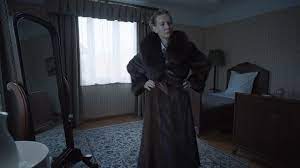
We are watching this family live their life with very little care in the world. We watch them swimming in a lake, we watch Hoss take a business meeting in which engineers casually explain to him how effective a new crematorium will be at killing a larger number of Jewish people, Hedwig tries on a new luxurious mink coat, the kids entertain other children in their new swimming pool while we see the smoke from another incoming train of people on path to be murdered.
There are also some sequences shot in night vision where we aren't entirely sure what is happening at first, involving a girl. Combined with Mica Levi's moody score, you feel very on edge yet again until you realize what she is doing and how for one brief moment, we see a glimpse of humanity.
We aren't being spoon-fed here; Glazer finds ways to sneak in. During moments where characters are having a casual conversation, we will hear gunshots faintly in the background or see smoke coming from the crematorium. The sound design here is so effective and it is no wonder that it may have a chance at overtaking Oppenheimer at the Oscars in that category.
When the film was over, I found myself not really sure what I felt. I knew that the film succeeded in making me uncomfortable and feeling a sense of danger. I don't want to fully spoil anything, but I will say some of the choices made, even those that are quite small, lead to rather stark and powerful results in ways that do make you feel uneasy and unsafe. You really don't know what to expect.
I can't say that I am going to revisit this film...unless if I am going to sit down and analyze certain scenes gradually, but for a film that mostly relies on "what you don't see" and perhaps what you can only hear, this results are truly remarkable.
It is hard to shake the film from my mind.
The final moments, which involve stark shadows and a time jump, feel rife for analyzation...and leave you wondering if perhaps Hoss had some ounce of empathy...but the whole film also makes you feel complicit too. We feel helpless watching it...and as uncomfortable as that may be, I can always respect a film that pulls that kind of emotion out of it.
I will express right up top that I am a little bit behind this season and that I still need to some a few of these contenders, so I will call out those films/performances just to ensure fairness.
When it comes to reading the reactions of others online, I am seeing a lot of comments that many of the nominations are quite basic...especially when it comes to the acting categories.
I will say that there was an opportunity for the Academy to recognize some performances that were out of the box...but in the end, it is all about exposure most of the time...and who campaigns the most.
I am only going to focus on the Big 8 categories, which will be the Screenplays, Acting, Directing, and Picture.
BEST ADAPTED SCREENPLAY:
American Fiction
Barbie
Oppenheimer
Poor Things
The Zone of Interest
THOUGHTS: The big snub here is Killers of the Flower Moon, and while I did predict it, I had wondered if it could end up being left off....though part of me wondered if Oppenheimer would suffer that fate. I think the strength of that latter film is just too hard to ignore...and frankly, despite the fact that I think Christopher Nolan gave short shrift to his female characters, it was his best script in years and was a major factor in why the film was such a success. But if I were to call out a winner in this category now, I think it is a tight race between American Fiction and Barbie. Due to the rules, Barbie got sent to compete in this category considering it is based on an IP...even though the film has been pretty much in Original Screenplay all season. I honestly could see this one going either way, but I would be inclined to vote for American Fiction of the two. I suppose you could consider Poor Things a dark horse here as well. Honestly, the only one that doesn't have much of a shot here is Oppenheimer but considering Nolan will (rightly) win Director, that is where his flowers should be focused. I think The Zone of Interest is in an interesting position here, but I do feel like it won't pull it through.
----------
BEST ORIGINAL SCREENPLAY:
Anatomy of a Fall
The Holdovers
Maestro
May December
Past Lives
THOUGHTS: Unlike a lot of critics and certain film buffs, I was not a fan of May December at all and was kind of hoping that it would get snubbed once we saw it wasn't performing well elsewhere. However unlike recent years, Original Screenplay feels more "barren" in terms of potential nominees...but I put it in quotations because there were other films that easily could've been placed here instead of not just May December but also Maestro.
Thankfully, neither of those films have a shot here.
While the Golden Globe for Screenplay is not always the best precursor for predictions, I do think there is a chance that Triet and Harari's win there for Anatomy of a Fall could prove hopeful that it could prove competitive here against The Holdovers.
With the Writers' Guild Awards being postponed til after the Oscars this year, we won't be able to look at them for any kind of predictions. BAFTA will end up being the major key here...but I do think that despite how much I do love Past Lives, it won't end up taking this prize.
I suspect it will be a race between Anatomy and The Holdovers. Both are worthy, but I am inclined to prefer the former. I also think that it could prove to be popular enough with the International block of voters to propel it to a win.
--------
BEST SUPPORTING ACTOR:
Sterling K. Brown, AMERICAN FICTION
Robert DeNiro, KILLERS OF THE FLOWER MOON
Robert Downey Jr., OPPENHEIMER
Ryan Gosling, BARBIE
Mark Ruffalo, POOR THINGS
THOUGHTS: No real shockers here. There was a possibility of seeing Ruffalo getting snubbed after being left off the lists for SAG and BAFTA...and at SAG, his costar Willem Dafoe got in over him.
Seeing Brown get this kind of recognition is nice after so many years of hard work, but American Fiction remains one of the films I have still not seen.
The trajectory right now seems to be that Downey Jr will sweep to a victory sort of for a combo of a good performance meets career win...and we've certainly had far worse wins. I am just not sure I would consider him undeniable in terms of his performance.
The real question will be seeing what SAG and BAFTA do. Keep in mind, last year no one was really considering Jamie Lee Curtis as a true factor in this race until she ended up winning at SAG over Angela Bassett and Kerry Condon.
And if you look at 2021 winner Youn Yuh-jung for Minari, she had been snubbed at the Golden Globes but then rallied for a win at SAG which led to her BAFTA and eventual historical Oscar win.
But yeah, that's Supporting Actress so I am going off on a tangent there...but the sentiment and thought process still stands.
At SAG, I suppose I wouldn't be shocked if Ryan Gosling managed to win thanks to the immense popularity of his work...but that is also the thing: it is not like Robert Downey Jr is in some obscure film or he is some unknown actor. Both are part of the Barbenheimer phenomenon.
I do think Downey Jr is the logical prediction at this point, but I think tides could possibly change.
I will say that Robert DeNiro gives his best performance in over 30 years in Killers, but I am not necessarily sure I would've been upset had he been left off the list.
I will say that one performance that I loved that didn't truly gain traction in this category, though he managed to get a GoldDerby Film Award nod (which is an online film critic voting site which I happen to be a part of) is the young Milo Machado Graner for Anatomy of a Fall....easily one of the finest child performances I have seen in a film.
--------
BEST SUPPORTING ACTRESS:
Emily Blunt, OPPENHEIMER
Danielle Brooks, THE COLOR PURPLE
America Ferrera, BARBIE
Jodie Foster, NYAD
DaVine Joy Randolph, THE HOLDOVERS
THOUGHTS: I have not seen The Color Purple, so I cannot comment on Brooks. HOWEVER - I saw Brooks do this role on Broadway and she did a truly lovely job in a role that most have associated with Oprah Winfrey's iconic take in the 1985 film.
Even though I am not sure I would say she is necessarily undeniable either, I think it is a safer bet to think that Randolph will continue her impressive sweep of the season just like Ke Huy Kwan did last year.
It is lovely to see Emily Blunt FINALLY get an Oscar nomination after all this time, and while I do think she suffers a lot from her role being underwritten, whatever moments she does get are superb.
While I was no fan of Nyad, I didn't have as severe of issues with the performances, particularly that of Jodie Foster who I felt easily stole the film with her passionate and warm performance of Bonnie. Also, it is just nice to see Foster back in this kind of arena again after all these years! With this and True Detective, we are in the midst of the Fostersance!
That brings me to America Ferrera, which might be the most controversial nomination of the morning.
I sort of compare this nomination to that of Laura Dern's for Marriage Story, in that a particular monologue was considered the centerpiece for attention...but unlike Dern and Marriage Story, I would say Fererra's role had more to it than Dern's and it is obvious that Barbie is a much more significant film to say the least.
However, considering Fererra managed to miss all the major precursors except for the CCs, this is clearly a nomination that was selected by passion...but it was at the expense of some truly amazing performances.
I had hoped Sandra Huller could pull a double nod and get in here for The Zone of Interest, but also, Julianne Moore for May December (the film's highlight IMO) was far more worthy to slip in here.
In the end though, I think Randolph would cost through the rest of the season. Her sweep thus far just feels too strong to ignore.
--------
BEST ACTOR:
Bradley Cooper, MAESTRO
Colman Domingo, RUSTIN
Paul Giamatti, THE HOLDOVERS
Cillian Murphy, OPPENHEIMER
Jeffrey Wright, AMERICAN FICTION
THOUGHTS: When people first started watching Killers, there was all this talk about how it might be DiCaprio's best work...and now, here we are: SNUBBED.
I don't think he was bad in Killers, but I do think there was enough stiff competition here and also a certain sense of frustration with the character he played that it ended up negatively affecting him.
I have actually not seen Rustin yet, but I have been a fan of Domingo as an actor for some time. I still recall his work in the little-seen but fantastic musical The Scottsboro Boys back in 2011.
Is there a possibility we could see a last minute surge for Bradley Cooper? I suppose I wouldn't rule it out. I don't think it is out of the realm of possibility he could win at SAG....not to mention he managed to also get a Directing nod at BAFTA which kind of shocked me.
I still think this race is between Giamatti and Murphy...and I sort of suspect that SAG will go for the former and BAFTA for the latter which will create a semblance of suspense on Oscar night...but I am sort of inclined to think Giamatti might pull it off.
However, the snubs of Andrew Scott and Teo Yoo are a shame. They were longshots, especially Yoo, but it is sad to see Cooper on here and not one of them.
--------
BEST ACTRESS:
Annette Bening, NYAD
Lily Gladstone, KILLERS OF THE FLOWER MOON
Sandra Huller, ANATOMY OF A FALL
Carey Mulligan, MAESTRO
Emma Stone, POOR THINGS
THOUGHTS: The big news of the day with this category is the snubbing of Margot Robbie...but the fact of the matter is that for a while, most people suspected Robbie would miss this list.
It wasn't until she kept getting nominated for various prizes that some suspected maybe she would actually slip in after all. If I am being completely honest, I am not so sure I would've nominated her either. It isn't that she was bad in the film, but the competition here is just SO FIERCE...although I would've nominated her over Annette Bening which...I will get to her in a moment.
I am still of the belief that Lily Gladstone is Supporting in Killers...and to be honest, the film should've truly given her MORE of a spotlight to warrant a Lead placement (one reason it is nice to see that Screenply snub)...but there is no denying that Gladstone is a force and has such an amazing screen presence.
Mulligan was the best thing about Maestro, and that seems to be the consensus with people who were not so keen on the film like myself. I am also something of a Mulli-hoola-gan...yes I just made that term up....well at least I think I did... but she has given us so many amazing performances that were worthy of Oscars and yet this is only her third nomination. She was win worthy for both An Education and Promising Young Woman plus she was stellar in snubbed roles like Never Let Me Go, Shame, and Wildlife. As Felicia Montealegre, she was that bloated pretentious film's saving grace by a mile.
I shamefully have still yet to see Poor Things which I need to get on fast as it does seem likely that Stone may pull off a second Oscar win here. She already has a pretty undeserved win for La La Land where she was clearly the weakest in her category.
As for Bening, some people have speculated that perhaps she could win the SAG and become competitive to win...but the thing is I am not sure how sentimental these voters are going to be. Just a few years ago, everything seemed to be set in motion for Glenn Close to finally win her overdue Oscar for The Wife...along for Globe/BAFTA winner Olivia Colman to (deservedly) swoop in and win. Then again - it would be on brand for the Oscars to finally award Bening for THIS performance rather than her work in films like The Grifters and American Beauty)
If anyone from this group deserves to swoop in (and she would need to win at BAFTA to be viable), it is Sandra Huller.
THAT is who I am rooting for her...and I do think if she wins at BAFTA, she could prove to be a strong candidate that a lot of international voters will rally behind. Her work throughout that film is the definition of sterling, but she does an exquisite job in the fight scene with her husband which, to her benefit for American audiences perhaps, is done primarily in English.
However, the tide seems to be moving into Stone's direction.
It is sad to see snubs for the likes of Greta Lee as well, but in hindsight, it was just a very subtle role going up against such big heavy-hitters.
--------
BEST DIRECTOR:
Justine Triet, ANATOMY OF A FALL
Martin Scorsese, KILLERS OF THE FLOWER MOON
Christopher Nolan, OPPENHEIMER
Yorgos Lanthimos, POOR THINGS
Jonathan Glazer, THE ZONE OF INTEREST
THOUGHTS: I never entirely bought into Gerwig making it in here and this was one category that I went 5/5 as I suspected Triet would benefit from her exposure of the Screenplay win at the Globes and the strong showing of the film at BAFTA. She also fits the bill of a foreign auteur slipping into the race a la Pawel Pawlikowski, Thomas Vinterberg, Ryusuke Hamaguchi, and Ruben Ostlund.
As it stands, Nolan is going to walk away with this and I think many of us suspected this even if we doubted Oppenheimer was the frontrunner to win Best Picture as well. I have never been a passionate fan of Nolan...and I am one of those people who still says his best film was Memento...and yet, I think Oppenheimer is worthy of that title as a whole. It is simply a monumental achievement.
I do want to give a shout out to another subbed filmmaker who I hope will keep making lovely films considering Past Lives was her debut: Celine Song.
--------
BEST PICTURE:
American Fiction
Anatomy of a Fall
Barbie
The Holdovers
Killers of the Flower Moon
Maestro
Oppenheimer
Past Lives
Poor Things
The Zone of Interest
THOUGHTS: As we have established, I have not seen American Fiction or Poor Things.
When looking at the nominees, there are no surprises. In fact, the 10 films on this list matches the PGA Top 10...which is actually kind of a big deal as normally that organization can lean more basic in terms of not acknowledging foreign films and they are more open to nominating popcorn flicks from time to time.
And yet, they went for the three foreign films...although I do think Anatomy and Past Lives both having portions of English do help them greatly in that regard.
As a list, even on just the films I have seen so far, the only ones that I have lesser of an opinion on are Killers and Maestro.
My issue with Killers still comes from having issues with its script and I frankly felt its pacing suffered on top of it. For anyone who wants to mock Oppenheimer for its length, go ahead...but for me, that film was a prime example of how to edit and pace a 3-hour film. I mostly found Killers to drag and found DiCaprio's Ernest a difficult character to watch after a while. There is no denying that there are great aspects, mind you.
As for Maestro, it may not have been 3 hours long but it sure as hell felt it! I know some pundits have been trying to defend Bradley Cooper but I also feel like so many film buffs were not pleased with this film. It just felt overly pretentious and a lot of it felt like a vanity project where Cooper just tried too hard all the time. I grew sick of hearing about him taking 6 years to learn to conduct...and then seeing articles crying for him that he keeps losing awards for said performance where he spent 6 years learning to conduct...but alas, the film has high profile producers (such as Spielberg) and is the prime example of the kind of film that the old guard Academy would eat up with a spoon.
Maybe not all of these films would make my personal lineup in the end, but simply put: Anatomy of a Fall, Barbie, The Holdovers, Oppenheimer, Past Lives, and The Zone of Interest are undoubtedly 6 of the better films to make a BP lineup in quite awhile. If I end up responding very positively to Poor Things and American Fiction, that will easily solidify this as one of my favorite BP lineups.
Some thought The Color Purple could still sneak in here, but I never bought into that narrative for them....but looking at a lot of these nominations, it is hard to tell what would've even been #11...unless they actually would've gone for something like Spiderman or The Boy and the Heron.
Oppenheimer is the current frontrunner, but I would say if it manages to face backlash like some films have managed to do recently (infamously La La Land), I think The Holdovers and Anatomy of a Fall are in the best position to actually be the strongest dark horses. I would also say American Fiction has a tiny shot if it manages to win Adapted Screenplay, so I would slot it fourth for now.
________________________________________
OVERALL FINAL THOUGHTS:
Without being able to comment on a couple of these films, I can't be fully definitive yet.
Like I said, a lot of the Best Picture nominees I did see were quite good or even great...that's a lot more than I can say for the last two Best Picture lineups.
I do think it is a shame that Fallen Leaves was left off the International Feature film list, but in case you were wondering why Anatomy of a Fall isn't there, Emmanuel Macron was said to have not selected the film to be France's representation for the International Film category and instead opted for The Taste of Things, a film that I have actually not seen yet but some have said is a bit more droll. His decision was apparently stemming from Triet's harsh criticism of various policies that weren't left-leaning enough...and let's just say she got the last laugh in the end.
I do want to take a moment to comment on the selection of The Teachers' Lounge, which is the selection from Germany. A very wonderful film I watched this past weekend that was a rich look at the erratic lives that teachers often face when dealing with troubled students.
Once the awards get closer, I will do a final predictions post. By then, I will have definitely seen the remaining contenders and I will also likely have my Top 10+ list for 2023 up around that same time as well. I want to be sure I have seen enough films and ruminate on them because...I guess my opinion matters on my own blog.
Ah yes, the ever popular "meet cute" that is a staple of romantic comedies.
When it comes to the genre of romantic comedies, it is one of those areas where you don't often see the films treated with a lot of prestige most of the time. Frankly, that is often a valid criticism.
Most romantic comedies don't end up reaching the heights of Moonstruck or When Harry Met Sally or have the vibrancy of so many of the screwball comedies of the 30s or 40s or the dynamics of a duo such as Katharine Hepburn and Spencer Tracy.
Romances, comedic or not, can end up being deceptively captivating films.
City Lights, Now Voyager, Brief Encounter, The Apartment, Annie Hall, the Before trilogy, In the Mood for Love...all truly magnificent example of romantic films whether they be more dramatic or comedic...or a mix of both.
In 2023, we got two films that played into those areas.
I have already discussed Past Lives, which had the more dramatic approach and perhaps a bit more realistic.
Now, I have to shed some light onto Rye Lane, which now joins the list of some of the greatest romance films I have ever seen.
Some of you might be wondering: "Why have I not heard of Rye Lane?"
Well, this is often the sad case of some of the small films that often premiere at Sundance. While Rye Lane made a splash at the 2023 Sundance Film Festival, it was quietly bought by Fox Searchlight and sent to Hulu for streaming way back in March. After hearing about the film through various YouTube channels of film lovers, it seemed as though it slipped through the cracks, and I ended up forgetting about it.
It wasn't until I saw a random review for it pop up on Letterboxd that I decided to check it out as I felt like the vibe of the film would be something I would enjoy. I am currently going through my second bout of COVID as I type this (but I am on the tail end of the suffering) and when I put it on, I was dealing with a very brutal, pounding headache. My goal was to just lay in bed and stare at the TV and hope that if I just did nothing else, I would feel better, and my Excedrin would kick in.
And it was easily one of the best decisions I could have made.
Rye Lane began as the first film script for British actor and writer Nathan Byron, who had acted on multiple seasons of the series Benidorm and helped co-create the show Bloods starring Jane Horrocks.
Byron co-wrote the film with writer Tom Melia and its original title was Vibes and Stuff...which, honestly, is VERY fitting. The directorial duties were given to Raine Allen-Miller, who had yet to direct a feature film and she actually had reservations to doing romantic comedies due to some of their more corny and predictable sensibilities. Her input to the film would become crucial to its tone...and also, her visual style would also aid to a lot of the film's flair.
The film is set in the South London neighborhoods of Peckham and Brixton. We meet Yas (Vivian Oparah) who overhears Dom (David Jonsson) crying in a bathroom stall. She peeks through the bottom sliver of the stall to see if he is okay (a reminder at the privacy one gets in stalls in the UK...) but is only able to see his pink-hued Converse.
Shortly thereafter, she is able to find Dom outside the stall by recognizing his shoes. They are both attending an art exhibition by their mutual friend Nathan and have an immediate connection despite him being a bit more reserved and her being more outgoing (classic "meet-cute" trope).
They go for stroll through Rye Lane Market and both discover that they are going through relatively recent breakups, but Dom's is deeply affecting him. He was with Gia for 6 years and he happened to find out (in a very silly but brutal way...let's just call it "low-res cock" as Yas puts it...) that Gia was cheating on him with his best friend Eric that he had known since childhood. After the breakup, Dom moved back home to his parents' place and is pretty much living life in limbo.
Before the two begin to part ways, Dom tells Yas that he is actually on his way to meet Gia and Eric as the two of them want to clear the air. However, Yas does have a plan...and from there, I became even more invested in this duo.
There is a famous quote that is basically "good artists copy, great artists steal".
As for who said the quote (some have said Faulkner, some have said Picasso, Tennyson, T.S. Eliot...), that isn't really the point here, but I do want to stress that this is a very true but precarious statement. A lot of how a great artist "steals" is what they can do to help make their work feel fresh and vibrant as opposed to something that just feels typical and barely competent.
While watching Rye Lane, you those meet-cute elements of many romcoms but you also get the sense of two people spending a day together similar to films like the Before trilogy. On top of that, this is romantic comedy focusing on two black people in South London...areas of that city that aren't often featured on media...at least as much on the media we often see prominently in the US.
The way that Raine Allen-Miller, along with her cinematographer Olan Collardy, films this feels so alive. The lens gives off a vibe as if we are watching the film through a 0.5x setting on our iPhone, and all of the colors pop so gloriously that it gives the film such a rich and welcoming vibrancy.
In some ways, it feels like just as a flashy an introduction to a neighborhood as when Spike Lee showed the world his home of Bed-Stuy in Do the Right Thing. While that film certainly had a darker subject matter to say the least, Lee immersed us in it with lots of pizazz and color and with creativity with his cinematography. Allen-Miller does that here with great fervor.
On top of that, we see small moment of flashbacks where Dom and Yas are interacting/watching themselves in their breakups...and this element reminded me a lot of how Woody Allen used similar motifs in Annie Hall.
And yet, these tropes were stolen and used with great care and given a new coat of paint.
I cannot begin to tell you what a joy this movie was. Oh, and with a runtime of just under 90 minutes, the film doesn't mess around. It just says what it has to say and doesn't outstay its welcome. Perhaps my only quibble is that it does feel a tad rushed once we get to the "conflict" but not enough for me to call it a true detriment by any means.
As a duo, Vivian Oparah and David Jonsson are simply divine. Their chemistry is off the charts, you adore both of them instantly, and even if Dom is supposed to be a bit of a wet blanket, you sense how good and sweet he is, you want him to be happy.
With Yas, you might view her as being too bold and obnoxious, but she totally has heart, and you root for her just as much as you root for Dom.
I really wish that this film was getting the same kind of attention as Past Lives. While both are very different in tone and content, they both represent what can be great about the romance genre when done with great integrity.
Past Lives represents that sort of bittersweet "what might have been" feel, but Rye Lane shows us the prospect of two souls who might be a bit different finding out that they may be perfect for each other.
It may not be something entirely new in theory, but I cannot stress enough how wonderful this film was and how much it just made me beam the entire time, COVID-induced headache and all.
I am often a very cynical person by nature, so when a film makes me feel this good, it is quite the feat. What a truly remarkable debut and what a fantastic led duo.
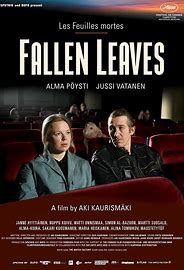
2023 seemed to be a big year for films revolving around two main stars at very tentative and pivotal moments in their lives: Past Lives, Rye Lane, and Fallen Leaves all seem to fall in this category.
I first saw an advertisement for Fallen Leaves via an arthouse theater screening that was occurring here in New York a couple of months ago, but what really shocked me was how much some of the photo stills provided actually pulled me in to wanting to learn more about the film.
Aki Kaurismaki is arguably the most well-known Finnish filmmaker...and if I may be so candid, I am not even sure if I know more. Even amongst Kaurismaki's filmography, I have only seen 3 of his other films:
1986's Shadows in Paradise
1990's The Match Factory Girl
2011's La Havre
One of the major things I recalled about Kaurismaki was that his style could be that of a Scandanavian Jim Jarmusch (which is particularly humorous considering a Jarmusch film makes an appearance within Fallen Leaves) or perhaps that of early Coen Brothers. He also doesn't try to give his films any more than what they need to get their point across. Of the three films I mentioned above, La Havre was the longest at just over an hour and a half. The other two ranged around an hour and ten minutes.
Fallen Leaves settles in at 80 minutes...and it does move at a leisurely pace, not that it is a detriment.
We begin with Ansa (Alma Poysti), a supermarket employee who is working on a zero hour contract and is promptly fired when she is spotted giving away old groceries to others in need and also stealing a sandwich for herself. She eventually finds another job as a recyclable plastic sorter.
We then meet Holappa (Jussi Vatanen), an alcoholic sandblaster who happens to cross paths with Ansa and after going to see The Dead Don't They (the Jarmusch film I alluded), they kiss and she offers him her number...which he accidentally loses upon her departure.
Fate manages to bring them together again, and this time they try to form a relationship with one another...but Ansa does notice Holappa has an issue with drinking, which proves to be the first hurdle.
Prior to watching Fallen Leaves, I checked out the film's profile on both Rotten Tomatoes and Letterboxd. The critics' rating on RT is a whopping 98% while the score on Letterboxd is 3.8/5...but if you look at the Audience Score on RT, it is a 55%.
This is an area where I begin to think a lot about the idea of art being subjective. Looking at a film like this, which is very slow paced and meandering despite its only 80-minute running time, I can see why many would watch it and think that it doesn't have much to offer. On top of that, there is the ever-pesky roadblock for those who don't want to read subtitles.
Kaurismaki, as I mentioned before, does not try to stretch his films out as if to try to act like his stories need to be told for 2+ hours to seem more prestigious. There is truly something refreshing about watching a film and seeing it not try too hard and yet, it manages to still soar despite how little it is seemingly doing.
It certainly helps that Poysti and Vatanen both make for a truly alluring duo in their own rather meek and subtle ways. To only add to that alluring appeal is the film's visual style, with gorgeous lighting which gives us small splashes of color mixed in shadows. It almost feels like Kaurismaki never felt compelled to move on to more advanced filming equipment and wanted to stay forever in the 70s or 80s. Even though the film is set in the present day (with repeated references to the Russia/Ukraine conflict), it almost feels like it was plucked from the past even more so than something like The Holdovers tried to achieve.
Kaurismaki's work often shines a lot on people who are on or near the poverty line...but the stories are often told in such a quietly comedic way that borders on dry that you find yourself feeling very endeared to the people even though we are often left with some distance. He gives the people enough dignity that we root for them...and we want to see Ansa and Holappa be able to work through their issues.
One might say that the distance that Kaurismaki has will leave us feeling uncaring, but somehow, I always find the humanity there.
Fallen Leaves is likely my favorite of the films of his I have seen, but that is irrelevant here. I just appreciate how much it made me think about films speaking to me without having to do anything bombastic. Not every film can pull off something so quiet and subtle without having the risk of being dull; it is a recipe that is very delicate and complex.
*I am writing this out in a rather freeform manner. I have a lot of random thoughts about this topic, so I just want to ramble and go on a journey with this...but I promise it won't be THAT chaotic!*
----
As we enter the thick of the 2023/24 Movie Award season, I felt compelled to talk about the topic of films that would be stereotypically classified as "Oscar Bait".
As one might expect, this is a term based on films that seem tailormade to win awards but might be seen by some as pretentious or stuffy or made with a lot of immense grandeur.
Going back through all of Oscar history would take far too long so I am going to give myself a timeline from 1960 to the present day because this will give me enough of a scope to show changing tides in the types of films that get nominated or rewarded.
With the 1960s, we see a rather big surge of rewarding movie musicals which also wasn't uncommon for them to do in the decades prior to that. In the 60s alone, they rewarded West Side Story, My Fair Lady, The Sound of Music, and Oliver!
Once you get to the 70s, you get a shift in what they honor that coincided with both the shift in Academy membership and the shift in Hollywood. This led to wins by films such as The Godfather I and II, The French Connection, and One Flew Over the Cuckoo's Nest...but there was still enough of the "old guard" that propelled films like Patton and The Sting to the win over "new" films like Five Easy Pieces or The Exorcist.
Once the 80s came along, it seemed more like grandeur was coming back into play and we saw an embrace of sweeping epics like Out of Africa and The Last Emperor. It was more common over the decades for certain years to have a film that would sweep the ceremony with 8+ wins.
The fact that Everything Everywhere All at Once even won 7 Oscars is practically unheard of any more.
And speaking of that film, I think nearly every avid film goer would willingly admit that if you approached them just a few years ago and said that a film about a multi-verse in which we get scenes with Michelle Yeoh and Jamie Lee Curtis as lesbian lovers with hot dog fingers and trophies that resemble butt plugs would end up making one of the most prolific sweeps in Oscar history, we would question their sanity.
In some ways, there is a shift of sorts as to what is being deemed "Oscar bait" these days...at least in terms of what will actually go on to win the prize or, at the very least, gets high praise and multiple nominations.
This recent shift reminds me a lot the late 60s/early 70s in terms of looking at the films that were awarded/being nominated. I know I have referenced some of these stories in various ways in other posts I have made, but I want to detail the journey of these eras a little better.
Actor Gregory Peck served as President of the Academy of Motion Picture Arts & Sciences in the late 60s and unlike many of his colleagues, he was very willing to see the cultural shifts and wanted to embrace the future of cinema. Not only did he want to see more foreign cinema recognized, but he wanted to hear more of a voice from younger artists and artists of color.
He was actually a big champion of animation and felt that The Jungle Book was worthy of a Best Picture nomination...and despite his efforts, it never materialized. Even to this day, only 3 animated films have received the honor of a Best Picture nomination...which is even more insane when you take into account that we've had an expanded number of Best Picture nominees since 2010...and that nominee expansion is a topic I will return to shortly.
Only Beauty & the Beast managed to get a Best Picture nomination when the nomination tally was stalled at 5.
Peck's efforts at the Academy did signal some significant change, but what is fascinating at that time is seeing the give and take of the "old guard" and "new guard".
Let's take a look at the 3 years in which Peck was at the helm and notice what kind of films made the cut. WINNER IN BOLD.
1967:
Bonnie & Clyde
Doctor Doolittle
The Graduate
Guess Who's Coming to Dinner?
In the Heat of the Night
______________________
1968:
Funny Girl
The Lion in Winter
Oliver!
Rachel, Rachel
Romeo & Juliet
________________________
1969:
Anne of a Thousand Days
Butch Cassidy & The Sundance Kid
Hello, Dolly!
Midnight Cowboy
Z
__________________________
Going in order, you see them opting for a film involving a murder mystery/racial tension in the South only to follow up the following year with a movie musical based on a popular Broadway show, only to follow that with the only X-Rated film to ever win the Oscar.
Even looking at the nominees, it feels incredibly jarring to see the likes of Anne of a Thousand Days and Hello, Dolly! in a lineup with Midnight Cowboy...and this isn't to say that I don't want variety amongst the nominations but these are films that don't stand the test of time and weren't even that well received by critics in 1969.
It is just interesting to see the back and forth between the bold and conventional choices...and that heavily mirrors what has been happening over the past 15 years with the Oscars.
As I mentioned earlier, the Academy expanded the Best Picture nomination total to 10 in 2009 and this was after a very heated and passionate protest occurred when The Dark Knight and even Wall-E were snubbed in favor of a movie like The Reader, which some deemed as a very droll and not particularly compelling film adaptation of what was otherwise a highly acclaimed novel...BUT...that film fit the mold of "Oscar bait". It had that air of prestige. It felt adult. It wasn't a movie based on a comic book or an animated film about robots.
With the change to the higher tally, this gave birth to the preferential ballot system. Whereas other years simply allowed the film with the most votes to win, the winner would now be chosen based on how well did in terms of its placement not just with #1 votes, but #2 and #3 as well. Essentially, as the other films get eliminated.
For example, let's say someone voted for Elvis as their #1 film last year (for some ungodly reason) and for #2, they voted Everything Everyhwere All At Once. It was obvious that the love for the latter was undeniable...and considering that Elvis went home empty handed at the ceremony, it seems likely that it didn't score as well in the final voting for Best Picture. Once that film got eliminated, that #2 vote for EEAAO becomes a lot more viable.
In the first few years of this system, we still saw some mini sweeps like The Artist or films that kept winning at precursors all season like Argo but over time, it became more common for winners to go in multiple directions.
2015 was a major example of this.
The Big Short won the PGA and The Revenant won the DGA...while Spotlight won at WGA and SAG.
You truly could make a case for any of them winning...but thanks to what likely seemed like strong support from both the writing and acting branches, Spotlight won and only walked away from that ceremony with its wins for Picture and Original Screenplay; the smallest tally for a Best Picture winner since the 1930s.
Then the following year, it seemed like La La Land was going to steamroll its way to an Oscar win after all the rapturous praise it received...not to mention a record 14 Oscar nominations which tied it with All About Eve and Titanic. There was even a time where the stat of being the film with the most nominations made you the very likely frontrunner...but instead, the backlash from some towards La La Land gave it inevitable voter fatigue and that led to critical darling Moonlight to win and many deemed that thanks to the preferential ballot (although I still think Moonlight was the worthy winner).
Moonlight winning was followed the next year by The Shape of Water and while not as insane as something like EEAAO, a fantasy/romance about a mute woman falling in love with a fish man does not seem like your typical Oscar fare...and yet it won and seemed like a likely victor despite close competition from films like Three Billboards Outside Ebbing, Missouri.
However, this is where I think the comparison to the Academy of the late 60s comes into play.
After showing a willingness to acknowledge a film about a woman having sex with a fish man and a film chronicling the life of an LGBT black person from the ghettos of Miami, the Academy then honored Green Book, a whitewashed and mawkish race film that felt as backwards and banal as any film of a similar ilk that had been made in the last 40 years prior to it.
Although, some may argue that it won out mainly due to the fact that the frontrunner was Roma, a slow-moving foreign film from Netflix and that many voters didn't want to give a streaming service that kind of victory. In fact, Steven Spielberg flat out said in an interview that he voted for Green Book for that very reason.
Is that petty? Yes.
However, I don't say that as a fan of Roma. I actually found it a bit overpraised and was fully in support of The Favourite that season.
But even with the next few years to follow, you see a bit of a back and forth.
2019 gave us our very first foreign language Best Picture winner with Parasite, a film that seemed to have such widespread adoration and universal acclaim that it seemed undeniable despite the fact that a lot of the industry guilds kept honoring a more typical "Oscar bait" film: 1917.
2020 was a bit more unusual due to COVID, but that year led to Nomadland performing a strong sweep at the precursors prior to Oscar night leaving its victory seemingly a foregone conclusion which, to me, still seemed mildly surprising.
I kind of felt like that film was a very unique choice and that the circumstances of the year led it to being consistently crowned more out of "sheep mentality" than anything else...but I also feel like I wasn't as enamored with the film as some were so that could be my own bias talking.
Then comes 2021, a year in which the overwhelming critical darlings were a 3-hour moody Japanese film: Drive My Car and a very slow-paced western: The Power of the Dog.
While I absolutely adored the former, it didn't seem to have enough industry support to propel it to victory but I LOVED the fact that it managed to get into Picture, Director, and Screenplay.
As for The Power of the Dog, its audience scores were not particularly strong and the film did suffer from that as it didn't exactly garner a lot of passion.
It went from being a film that many thought could win Picture, Director, Actor, Supporting Actor, and Screenplay to only winning Director for Jane Campion on Oscar night.
What film ended up winning?
Coda, the sentimental heartwarming film bought by Apple out of Sundance that no awards pundit seemed to take seriously until the very last minute. By Oscar night, I did predict it would win but its win felt more like a desperate attempt to crown something other than The Power of the Dog.
And as I have mentioned, Everything Everywhere All at Once managed to win last year and thanks to a relative lackluster group of nominees, its passion carried the day and it became what is easily the most bonkers film to ever take the prize to date.
With all this in mind, let's discuss the state of this current Oscar season.
There are only a small handful of films that seem to be in the running for a Best Picture nomination currently and while the tide could change, I sort of feel inclined to say that Oppenheimer is the frontrunner to win Best Picture at this point.
I am coming to this opinion with a positive bias as I was pleasantly surprised by how much I loved the film, but it seems like a perfect winner on paper thanks to the high acclaimed it received from both critics and audiences. The fact that a 3-hour biopic about J. Robert Oppenheimer managed to gross nearly $1 billion worldwide is absolutely remarkable...and sure, a lot of that has to do with the general respect that Christopher Nolan has and the fact that Oppenheimer is forever linked to Barbenheimer zeitgeist with Barbie.
And speaking of Barbie, it is the highest grossing film of the year and is not in the slightest what one might consider to be typical Oscar fare, and yet here it is, rightly being discussed for a nomination and frankly, it is performing very well with nominations in the precursors.
But there is one film that I really want to discuss here, and that is Maestro.
Like The Power of the Dog and Roma, Netflix is pushing Maestro as its main awards priority this year...and at first glance, you can understand why: it is Oscar bait to the nth degree.
It's a period piece biopic about a very iconic figure in the music world which allows its lead to transform thanks to rather prominent makeup/prosthetics...easily the most discussed fake nose since Nicole Kidman in The Hours.
And much like Oppenheimer, it uses a black & white/color motif with the cinematography...although Oppenheimer primarily uses B&W when it is telling the story from Lewis Strauss played by Robert Downey Jr whereas Maestro uses it for flashbacks.
Maestro is also filmed in a way that screams "Look at me! This film is art!" and sure, there is no denying that from a visual aesthetic, Maestro is a gorgeous film to look at but it does teeter on the brink of being pretentious.
Oppenheimer is certainly a stunning film visually, but the scope of it truly felt epic to warrant it...and to further add to that, I found that despite being roughly 50 minutes LONGER than Maestro, Nolan and his editor Jennifer Lame outdid themselves as I found Oppenheimer to be one of the best paced films I have ever seen...which is even more impressive considering it is 3 hours long.
The only real slap I can give it, and it is a justifiable complaint, is that the film really short shrifts both Emily Blunt and Florence Pugh in their roles even both are truly fantastic in the time they are given...but beyond that, the pace of the film is fast. It feels like the film has no bloat to what we are seeing and that felt refreshing as so many films in recent years, including this year, could've used either a rewrite or another trip to the editing room (i.e. Killers of the Flower Moon or Maestro).
I do think critical ratings systems can be problematic at times but they can also be very telling to see certain trends.
Rotten Tomatoes is definitely the key here and can be a bit hard to gauge...but as of this writing, Maestro has a 79% rating with professional critics. To put that into perspective, Green Book has a 77% and Crash, one of the other more infamous and derided winners in Oscar history, has a 74%...BUT both of those films have higher audience scores: 91 and 88, respectively.
Meanwhile, Maestro has a 64...and it actually dropped from 69 in just a matter of a couple of days.
On the app Letterboxd, Maestro has a 3.3/5 rating...and while these ratings are primarily from film buffs and not people like Oscar voters, it does prove to be a very telling way to see how tides are turning with a film's passion level.
But through it all, Maestro has received a lot of press mainly due to how thirsty of a campaigner Bradley Cooper is and the high profile Executive Producer team which includes Steven Spielberg and Martin Scorsese.
Similar to his A Star is Born costar Lady Gaga, who spent the entire 2022 season using verbiage to appear like a prestigious figure talking about her acting training at the Lee Strasberg Institute, Cooper has gone on repeatedly about how much he feels like he has developed a strong kinship to Leonard Bernstein, as if his spirit was present to him on set. He even did an interview on CBS Sunday Morning with Bernstein/Felicia Montealegre's children in which he tearfully said he already missed Bernstein and how much he feels close to him despite never having met him considering he died in 1990.
Cooper has also talked about how from a young age he took an interest in the idea of conducting; even asking for a baton one Christmas. Needless to say, it was no surprise that he was drawn to the film when it was first being developed at Paramount back in 2018 with Martin Scorsese and Steven Spielberg attached to direct at different points. Once both dropped due to scheduling conflicts, Cooper asked Spielberg if he could be given a chance to direct as well...and considering he was just finishing up work on his debut A Star is Born, he was able to get Spielberg's blessing.
And that blessing has turned into immense adoration.
Spielberg recently held a screening for the film via Netflix in which a talkback with Cooper followed and the amount of passion he felt for Cooper's work was expressed with great fervor...and it wouldn't shock me if some of the more "traditional" voters (i.e. older white men) would flock to Maestro.
So what I will be curious to see is how much this seemingly lack of passion from general audiences and even from a lot of critics in terms of top level praise will translate when it comes to a Best Picture nomination.
There is even a case to be made that Bradley Cooper's performance could lead him to an Oscar because it too fits that mold of "Oscar bait": he ages throughout the film, using makeup/prosthetics (that damn nose yet again), and even trying to work to alter his voice based on how much the chain smoking lowered Bernstein's vocal timbre over time.
On top of that, Cooper keeps flaunting how it took him 6 years to prepare for the role...including spending that whole time trying to properly conduct an orchestra for a 6-minute scene.
Just typing in "Bradley Cooper Maestro" on Google led to me finding over a dozen articles about this very topic...and after watching the film, I found a lot of it to be showboating.
Bernstein WAS very animated as a conductor at times but he was still (it goes without saying) in tune with his orchestra. I never got the sense that Cooper was actually conducting the orchestra rather than trying to appear completely consumed about the music and wanting to show off a lot of vigor.
If you watch videos of Bernstein, he was very even tempered. In fact, just watch this clip of Bernstein conducting the NY Philharmonic through Sousa's Stars and Stripes Forever:
The one moment I want to point out in this clip happens right after the 1:45 mark which is where the full orchestra practically falls to whisper so the flock of piccolo players can have their solo. He does the "bring it down" motion and then turns his gaze to the piccolos where subtly conducts them with a little bit of a devilish glee (he did adore this piece) before returning with gusto to bring the orchestra out of their quiet slump. But it never felt like it was ABOUT him whereas Cooper felt like he was trying too hard...and often didn't even convince as a conductor.
All you have to do is look at Cate Blanchett in Tar who did come very close to winning an Oscar for the role. Considering she was playing a fictional conductor, it is kind of amazing how little focus was made on that aspect of the role. There were some interviews that went into and she talked about her training, but more of her press just simply revolved around how strong her performance was as a whole...or the fact she nobly tried to shine a spotlight on other actresses in her stead. Her conducting also came across as very distinct to her but completely believable.
It took a moment to get there, but Maestro was really the driving force behind why I wanted to write this post...and a lot of that stems from reading more about the responses to the film and also just my own thoughts after I have ruminated on the film after having finally seen it two weeks ago.
I did write a "review" (see here), but as I state, the film left me feeling so indifferent that I didn't feel compelled to say much...so I guess you can consider these comments as a follow-up review.
Will Maestro get nominated for Best Picture? If it does, I do think it will be thanks to those older voters desperate to cling to the past...but it is sad to think that it is just as viable for a slot as films that have had a stronger critical response like The Zone of Interest, Anatomy of a Fall, All of Us Strangers, and May December.
In fact, May December is a fellow Netflix outing...but it isn't getting much of a campaign push compared to Maestro despite the fact that it has been performing far better with critics and at the precursors...although its audience score is not much higher than Maestro's.
Frankly, neither of them are worthy but that is just my opinion.
I am still waiting to see a few more of the major contenders, so I can't really comment in great detail on the race as of right now but I feel like a movie like Maestro missing the category would be a glorious win in terms of these glossy "thirsty" films will get shafted for lack of passion.
Let's just say Maestro does miss out on Best Picture. Would that affect Cooper's chances at a win?
I would be inclined to say yes, but it didn't affect Brendan Fraser last year when The Whale missed out on major nominations that quite a few people suspected it would get despite it too having a pretty mixed response. And not only did Fraser win, but the film won Makeup/Hairstyling which is something that Maestro might actually win too despite the controversy it holds.
After seeing Rami Malek winning most of the industry awards for Bohemian Rhapsody over, ironically, a better Bradley Cooper performance in A Star is Born, I still feel like Cooper may have a shot.
We are inching very close to the beginning of the award show run...as of this writing, the Golden Globes are just 3 days away...so the tides are going to start revealing themselves.
I will likely be posting more about the season as it progresses and especially once I have seen a few more films (my top 10 list for 2023 will likely occur sometime in February or early March), but I did feel compelled to put these thoughts out into the world...mainly because it is films like Maestro that feel like the stuffy baity relics I wish we could leave behind.
A sophomore effort can be quite precarious for artists. Following a strong debut of what may be a film or a play or a first season of a television show, there is always that concern of hitting a sophomore slump.
In 2020, British actress Emerald Fennell managed to strike gold with her writer/directorial debut Promising Young Woman, which also netted her an Original Screenplay Oscar win...and it also should've netted Carey Mulligan the Oscar as well.
Despite that film's rough edges, there was a very stylized and charismatic voice and vision there. Over time, I do find myself being more of a fan of Promising Young Woman...and naturally, I was very excited when news came out about her second film: Saltburn.
Not surprisingly, you can tell that her vision was taken to another level here.
One thing that made me very happy was seeing the truly unique and captivating Barry Keoghan getting to lead a film after he made such an indelible impression in films such as The Killing of the Sacred Deer, Dunkirk, and especially The Banshees of Inisherin.
Keoghan plays Oliver Quick, a young man who is attending Oxford on scholarship...and considering we are in England, you can imagine all of the snotty "class" comments he seems to be getting not having the manners of the upper class.
Oliver takes an interest in popular and affluent classmate named Felix (Jacob Elordi) and after encountering Felix with a flat tire on his bike, offers up his own bike and manages to curry Felix's favor.
Oliver's more eccentric tendencies do turn off a lot of Felix's friends...and it even seems to start to bother Felix after a short period...until Oliver shows up crying at his door with some painful news.
On a whim and feeling some empathy for Oliver's plight, Felix offers Oliver a chance for him to come stay at Saltburn, his family's estate.
On the estate, we have his mother Lady Elspeth (Rosamund Pike), his father Sir James (Richard E. Grant), his sister Venetia (Alison Oliver), and his American cousin Farleigh (Archie Madekwe)...oh and we also briefly get Elspeth's friend Pamela played in a kooky cameo by Carey Mulligan.
One thing we can clearly see is that Oliver is deeply obsessed with Felix and this lifestyle...and even in the first moments of the film where we get a quick montage of moments that almost act as "On tonight's episode of Saltburn" motif, you can tell that things are about to get weird.
And yes...they do get weird...
However...I am not sure I would consider most of it shocking.
So as I stated earlier, sophomore efforts can be a bit of a tightrope...and sadly, I am not entirely sure Emerald Fennell succeeded fully with this one. I think, at best, she walked the rope but had to occasionally put one foot down to try to maintain some legit balance.
I wouldn't say the film was necessarily a failure, but I consider it yet another example of a film that mostly suffered due to weird pacing/structure choices.
The actual plot twist is that Oliver's plan all along was to find a way to assimilate into the lives of the Catton family at Saltburn and then kill them so he can obtain their entire estate. Think of it as an even darker version of Kind Hearts & Coronets...or as more people these days may know that material in its musicalized form: A Gentleman's Guide to Love & Murder.
To me, this twist was basically visible from a mile away...although I suppose the idea of having him recount the story to a dying Elspeth in bed was what I find like a nice touch.
But I am getting ahead of myself here.
Barry Keoghan is one of the more distinct actors I have seen come along in recent years...and I will say that despite the issues with the script and the fact that he was a bit too old for most of the film, he does quite well. However, we still don't truly get to understand this guy other than he is totally obsessed with Felix...which includes both slurping up the remaining bathwater from Felix's bath (which he had his cum in it) and also trying to fuck the dirt mound above his freshly prepared grave site...or basically raping Raleigh in his bed or going down on Venetia despite the fact she is on her period.
These moments in particular have been singled out as being strictly there for shock value...but frankly, I didn't take as much issue with them. On one hand, I like that Fennell wanted to explore these rather dark kinky edges...but it still felt very hollow at the same time. I had hoped the film would explore this more deeply but as it progressed, it really truly became obvious that he was out to dispose of these rich people and take over their lives.
I do admit that Fennell's statement in an interview how she hoped to find a way to sympathize with people that many of us typically find abhorrent is rather interesting...but the results just don't fully jive.
This year in film has actually been plagued by many films that suffer from needing rewrites and a trip to the editing room. Saltburn definitely falls into this category as the third act gets to be a bit long winded and yet somehow still cheats us from a strong payoff.
Once Felix is found dead, the film seems to proceed in pacing as if were unsure of when to speed up or slow down. The real issue is that they slow down for portions that don't seem as necessary, but once the film gets fixated on a scene that seems intriguing, it speeds off in another direction that is often less interesting.
It can be a bit precarious to plot out films where you are hiding a twist just waiting to be revealed, especially when you want characters to be completely oblivious to someone else's evil.
Like - I don't know about you, but while watching it, it seemed so obvious that Oliver was more involved in the murders and yet, Elspeth and James don't seem to question it at first...even if James does seem to be a bit put off about Oliver's presence once Felix and Venetia are dead.
Emerald Fennell shows such promise as a filmmaker...which feels weird to say considering how much I was fan of her debut effort. Although I think she has the makings to be a very stellar filmmaker the more she works to improve upon the structure of her films.
On a random note, I am posting this shortly after I gave my thoughts on Bradley Cooper's Leonard Bernstein biopic Maestro.
When I talked about that film, I said that most of it left me feeling indifferent despite of how much effort went into it...resulting in a truly handsome looking film.
Saltburn falls into a similar category...but what saves it is that it made me feel something...even if it was a feeling of uncertainty amongst enjoying its moments of deliciousness.
If someone were to ask me to define what kind of film would fall under the definition of "Oscar bait", I think that my answer would vary slightly from certain points over the years.
There was a time when big sweeping epics seemed to be the "piece de resistance": Out of Africa, The Last Emperor, The English Patient, Titanic...but nowadays, there is a lot of emphasis on the "biopic".
Every year...we get a few films where that get the whole "this person disappears into the role" or "they capture the spirit or voice or mannerisms of whom they are playing" mumbo jumbo.
It can be less of an issue when the person someone is playing may not be as known a figure these days for people to compare...and I suppose you could argue Leonard Bernstein and Felicia Montealegre both fall into this category.
As a musical theatre fan, I do know quite a bit about Leonard Bernstein thanks to his work on legendary musicals such as On the Town, Wonderful Town, Candide, and West Side Story...not to mention the fact that he is indelibly linked to being Music Director the of New York Philharmonic from 1958-1969.
As a figure, Bernstein has had his high moments and his low moments...to put it mildly. For every high (his immense support of civil rights and the Black Panther Movement) we also get the lows (his more predatory actions towards young men later in life)...but with a life like he had, it makes total sense that he would get a biopic.
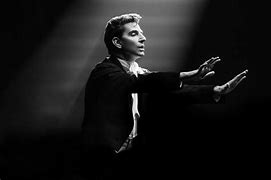
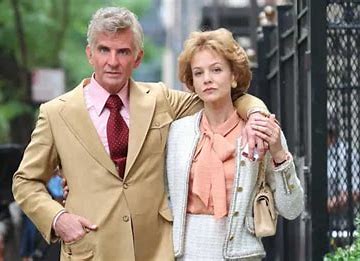
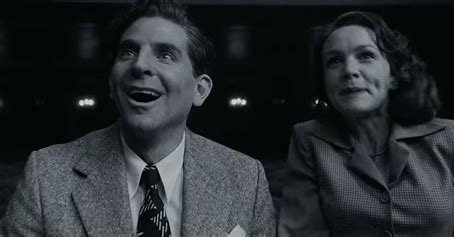
The final result is that Maestro is a pretty pedestrian biopic which just so happens to be handsomely made...if not flirting with a hint of pretentiousness. If the film offers anything beyond being incredibly handsome, it is that we get to see Carey Mulligan as Felicia Montealegre.
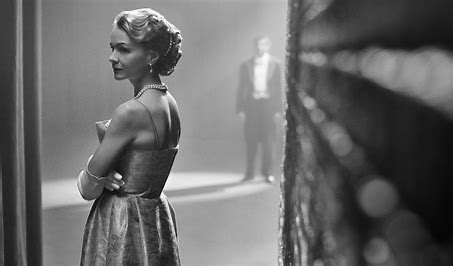
A lot has been said how this has been a long gestating passion project for Bradley Cooper, who has had a fascination with conducting since childhood...and while you do see his passion in this film, I was left more in awe of Mulligan.
This isn't a surprise considering Mulligan typically hits it out of the park every time from An Education to Never Let Me Go to Shame to Wildlife to Promising Young Woman...and I think she does an absolutely lovely job here. While the fact that Montealegre was half-Costa Rican and raised in Chile, that does raise some eyebrows with Mulligan's casting, but she does seem to do very well at nailing the unique accent and gives the role a rich emotional life.
Cooper is in a prime position to potentially win Best Actor this year...but I am not entirely sure he would be my pick in the end. I am more inclined to support a win for Cillian Murphy.
I am not really offering much insightful here otherwise. This might also be the quickest review I have ever written, but I found very little passion for the film otherwise.
I do see the great potential in Bradley Cooper as a filmmaker after this and A Star is Born (which I was less enamored with than most), but I hope he is able to have material with far more heart and soul rather than only fleeting moments of it.
I would've loved to see more from the music side and the passion from there...but I guess that is just a personal preference. It was good that they didn't entirely shy away from the sexual orientation conflicts, but it still feels like the film suffered from not finding the right ingredients for the recipe.